How the far right rationalises its acts of violent disorder
More must be done to combat the algorithmic reward to moral outrage on social media platforms, writes Claire Hamilton
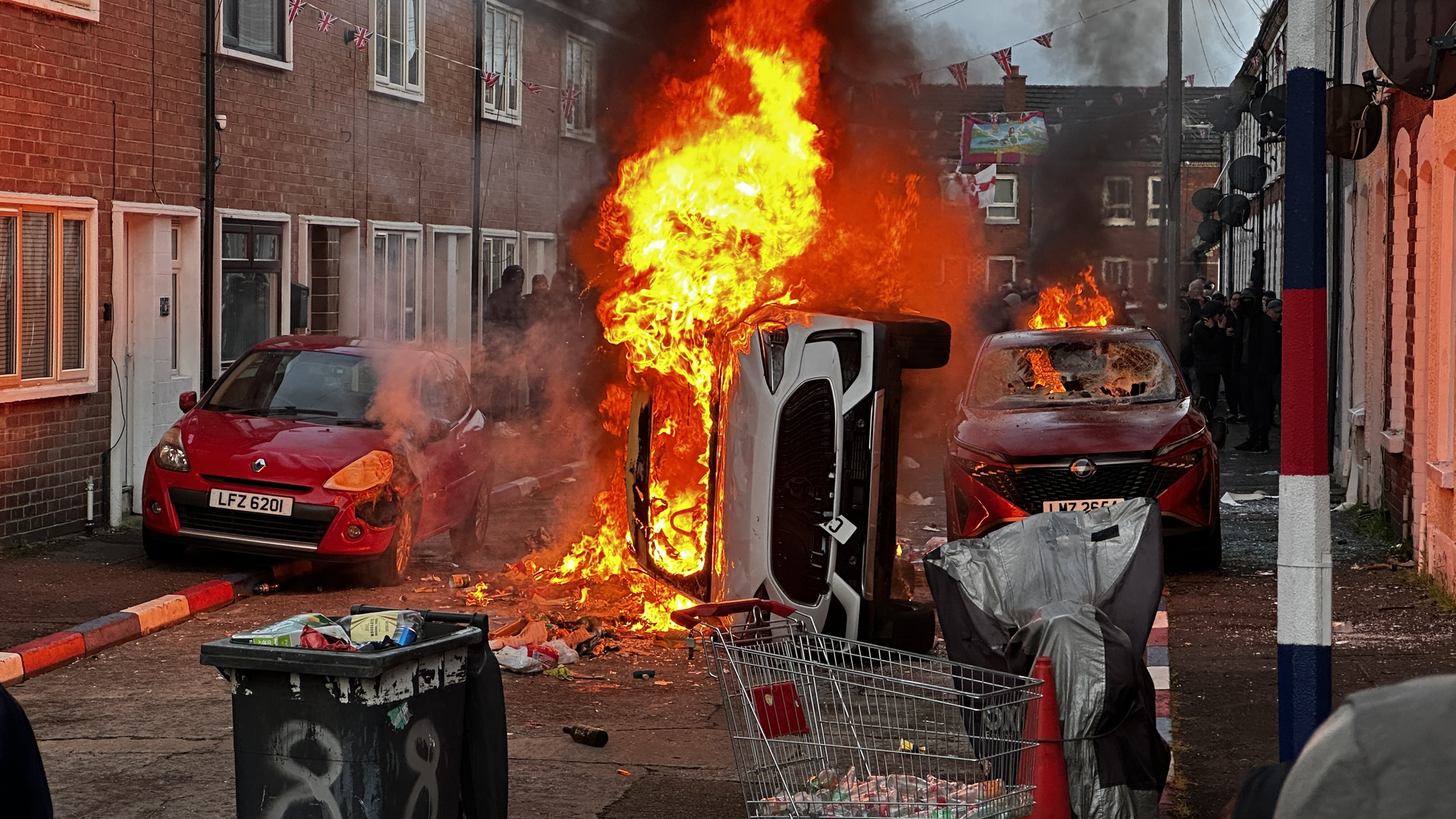
Vehicles set on fire by protesters on Lendrick St in Belfast, as disorder flared in response to a stabbing attack in the city. Riotous actions by such groups are often framed by violent protesters as ‘protecting communities’.

Vehicles set on fire by protesters on Lendrick St in Belfast, as disorder flared in response to a stabbing attack in the city. Riotous actions by such groups are often framed by violent protesters as ‘protecting communities’.

AS COMMUNITIES in the North recover from the recent unrest, many people listening to this news will be pondering the paradox of protesters engaged in arson, criminal damage, and various acts of violent disorder in the name of public safety.

While it is important to say that not all of the Belfast protestors engaged in acts of violence, many of those protesting at the stabbing of a man by a Sudanese asylum seeker on the streets of Belfast claim that their violent acts are their way of ‘protecting’ communities.

Understanding this contradiction between the behaviour of protestors and their ‘enough is enough’ rhetoric is important and merits further examination in order to get to the bottom of these ‘trigger events’.

For many experts on the rise of the right, this is best explained by examining the moralising character of hard-right discourse, a kind of moralistic blame or distortion of moral critique that sets a putatively morally pure and fully unified people against morally inferior elites and dangerous ‘others’.

Advocates often compare the high moral grounding of their message with the corruption and betrayal of the political establishment. 

In this way, political disputes about complex topics — such as migration and crime — become transformed into Manichean battles of black vs white, good vs evil, where political concession is framed as national betrayal.

My research, which examined the social media posts and responses in the days before the Dublin riots in 2023 and Belfast riots of 2024, supports this view. 

Conducted with the help of a UK-based research and technology organisation specialising in the analysis of online data, the findings strongly suggest a process of moralisation of crime and disorder issues, together with rationalisations of criminal acts that preserve protestors’ sense of moral legitimacy.

Prime among these is the moralised language of criminal justice or, put differently, the ‘changing of the subject’ from racism to the more sanitised language of ‘concerned citizens’ and law and order — ‘not far right, just right so far’. 

This focus on victimisation of both the actual victims and the State as symbolic victim centres the idea of acts of disorder merely as a form of retaliation to prior aggression.
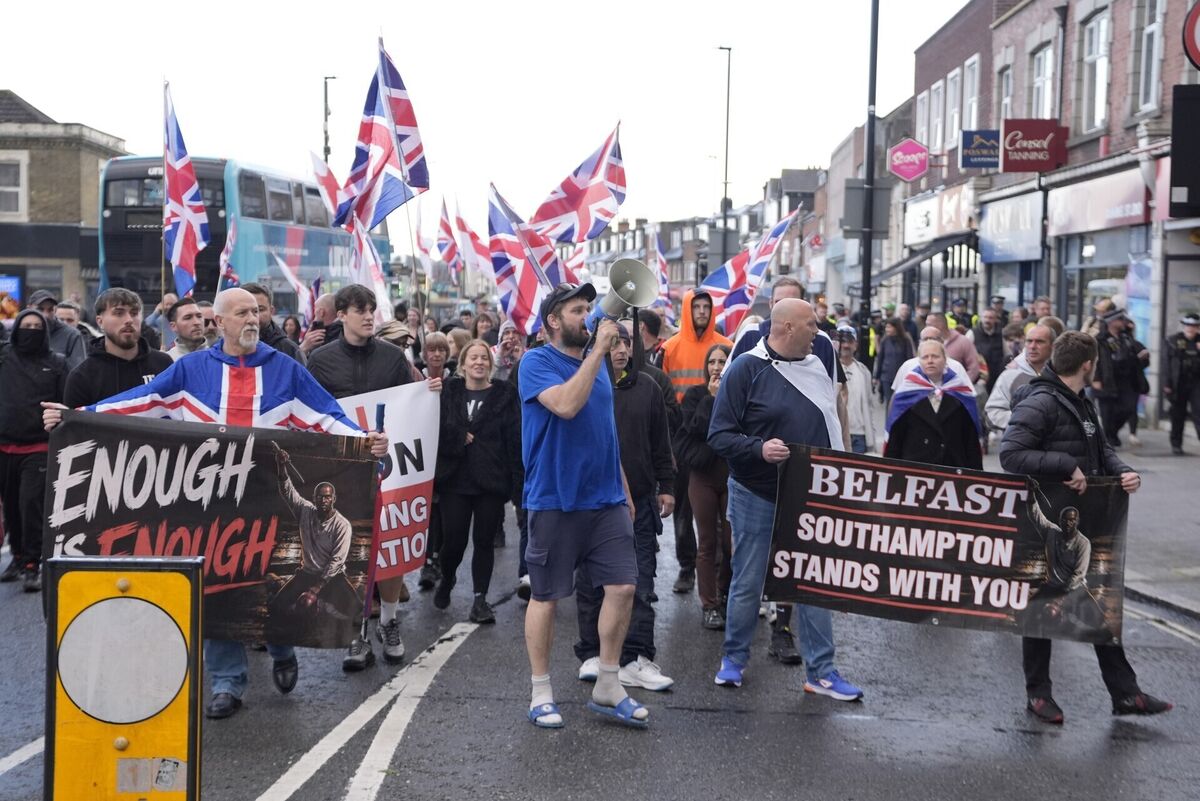
Demonstrators march in Southampton after a man from Sudan was arrested over a knife attack in Belfast. Understanding the contradiction between the behaviour of protestors and their ‘enough is enough’ rhetoric is important and merits further examination in order to get to the bottom of these ‘trigger events’. Photo: Andrew Matthews/PA

Moreover, the construction of a war/self-defence rhetoric against an aggressive ‘other’ serves as another important source of legitimation that positions activists as victims of external forces and chimes with accepted justifications for violence in the West.

Of course, much of the moralising discourse online can also be seen as an attempt to ‘condemn the condemners’, depicting migrants and political opponents as, respectively, morally depraved conspirators engaged in inter alia acts of war, treason, and corruption.

Other legitimising discourses feature ‘appeals to higher loyalties’ such as a sense of patriotic duty, as reflected in banners reading ‘no racism, just patriotism’ in Southampton weeks ago.

The Belfast riots and the Troubles

In Belfast, there is of course the wider context connecting to the conflict in the North and the fact that most of the social media accounts associated with promoting the 2024 protest could be confidently categorised as self-identifying with Ulster loyalism.

Perhaps unsurprisingly, therefore, online discourse before and during the riots saw the rhetorical appropriation of well-known slogans, such as ‘no surrender’, to racially motivated campaigns. 

Allied to this was the presentation of vigilante-style punishment, the courage to ‘resist’ criminals, as part of the national character or the North’s ‘spirit’ — a phenomenon known as ‘penal nationalism’.

Related references to locals in Belfast going ‘door to door’ following a supposed attack on an elderly woman — boasting that such attacks may be tolerated elsewhere but not in Ireland — are strongly reminiscent of the recent troubling scenes in Belfast. 

On the other hand, narratives of uniting a unionist and nationalist Christian West against a common enemy casts protestors as peacemakers working together to protect children, further strengthening their legitimacy and fostering a sense of moral superiority.

One video, posted to social media before the 2024 riots and repeatedly re-purposed across all social media platforms, showed a scene where republican and loyalist ‘comrades’ are walking ‘shoulder to shoulder’ carrying a variety of flags and banners.

Moralising discourses are not new. For decades now, objections to immigration, asylum seekers, welfare policy, gender equity, and a host of other issues have been cloaked in the language of crime control.

What is new, however, is the clear affinity between moralising narratives promoted by activists on the ‘new’ right, the algorithmic reward associated with moral outrage and the suspicion of complexity baked into much of the digital architecture.

Until efforts are made to address some of these larger structural issues — particularly on platforms such as X, where many of the safety guardrails have been dismantled — the current trend of horrifying ‘trigger events’ and their unfortunate weaponisation by online agitators will continue to provoke offline unrest.

  • Claire Hamilton is professor of criminology at Maynooth University

More in this section

Revoiced

Newsletter

Had a busy week? Sign up for some of the best reads from the week gone by. Selected just for you.

Cookie Policy Privacy Policy Brand Safety FAQ Help Contact Us Terms and Conditions

© Examiner Echo Group Limited