Mick Clifford: Jeffrey Donaldson’s claim to be a man of God proved as hollow as his politics
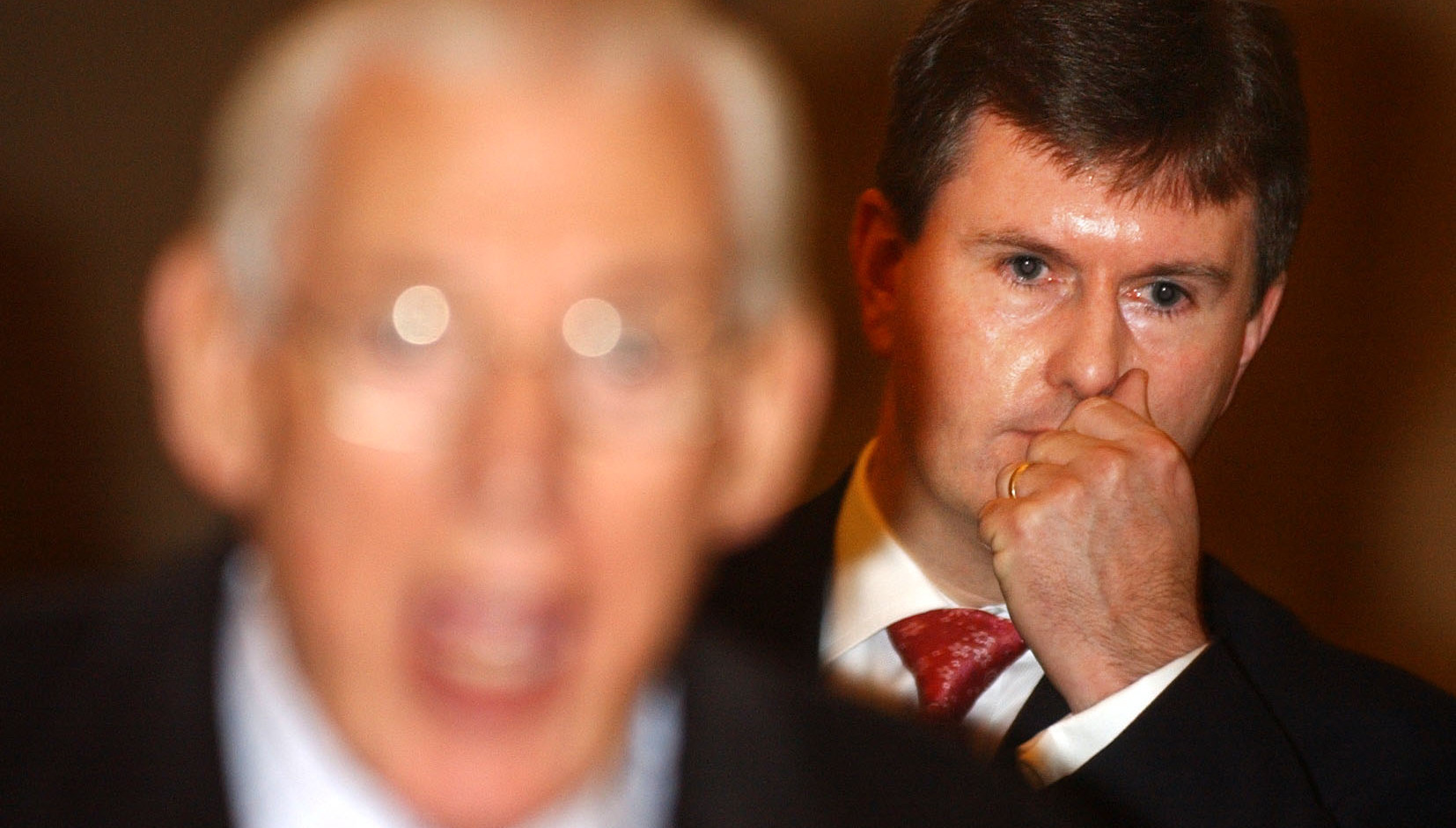
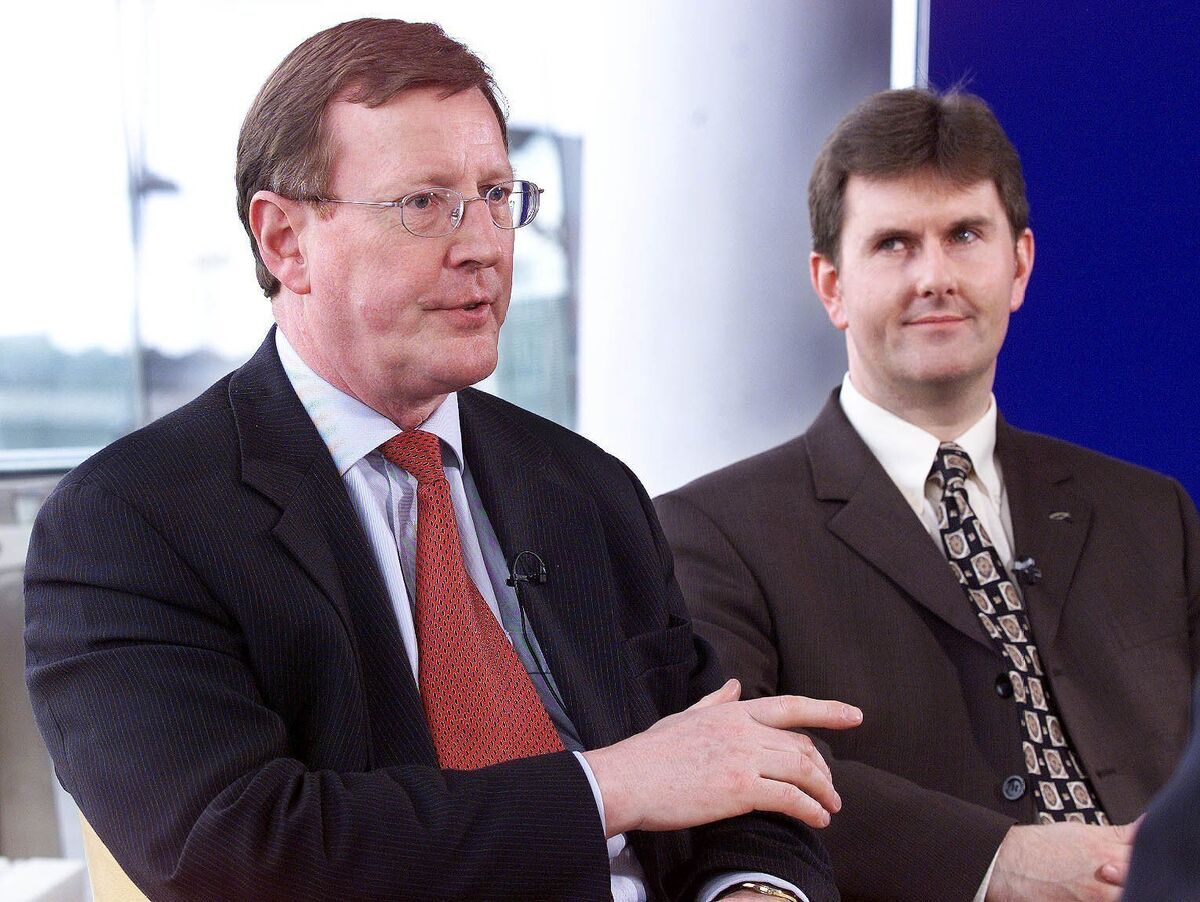
Then Lagan Valley MP Jeffrey Donaldson listening as Ian Paisley welcomes the former UUP member into the DUP in 2003, having opportunistically abandoned David Trimble's UUP.
Jeffrey Donaldson always had the capacity to gauge the political temperature and position himself to make the most of it.
By such instincts, he advanced through politics without ever displaying a deep political core.
He began by working for Enoch Powell, a racist politician who was the first to see an advantage in targeting immigrants, and whose ‘Rivers of Blood’ speech has gone down in political infamy.
After moving on from Powell in the late 1980s, Donaldson reached for the other end of the political spectrum.
A profile compiled internally in the Northern Ireland Office in 1997, and released in 2022, pointed out that Donaldson’s career began to develop with the election of David Trimble as Ulster Unionist Party (UUP) leader.
It noted that, during political talks in 1992, he gained a reputation of “being one of the more liberal members of the UUP team”.
“Since then, his stance has been less easy to pin down,” it added.
Following the Good Friday Agreement, he sniffed the wind and abandoned Mr Trimble’s party for the more extreme Democratic Unionist Party (DUP).
Read More
And within that party he bided his time until all opponents fell by the wayside and he was acclaimed leader.
Precious little political core, but a talent for opportunism.
Now, in light of his conviction for child abuse, it would appear he has precious little moral core either.
The crimes he was convicted of are of the most grievous nature, not least in the lifelong devastation they can wreak on a childhood.
Two victims, A and B, claimed he was responsible for 18 counts of child sexual abuse, including one of rape.
Central to the case against him was the evidence of David and Linda Hoy, a couple who ran a Christian community in Armoy, Co Antrim.
They facilitated a meeting between Donaldson and victim B in 1997.
Some time previously, B had told a pastor, Stephen Matthews, that she had been abused by a political figure.
Mr Matthews said in a videoed witness statement that it was obvious that this was Donaldson who was en route at the time to becoming an MP.
At the Hoy meeting, Donaldson spoke first.
“I know what this is about. I’m sorry. Will you please forgive me?” Mr Hoy recalled the defendant saying.
It wasn’t specifically said at the meeting that the issue was one of child sexual abuse, but it was assumed by the Hoys to be the case.
Donaldson told the court he was referring to something else, an unspecified issue for which he felt compelled to apologise to B.
The verdict suggests the jury didn’t believe him.
If he knew precisely what he had done to B, which he must have, if he was genuinely repentant about what he had done, why did he plead not guilty to the charges?
Why did he put his victims through a trial?
Why did he not make peace with his God and take the consequences with the prospect of at least some personal redemption down the line?
Why did he, a man who always claimed to be deeply religious, give evidence under oath denying all of it?
If he had come clean, he could at least attempt to atone.
Instead, he measured up the situation, as he had done so often in his political life, and took what he considered the best course of action in advancing his own position.
He would give evidence and rely on the powers of persuasion that had served him well throughout his career.
Rarely in a criminal trial will a defendant give evidence.
The onus is on the prosecution to prove the case beyond a reasonable doubt.
Most experienced lawyers will heavily advise a defendant that the possible downside of exposure to questioning far outweighs any credit to be gained in appealing to a jury’s collective wisdom. That didn’t deter Donaldson.
It may be that he reckoned his only chance of beating the charges was to give one last barnstorming public appearance.
He would dig deep to assemble all the resources accumulated over a lifetime of public debates and interviews.
It didn’t work.
The jury came to the conclusion that the weight of evidence against him was just too heavy.
They didn’t believe him.
He was, they determined, guilty of sexually abusing children, and, by implication, of using skills acquired to ostensibly better the lives of people in an attempt to deflect and lie about his crimes and wriggle out of the consequences.
Read More

CONNECT WITH US TODAY



Be the first to know the latest news and updates