Colin Sheridan: The Phoenix magazine made powerful people uncomfortable
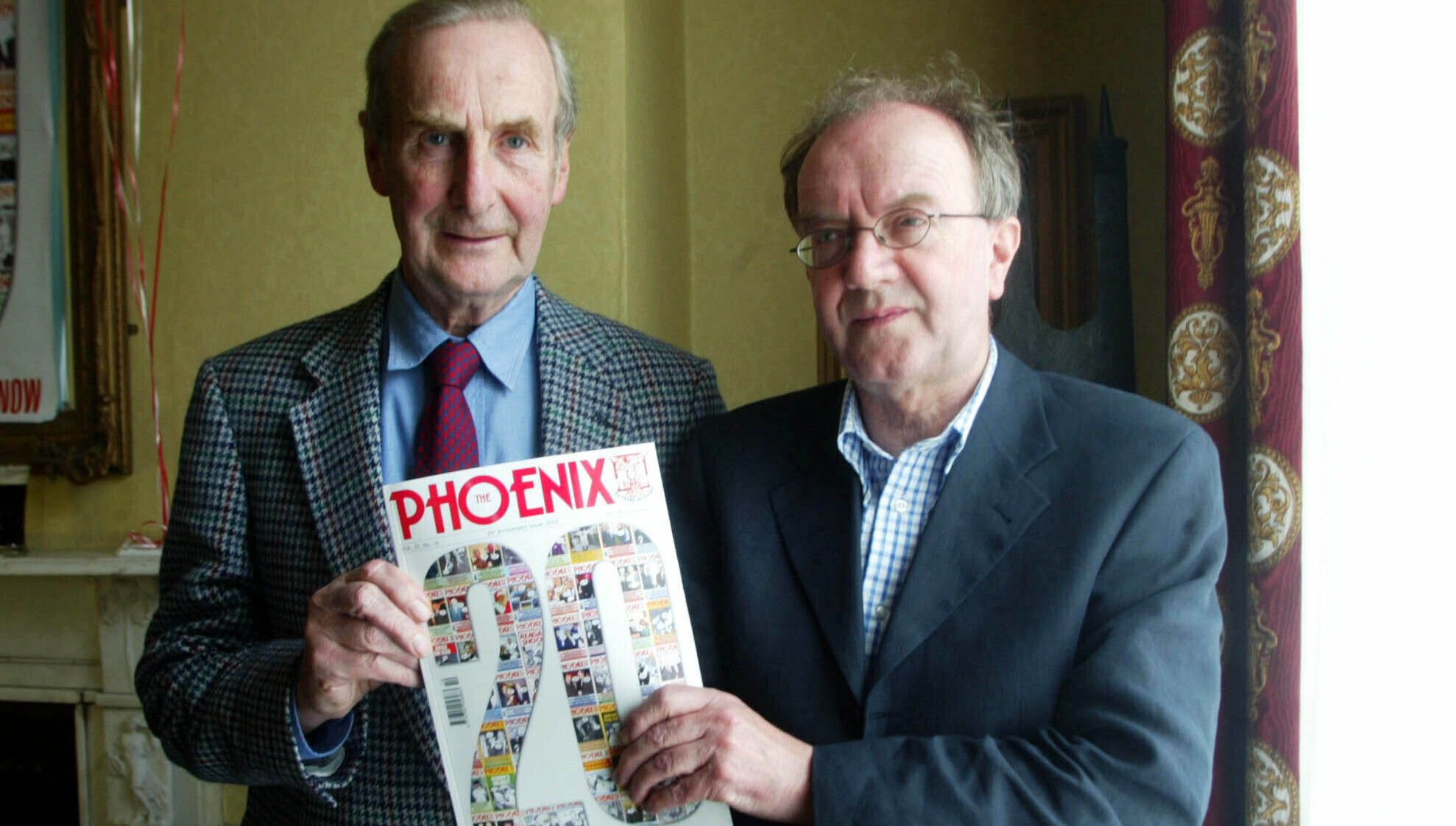
Founder of Phoenix magazine John Mulcahy, left, and editor Paddy Prenderville at its 20th anniversary in May 2003 Picture: RollingNews.ie

There was a drollery about that drifted through corridors of power, media and public life for decades. Folks claimed they bought it every fortnight not to see which poor devil was actually in it, but to ensure they weren't. Like all good jokes, it contained more than a grain of truth.
After 43 years on Irish newsstands, The Phoenix is due to cease publication this summer, dropping the curtain on one of the most singular titles in our journalism. Its shuttering marks the finish of a rag that was feared, admired, resented, mocked and, crucially, read.
For anyone who grew up around Irish ink, was instantly recognisable. It sat on the shelf with a swagger all of its own — the cover photomontage, the speech bubbles, the acidic headline. The promise that somewhere inside, somebody powerful was having a distinctly uncomfortable fortnight.
Founded in 1983 by John Mulcahy, it emerged from a turbulent era in Irish media. Mulcahy had already established himself as one of the state's most formidable reporters through his work with , and later the .

When Hibernia folded, he did not simply lament its passing. Instead, he built something new. Hence the name. Like the mythical bird rising from the embers, The Phoenix was born from the collapse of an earlier generation of Irish journalism. It inherited many of the same instincts: scepticism of authority, an appetite for investigation and a belief that official narratives should always be tested rather than accepted.
The magazine was often compared to London’s , and the comparison was understandable. It was satirical and mischievous. It delighted in puncturing pomposity. Yet the comparison never quite captured what made uniquely Irish.
Read More
Beneath the humour lay something more serious — an understanding that power deserved scrutiny and that nobody, regardless of status, should be beyond interrogation. Politicians, business leaders, judges, civil servants, media figures, sporting personalities — all were fair game. In an often deferential Ireland, developed a reputation for asking questions that others would not.
That mattered then, and it matters even more now. We live in an era when journalism finds itself under siege from every direction. Distrust has become an industry in itself. Journalists are routinely accused of being political operatives, corporate mouthpieces or participants in elaborate conspiracies.
Every uncomfortable fact is dismissed by somebody as propaganda. Every inconvenient story is evidence of an agenda. Against that bleak backdrop, represented something increasingly rare: independence.
Readers did not always agree with its editorial judgments, but there was never any doubt about the magazine's fundamental instinct — to always challenge power rather than accommodate it. That is, after all, what journalism is supposed to do.
One of the great strengths of was that it helped teach generations of journalists exactly that lesson. Long before newsrooms became consumed by clicks and algorithms, the magazine embodied a simpler principle: stories matter because they reveal something worth knowing.
The magazine's regular sections became part of the vocabulary of Irish journalism. Affairs of the Nation. Hush-Hush. Moneybags. Pillars of Society. They reflected a worldview that saw politics, business, media and public life as interconnected systems deserving constant scrutiny. And occasionally they produced moments that reverberated far beyond the confines of a fortnightly publication.
Over the years, developed a reputation for exposing stories others missed, uncovering controversies others ignored, and publishing information that generated equal measures of fascination and fury. It accumulated critics, legal challenges, enemies and devoted readers in roughly equal measure. That is usually a sign that a publication is doing something worthwhile.
Its disappearance is also a reminder of a more uncomfortable reality: Print journalism is shrinking before our eyes. Every closure now feels like the loss of another landmark. Not because print is inherently superior to digital, but because every publication develops its own voice, culture and institutional memory. Once those things disappear, they are rarely replaced. They simply become part of the landscape that used to exist.

The irony is that we probably need publications like The Phoenix more than ever. An age saturated with information has not necessarily produced greater understanding. Social media has democratised publishing, but it has also rewarded outrage, certainty and speed. The Phoenix belonged to an older tradition that valued scepticism, patience and reporting. It understood that influence should be earned rather than manufactured.
Its passing deserves more than a brief acknowledgement, because when a publication like disappears, something else disappears with it: a little of the institutional memory of Irish journalism, a little of its irreverence and a little of its courage.
The famous joke will survive, of course. Somewhere in Leinster House, a boardroom or a Government department, there are undoubtedly people relieved that they no longer need to rush to the newsagent every fortnight to check whether they have appeared in its pages. The rest of us should be less relieved.

CONNECT WITH US TODAY



Be the first to know the latest news and updates