Cost of living, health, housing eclipse climate issue in people's priorities – Irish Examiner poll

The survey conducted by Ipsos B&A published in the 'Irish Examiner' on Monday suggests people believe Ireland is not ready for climate change — but that the issue is not as important as the cost-of-living crisis, healthcare, and housing. Picture: iStock
Irish people believe the country is not ready for what climate change is set to throw at us in the form of storms and heatwaves, but the issue is still not deemed as important as the cost-of-living crisis, healthcare, and housing, a survey shows.
A poll for the by Ipsos B&A, has found that Ireland is a very climate-conscious nation, but this does not always translate into individuals taking action in their day-to-day lives to be more sustainable.
The poll was conducted in late April and early May, after the fuel protests which brought the country to a standstill but before Ireland faced record temperatures for May and 1.1m customers of Electric Ireland being told they face a hike to their bills.
CLIMATE & SUSTAINABILITY HUB
On Monday, June 1, the 'Irish Examiner' publishes an in-depth analysis — in print and and online here — of its new Ipsos B&A poll on Irish people's attitudes to issues including climate change
The poll found:
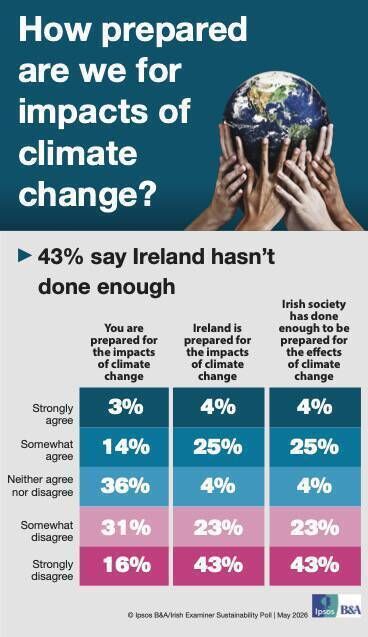
- Some 59% of people think the Government is not doing enough with the resources it has on climate change, with less than one in five (18%) deeming the current efforts adequate;
- A total of 71% of adults identify as environmentally conscious, but only 14% make significant behavioural changes;
- The public supports greater investment in public transport (65%), wind energy (58%), solar (54%), and higher electric vehicle grants (44%);
- There is less support for higher carbon taxes (11%), higher petrol/diesel taxes (11%), and reducing the national herd (15%);
- Some 61% of people say Ireland is not prepared for the impacts of climate change;
- Of these impacts, 42% rated storms as one of their top three concerns, followed by food insecurity (37%), risks to public health (32%), extreme heat (28%), and rising sea/water levels (26%).
The results suggest that climate change features far lower down the priority list, both in our day-to-day lives and at the ballot box, than other issues.
Inflation, healthcare, global instability, housing, crime/violence, and immigration all featured ahead of climate change when people were asked the three main issues of most concern to them.
It was, nevertheless, cited by nearly one in four people (23%) as a top concern.
University College Cork (UCC) environmental psychologist Marica Cassarino said that this points to gaps in how we understood that the challenges facing us are interconnected.
“Issues such as cost of living, migration, and resource pressures are closely tied to global environmental and geopolitical dynamics, yet this complexity can be difficult for individuals to fully engage with,” she said.
“This highlights the need for clear, trusted communication that helps people make sense of these interconnections, fostering more systemic thinking and, ultimately, supporting more sustained climate-positive behaviours.”
Also analysing the results, Breffni Lennon, research fellow in the School of Engineering and Architecture and the Sustainability Institute at UCC, said it was notable that people in Ireland are far more engaged and knowledgeable than they are sometimes given credit for when it comes to climate.
“But the systemic and institutional inequalities that we are experiencing are being translated into individual experiences in real-time and hindering our individual [and collective] agency to effect the changes that are needed.
“Individuals cannot instigate change unless the system is built to facilitate it. We are still missing those levers.”
Another expert, James Green, a health psychologist specialising in behavioural science at the University of Limerick, said small changes in behaviour will be easier to achieve than a complete overhaul of people’s lifetsyles.
“From a behavioural perspective, it is more realistic and effective to encourage incremental, high-impact shifts, such as reducing meat consumption, particularly beef, or making partial substitutions rather than expecting entirely new lifestyles.
“Ultimately, the findings underscore the need for stronger, more coordinated government action to enable change, rather than relying on individuals alone.”
- This article was funded by the News Reporting Scheme
Read More
CLIMATE & SUSTAINABILITY HUB
CONNECT WITH US TODAY



Be the first to know the latest news and updates