Why is Ireland's Government cheerleading for privately owned AI?
As Eric Schmidt found out recently , ordinary people are not as keen on AI as the industry is. James Lawless should take note, writes Liz Carolan
Why is Ireland's Government cheerleading for privately owned AI?

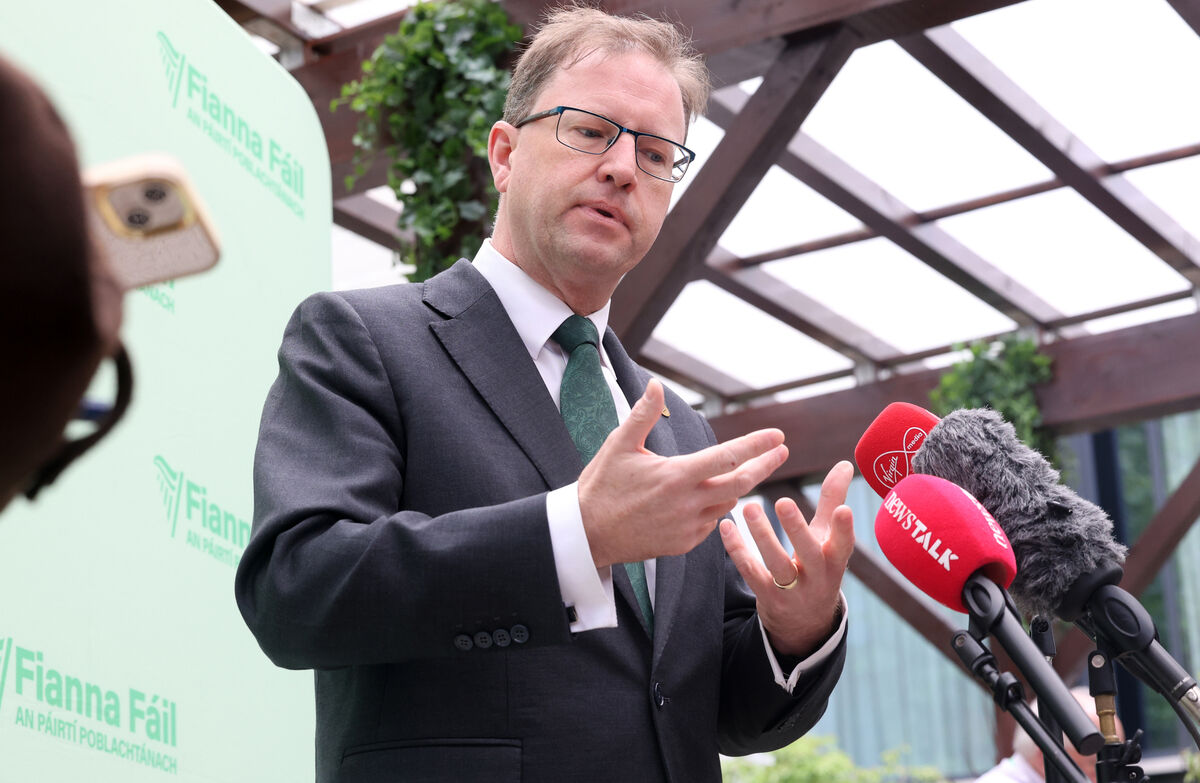
'This new training programme will not strengthen the public’s view that the State is there to shape how our country changes as AI continues to creep in.' File picture

Something odd is happening this college graduation season. University commencement addresses, the gold standard of the American inspirational speech, have been meeting with boos and jeers. This happened to Google founder Eric Schmidt in Arizona last week, and to other business leaders at Universities in Florida and Tennessee.

The jeers appeared whenever the speakers mentioned artificial intelligence, and in viral videos Schmidt seems genuinely taken aback at the reaction. Why are the young, educated, and highly tech literate rejecting his exaltation of AI as the future?

And if some of the world’s wealthiest and most powerful people can’t convince young graduates of this story, why is our Government cheerleading the same tech to us?

The Irish Government recently launched ‘AI Ready’, a citizen training programme that has been heavily promoted in both media appearances and advertising. 

The Government hopes that the programme will eventually train a million Irish people to “jump straight into using AI for daily life, getting ahead in work, or helping with admin tasks.” The training on offer focuses mostly on generative AI, such as Chat GPT, and is targeted in the first instance at older people.

The programme is built on two assumptions. The first is that AI is an economically transformative technology, similar to previous waves of industrial revolution in the past. Speaking at the launch of the training portal, minister James Lawless said that “AI readiness is no longer optional — it is essential.”

The second is that knowledge gaps are the main barriers holding Irish people back from embracing AI. As the minister added, “it is about giving people the skills, confidence, and understanding they need to participate fully in an AI-enabled society.”

These assumptions feel increasingly shaky when exposed to scrutiny. Speaking on Morning Ireland, Mr Lawless declared that AI was “like electricity or the internet”. This is part of a trend of policy makers treating AI like an exogenous force of nature. AI is not electricity, or the internet, both of which were non-proprietary infrastructure systems, built over decades and not controlled by any one company.

What most people mean when we talk about AI is not infrastructure but a set of privately owned products, built on jealously guarded models, competing to “win” the race to dominate a new marketplace. AI is not a force of nature, it is a fight for power among the wealthiest companies to have ever existed.

When tech journalist Elaine Burke and her mother worked through one of the new courses her impression was that they were largely structured around steering users toward setting up accounts with ChatGPT and Gemini.

Higher education, innovation, and science minister James Lawless said that ‘AI readiness is no longer optional — it is essential.’ Picture: Leah Farrell/RollingNews.ie

Her mum came away with the distinct impression she was being sold to. This could be because the platform was developed in partnership with Microsoft Ireland, a large investor and provider of cloud computing to ChatGPT, a fact buried in a ministerial op-ed and absent from the platform itself. (A Government representative told Ms Burke that “AI Ready does not promote, recommend, or privilege any commercial provider, and it does not require learners to use any specific tool”).

The second assumption, that knowledge and confidence gaps are barriers to AI adoption, is not born out by the evidence. In fact a piece of research published last year found that people with lower AI literacy are typically more receptive to AI, that the less you understand the technology, the more likely you are to be excited to use it.

Distrust of AI

The paper, published in the Journal of Marketing concludes that “companies may benefit from shifting their marketing efforts and product development toward consumers with lower AI literacy.” This might go some way to explain why a generation of graduates are booing the AI paeans.

It was this generation’s parents who were sold the idea that iPads in school would somehow equip their kids for coding jobs; and it was this generation who were handed phones at 10, possibly the largest social experiments we have ever conducted on young brains. 

They had AI shoved into every aspect of their education and social lives, as well as the recruitment processes they are trudging through. And it is their entry level jobs that have dried up as investment shifts from humans to data centres.

It is not that they aren’t skilled in AI, it is that they don’t trust it. Nor do they trust the people who peddle and stand to benefit from it. The companies battling it out to lead on AI are broadly the same ones — Meta, Google, Microsoft, Elon Musk’s X — who have lost the public’s trust in this past decade of scandals, privacy violations, obscene profits, and enshitification.


Research published last week found that Ireland’s two least trusted brands — across any and all industries and public bodies — were Meta and X.

AI may well transform the economy, but ensuring that it will bring the kind of innovation — economic, cultural, environmental, medical — that can benefit us all will take public trust, something the companies leading this roll out lost long ago.

Adoption will therefore depend on us believing that someone involved has our interests at heart. Polls consistently show that Irish people want more, not less, Big Tech regulation.

We have to know and believe that when it comes to this big social change, the State, at least, is on our side.

This new training programme will not strengthen the public’s view that the State is there to shape how our country changes as AI continues to creep in.

Achieving that would take our elected representatives showing us that they are on our side.

A good place to start would be a public acknowledgment that the AI race is as much about power as it is about compute, and that the State’s role is not to champion AI, but to make sure that it is put to use for the public good.

More in this section

Revoiced

Newsletter

Had a busy week? Sign up for some of the best reads from the week gone by. Selected just for you.

Cookie Policy Privacy Policy Brand Safety FAQ Help Contact Us Terms and Conditions

© Examiner Echo Group Limited