Ireland favours greater EU independence from the US ahead of assuming EU presidency
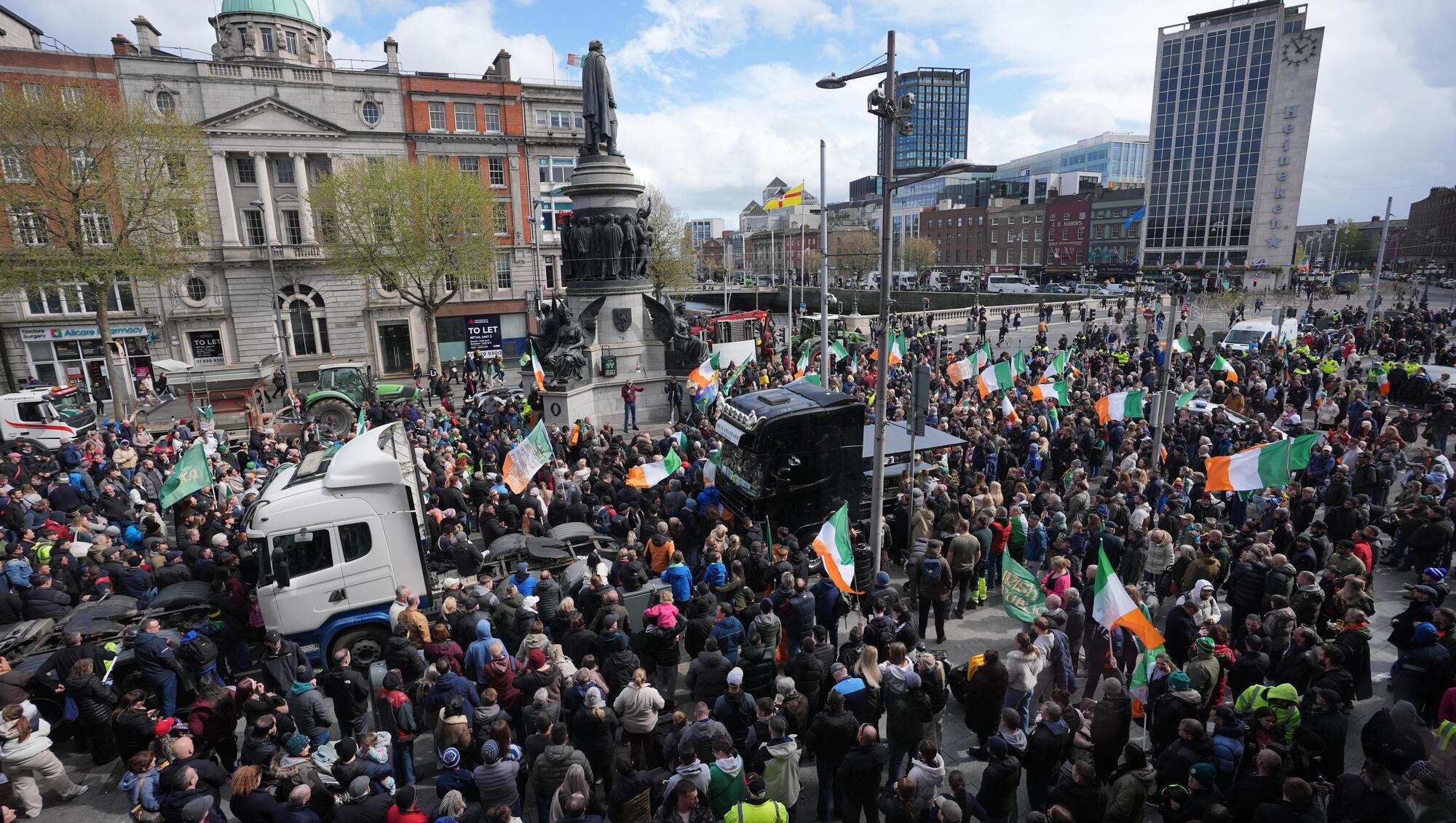
Protesters on O'Connell Street in Dublin during the fuel price protests in April sparked by the price rises caused by the blockade of oil tankers in the Strait of Hormuz.
In just six weeks Ireland will begin its eighth presidency of the Council of the European Union, leading the EU at a pivotal time as it seeks greater self-reliance amid seismic geopolitical change.
European Movement Ireland’s Island of Ireland EU Poll 2026 with Amárach Research reflects this shift with 71% saying the EU should become more independent from the US. Given Ireland’s deep cultural, economic and political ties, many may be surprised by this finding.
As former Tánaiste Mary Harney once put it: “Geographically, we are closer to Berlin than Boston. Spiritually, we are probably a lot closer to Boston than Berlin.”
That observation still carries weight, but across Ireland there is a growing recognition that the EU must become more independent. This necessity is driven by Russia’s war in Ukraine, the growing attacks on multilateralism and international law led by the US, and the need to build resilience in the European economy from trade to digital.
Read More
With challenging decisions ahead for Europe, it is heartening that our latest EU Poll shows support for EU membership remains high and stable at 82%, well above the 74% European average recorded by Eurobarometer. Whether it is access to the Single Market, free movement, a shared currency or the wider benefits of membership, Ireland remains clear that it is better in than out as we prepare for our next EU presidency.
Despite this good news, we cannot be complacent. Beneath the strong support for EU membership, a clear disconnect is emerging. Only 45% believe the EU is moving in the right direction, while 26% say it is not and 28% don’t know.
Critics point to concerns about immigration, regulation, disputes between Brussels and the Irish government over national authority, and the EU’s stance on foreign policy.
Some of this unease may also reflect the public’s disillusionment with the EU’s inaction in response to Israel’s ongoing violations in the Middle East, which is at odds with its founding values.
In addition, it is no surprise, especially given the sentiment expressed in recent fuel protests, that 58% cite the cost of living as a top concern at EU level, alongside migration, housing and rising energy costs.
People judge governments, whether in Dublin or Brussels, through the lens of the quality of their own lives and the prevailing economic climate.
However, it is worth remembering that in response to the fuel crisis linked to the US-Israeli war in Iran, the European Commission moved quickly to relax state aid rules to help ease the burden on businesses, farmers and households across Europe.
The findings of our latest EU poll also raise important questions about security and defence ahead of Ireland’s EU presidency.
As host, Ireland will act as an honest broker and an impartial chair, but with war on the periphery of Europe ongoing in Ukraine, security and defence will shape much of the agenda.
This remains a sensitive issue domestically, but the poll shows 48% support increased EU security and defence co-operation, reflecting the recent Irish Government’s decision to join the Security Action for Europe Initiative (SAFE), alongside other EU security and defence partnerships.
As Ireland continues preparations for our upcoming EU presidency, Northern Ireland cannot be forgotten. In the tenth year since Brexit, our EU Poll found that 73% of respondents in Northern Ireland would vote to rejoin the EU if a referendum were held in the UK tomorrow.
While a repeat of the EU-UK referendum is unlikely anytime soon, particularly in light of the recent local Welsh and Scottish election results in Great Britain, the finding underlines the continued importance of EU level representation for Northern Ireland.
Just this week, UK prime minister Keir Starmer signalled he may soften Labour’s Brexit red lines after bruising election results and ministerial resignations amid growing pressure on his leadership, saying his government would be “defined by rebuilding our relations with Europe” ahead of a key EU summit.
For 73% of those in Northern Ireland calling for more representation given EU law still applies in the North, there will be significant interest in what might come next.
In addition, a majority in Ireland, 59%, as well as 63% in Northern Ireland would vote for a united Ireland within the EU.
This indicates strong pro-European sentiment across the island and points to important future discussions, as referenced by Sinn Féin president Mary Lou McDonald and the significant media attention the question on a United Ireland within the EU received last week.
While this is separate from Ireland’s presidency role, it reflects the importance of the outreach by the minister for foreign affairs and trade, Helen McEntee, in considering invitations for ministers from Northern Ireland and the UK government to some of the informal council meetings to be held during our EU presidency.
Returning to the headline finding in the poll, people across the island support greater EU independence from the US, this is likely due to the volatility we continually experience from this US administration.
With US president Donald Trump recently plunging the EU-US Turnberry Agreement again in doubt by threatening 25% tariffs on car and truck exports to the US, Washington has now offered a reprieve on tariff hikes, once the EU can conclude its negotiations by July 4.
Back in Brussels, with much internal division within the EU regarding the EU-US trade agreement, there are fears of a stalemate at trilogues next week, with mounting pressure to conclude the negotiations or face US tariff hikes.
With growing uncertainty in the US partnership, it is understandable that there is a desire for greater EU autonomy.
With EU-US relations likely to feature prominently during Ireland’s EU presidency, this raises interesting questions for Ireland, not only in the months ahead but in the coming years too, as we will need to re-orient ourselves towards Berlin instead of Boston.
Yet our EU presidency also presents an opportunity for Ireland to demonstrate how we can act as a bridge to the US and leverage our strong cultural and economic links with the US for the wider benefit of the EU.
The policy decisions facing Ireland during its presidency of the Council of the EU on trade, security, defence and digital policy come at a crucial time.
As the EU seeks greater strategic autonomy, Ireland will play a central role in helping Europe defend its interests, strengthen its resilience and uphold its founding values in an increasingly uncertain world.
The great test of Ireland’s presidency will not simply be whether we can manage the EU’s agenda, but whether we can help positively shape Europe’s future direction. Irish diplomacy is well placed to meet that challenge.
- David Geary is CEO of European Movement Ireland
CONNECT WITH US TODAY



Be the first to know the latest news and updates