Sprucing up the truth: Schools should not be a battleground for vested interests
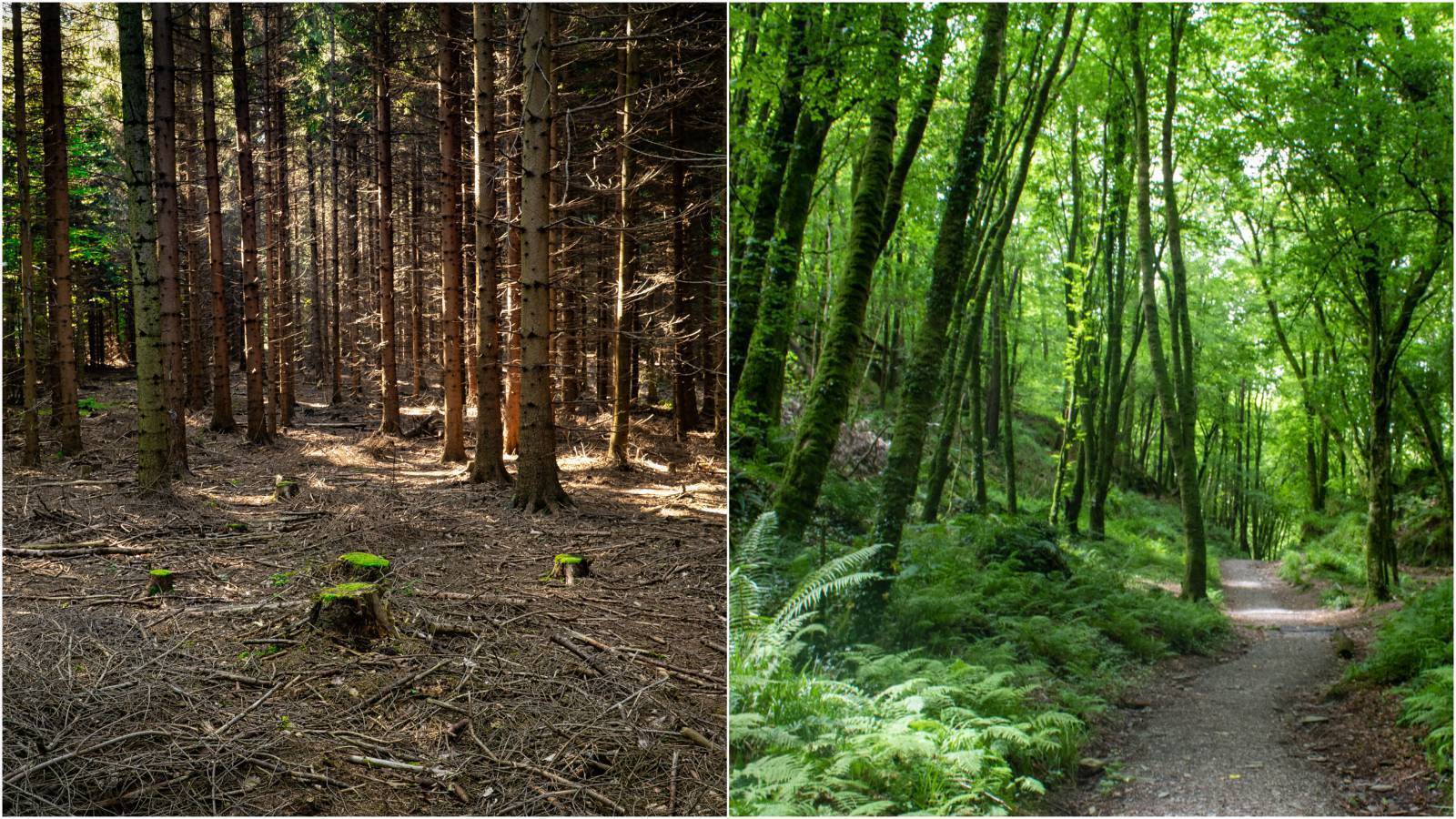
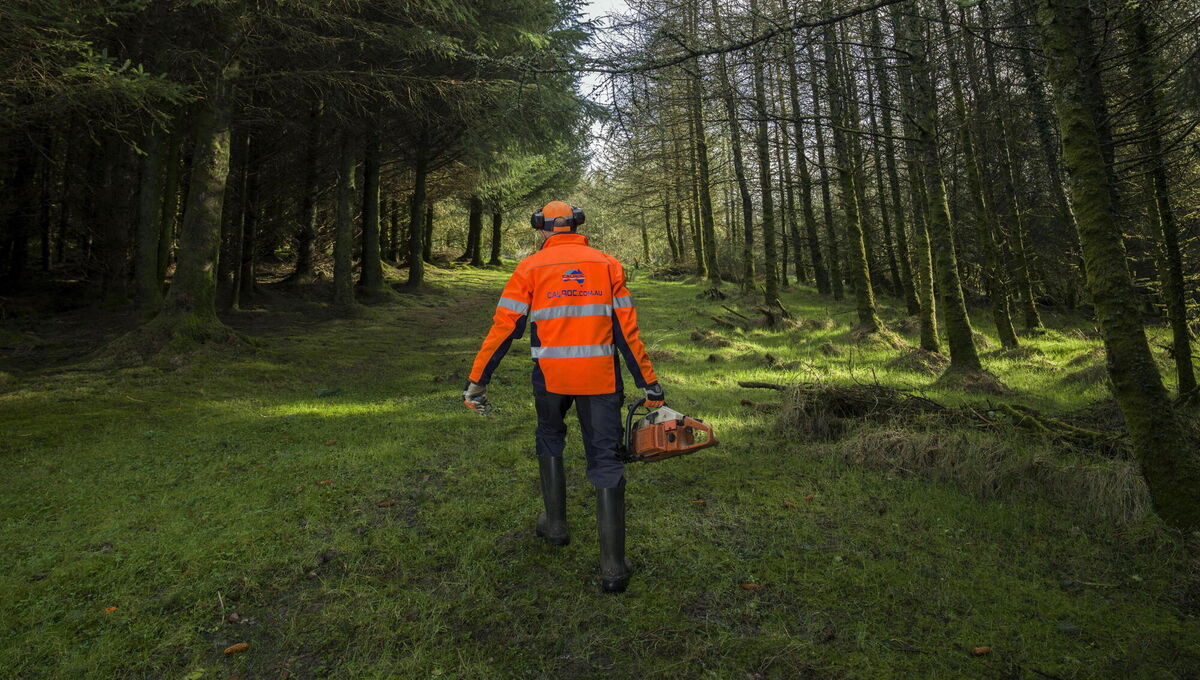
Left: About 300,000 hectares of Irish land is covered in a vast monocultural desert consisting of millions of tightly packed Sitka spruce trees. Right: A forest is a complex ecosystem comprising thousands of species operating in an intricate web of interdependence.
While our children are constantly bombarded with advertising and marketing messages peddled by corporate interests, the one place we might reasonably assume is off limits for such intrusive influence is the classroom.
Our schools should be a bulwark against PR gurus and industry spin doctors. Therefore, it came as a surprise to many people in recent days to discover a campaign promoting commercial timber plantations has sent out material to more than 3,000 Irish primary schools.
The material in question, a booklet titled is written in the style of a children’s story, narrated from the point of view of an actual tree. It clearly implies Sitka spruce forest are havens of biodiversity, stating: “We need to look after the biodiversity, the plants and animals, that call that habitat home.”
The booklet originates in the UK, where it was published on behalf of an industrial timber company. A local adaptation is backed by the Irish Timber Council and the Society of Irish Foresters, with endorsement from the Department of Agriculture via a foreword by then forestry minister, Michael Healy-Rae.
“Forests are not just about trees, they are homes for birds and animals, places where plants grow, and spaces for people to enjoy…living spaces full of growth, learning and possibility,” Mr Healy-Rae said.
All of this is of course true — of an actual forest, which is a complex ecosystem comprising thousands of species operating in an intricate web of interdependence.
Industrial timber plantations are the polar opposite. About 300,000 hectares of Irish land is covered in a vast monocultural desert consisting of millions of tightly packed Sitka spruce trees — a non-native species emanating from the north-western US — and virtually nothing else.
I have visited Coillte-owned plantations of Sitka spruce and the thing that really hits you is the eerie silence. There is no birdsong, while the forest floor is almost completely bereft of secondary growth of plants, fungi or flowers. These plantations are then harvested by clear-felling, the aftermath of which is a wasteland resembling a battlefield.
Where, you may ask, is the Department of Education in all of this? Where too is our National Council for Curriculum and Assessment? The latter "is charged with advising the Minister for Education on early childhood education, primary and post-primary schools”.
Surely these State bodies exercise some oversight into the type of content that can be distributed to Ireland’s primary and secondary schools? A spokesperson confirmed the council “has no remit in deciding what materials are sent into schools".
"Schools receive numerous different offers of schemes, programmes, projects, competitions, initiatives etc, and it is for schools to decide themselves what materials they use to provide children with appropriate learning experiences.”
It is, in other words, a free-for-all. This issue was raised in the Dáil in December 2020, when TD Thomas Pringle asked then education minister Norma Foley to comment on the “proliferation of non-curricular publications seeking to target primary school children”. The materials in question were from agri-industrial players.
In reply, Ms Foley confirmed the Government’s laissez faire approach. She said the department “does not have a role in approving, commissioning, sponsoring or endorsing any content in any private programme delivered in schools … teachers and principals are best-placed to determine the suitability of a resource for the children that they teach.”
Two of the most prominent organisations promoting Ireland’s overwhelmingly livestock-based agriculture systems are Agri-Aware and the National Dairy Council. Agri-Aware, a registered charity, shares its premises with lobby group, the Irish Farmers' Association, and is industry-funded and controlled.
Its stated aim is to deliver "high impact educational and public awareness initiatives nationwide". Agri-Aware distributed a series of four 60-page workbooks under the title 'Dig In' to more than 3,000 primary schools. These include lesson plans linked to the curriculum.
In the workbook’s section titled ‘Healthy trees, healthy air’, it explains: “The animals on the farm inhale oxygen and exhale carbon dioxide. Animals and humans need oxygen to stay alive and healthy.”
No mention whatever is made of methane, the powerful greenhouse gas produced in huge quantities by ruminant livestock, nor of the serious water and air quality issues associated with livestock agriculture, yet these are packaged and presented to schools as bona fide educational materials, and the Irish National Teachers’ Organisation has a representative on the board of Agri-Aware.
Based on its title, most people would assume the National Dairy Council (NDC) is a State-backed organisation). It is, in fact, a private marketing and PR agency for the dairy industry.
Among the NDC’s educational resources is one called ‘Moo Crew’. One of the questions it poses is: "Why is Ireland a good place for making milk in a way that’s good for the environment?" The answer it gives: "Because cows in Ireland eat grass, which helps the environment and makes milk production more sustainable."
There is no reference in this material to the million tonnes of chemical fertilisers imported annually to boost grass growth, nor the five-six million tonnes of imported animal feed for our oversized livestock herd, nor indeed of its huge impact on Ireland’s greenhouse gas emissions and water pollution.
An NDC advert in 2023 claiming Irish milk is the most environmentally friendly in the world was rejected by the Advertising Standards Authority, as the claim was not supported by evidence.
It also criticised a statement that 96% of Irish dairy farmers are signed up to sustainability programmes, as they again showed no evidence of these having any meaningful impact.
This same playbook of deception and greenwashing very much applies in Ireland. What for me is truly pernicious is the targeting by commercial interests of young children for indoctrination via our education system, exploiting weak governance and the apparent unwillingness of our politicians and institutions to face down industry misinformation at any level.
Half-truths are little better than outright lies. To protect the integrity of our education system, education minister Hildegarde Naughton must ensure the Department of Education does its job and adequately regulates what can and cannot be presented as legitimate educational materials in our schools.
- John Gibbons is an environmental journalist and author of


CONNECT WITH US TODAY



Be the first to know the latest news and updates