Global food systems are under fire due to a lack of political will
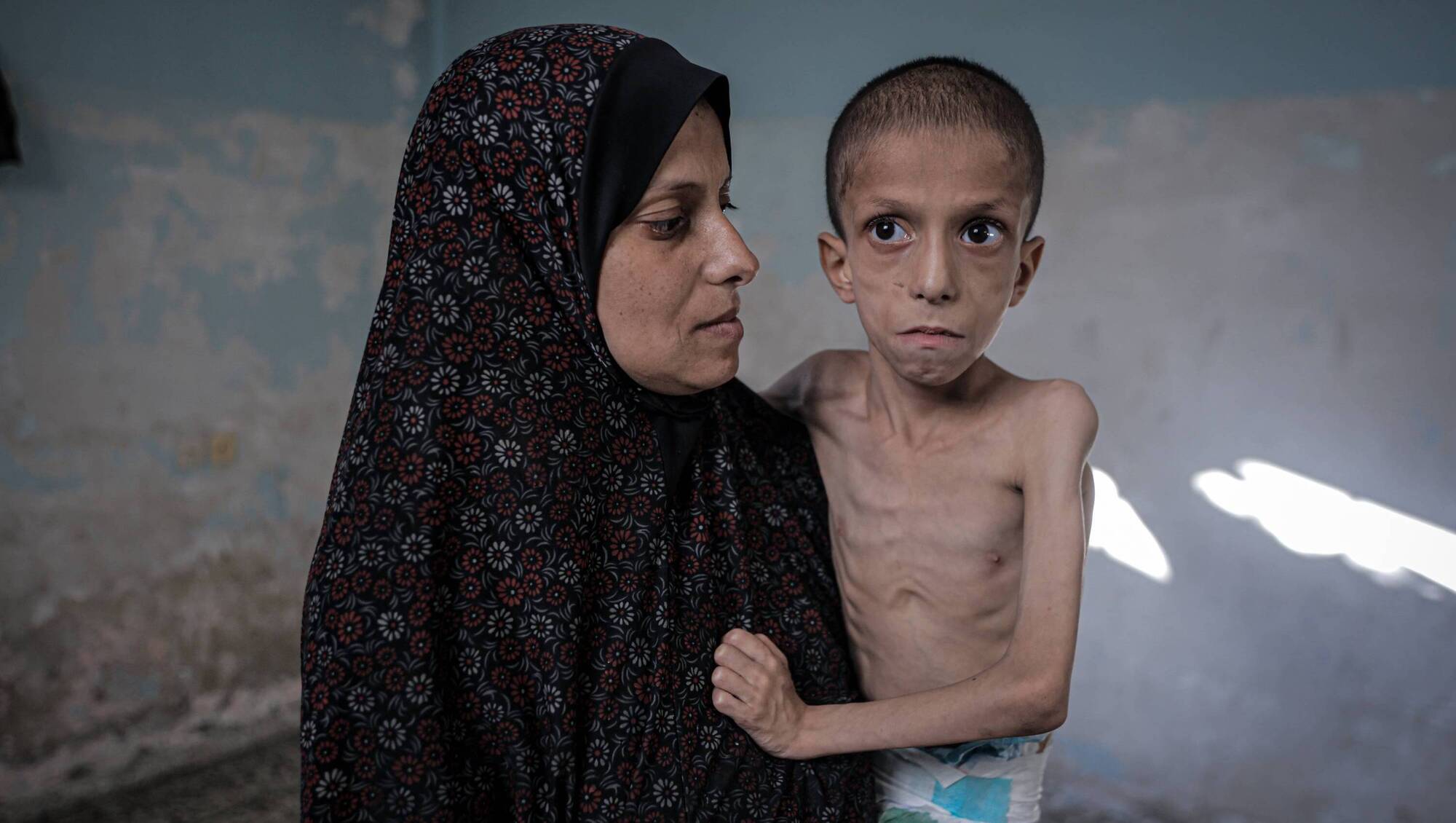
Ten-year-old Nafez Mohammed Khidr Nasser struggles with serious health issues due to malnutrition and brain atrophy in Gaza City, Gaza. His weight has dropped rapidly, and he lost the ability to walk. Nafez and his family are living under harsh conditions in the Tuffah neighbourhood, lacking basic food and medicine. File picture: Getty
The global food system is under unprecedented strain — not because the world is running out of food, but because conflict is reshaping how it is produced, transported, and priced.
The latest and most striking example is the escalating war involving Iran.
As tensions disrupt shipping routes through the Gulf and raise concerns about access to fuel and fertiliser, the effects are being felt far beyond the immediate region.
Food prices are rising, supply chains are tightening, and humanitarian agencies warn millions more could be pushed into hunger if instability persists.
It is a stark illustration of a broader reality: in today’s interconnected world, war does not just create hunger where it happens. It globalises it.
Read More
Across multiple regions — from the Middle East to Africa to Eastern Europe — conflict has become the single biggest driver of acute food insecurity.
The World Food Programme estimates that most people facing crisis levels of hunger now live in conflict-affected settings.
Modern warfare disrupts every layer of the food system, from farms to markets to global trade.
At its most immediate level, conflict destroys the ability to produce and access food.
Farmers abandon land, crops go unharvested, livestock is lost, and infrastructure falls into disrepair. Even where food exists, getting it to market becomes difficult or dangerous.
In Gaza, conflict has severely restricted the flow of food and aid while local production has collapsed.
In Sudan, mass displacement has disrupted agricultural cycles.
In Yemen, years of war have entrenched one of the world’s worst hunger crises.
Timing matters. If violence disrupts planting or harvest seasons, the effects can last for months or years.
A missed harvest can lock communities into prolonged food insecurity. Over time, these shocks accumulate, turning disruption into systemic collapse.
But as Professor Stuart Gordon of the London School of Economics argues, the deeper story is not simply about disruption — it is about decision-making.
“In today’s major crises, famine is far less about failed rains than failed politics — what we’re seeing in places like Gaza is, by many expert assessments, a man-made famine driven by restrictions on access and aid,” he says.
That political dimension is visible across multiple crises.
“Sudan shows that famine is fundamentally political: food exists, but conflict, siege dynamics, and blocked humanitarian access determine who can reach it and who cannot.”
Environmental shocks still impact, but are rarely decisive on their own. “Modern famines emerge when political decisions turn vulnerability into catastrophe.”
While much of the hunger associated with conflict stems from disruption, there is increasing proof that in some cases it is also used deliberately, even as a weapon of war.
Sieges, aid restrictions, and control of supply routes can all serve strategic purposes. Denying access to food can weaken populations, force displacement, or exert pressure.
“There is growing evidence that hunger is being used less as a byproduct and more as a method,” Mr Gordon says.
“When entire populations face catastrophic hunger because access is restricted or delayed, as in Gaza, it raises serious questions about whether starvation is being instrumentalised within military strategy.”
What is striking is how visible these mechanisms have become.
“The mechanisms of starvation — blockades, bureaucratic impediments, market disruption — are often foreseeable and, in some cases, preventable.”
International law prohibits the use of starvation against civilians, yet enforcement remains weak. The UN Security Council formally recognised the link between conflict and hunger in 2018, but accountability is limited.
What distinguishes today’s crisis is how globally interconnected food systems have become.
The war in Ukraine offered an early warning. As a major exporter of wheat, maize and sunflower oil, disruptions sent global prices rising, affecting countries far beyond the battlefield.
The conflict involving Iran carries similar — and potentially broader — implications. The Gulf is central not only to energy but to fertiliser and global shipping. Disruptions raise the cost of producing and transporting food worldwide.
For import-dependent countries, particularly in the Middle East and parts of Africa, the impact can be severe. Food prices rise quickly, governments struggle to respond, and households already spending heavily on food are pushed into crisis.
As Prof Gordon puts it: “Modern hunger crises are no longer contained within war zones — conflicts now disrupt prices, supply chains, and aid flows globally, amplifying food insecurity far beyond the battlefield.”
This is how conflict in one region translates into hunger in another. Effects ripple outward through trade, prices and supply chains.
The danger grows when multiple crises unfold at once.
“The simultaneous famines in Sudan and Gaza underline how interconnected the system has become,” Mr Gordon says.
“Multiple crises can now unfold at once, stretching global response capacity to its limits.”
The relationship between conflict and hunger is also not one-directional. While conflict drives hunger, hunger can fuel instability.
Rising food prices and shortages can deepen grievances, contribute to unrest, and in some cases drive recruitment into armed groups.
In May last year, NGO ActionAid reported the cost of a bag of flour in Gaza was anywhere between $300 and $500.
This creates a feedback loop: conflict leads to hunger, and hunger increases the risk of further conflict. Supply chains of aid become manna for a black market economy.
“Conflict today doesn’t just destroy harvests locally — it drives inflation, collapses markets, and cuts supply lines,” Mr Gordon notes, pointing to Sudan where food prices have surged dramatically during the war.
Breaking this cycle is difficult, particularly in protracted crises where institutions are weakened and resources scarce.
Behind these dynamics are millions living with daily hunger. Families skip meals, diets deteriorate, and children are withdrawn from school.
Assets are sold, leaving households more vulnerable to future shocks.
For children, the consequences can be long-term. Malnutrition can lead to stunted growth and impaired development.
Hunger also forces difficult choices — migration, or even joining armed groups — further entrenching instability.
Humanitarian organisations continue to provide life-saving aid, but face mounting challenges including funding gaps and restricted access.
As conflicts multiply, needs are outpacing resources. Emergency food assistance is essential, but it does not address root causes.
At its core, this is a political problem. Ending hunger in these contexts depends on resolving the conflicts that drive it. Diplomacy, conflict prevention, and peace-building are central to any lasting solution.
At the same time, strengthening food system resilience is critical. Supporting sustainable agriculture, investing in infrastructure and building social protection can help communities withstand shocks.
There is also growing emphasis on early warning systems and anticipatory action — identifying risks before they escalate. Acting early can save both lives and resources.
Accountability also matters. Where hunger is used as a weapon, there must be consequences, but increasingly, there rarely is.
The convergence of conflict and hunger is one of the defining challenges of our time. What is new is not just the scale, but the nature of the problem.
In an interconnected world, the impacts of war are no longer contained. A conflict in one region can disrupt food systems across continents, amplifying vulnerabilities and creating new ones.
The war involving Iran underscores this shift. It is not only a regional crisis but a global one, with implications for food security far beyond its immediate geography.
The risk is that such disruptions become normalised — that hunger driven by conflict becomes an accepted feature of the global landscape.
Because when conflict and hunger collide, the consequences are measured not just in statistics, but in lives diminished and futures lost.
And in a world with the resources to feed itself, that is a failure not of capacity, but of political will.

CONNECT WITH US TODAY



Be the first to know the latest news and updates