'People spend days without food': Kenyans suffering malnutrition due to recurring droughts
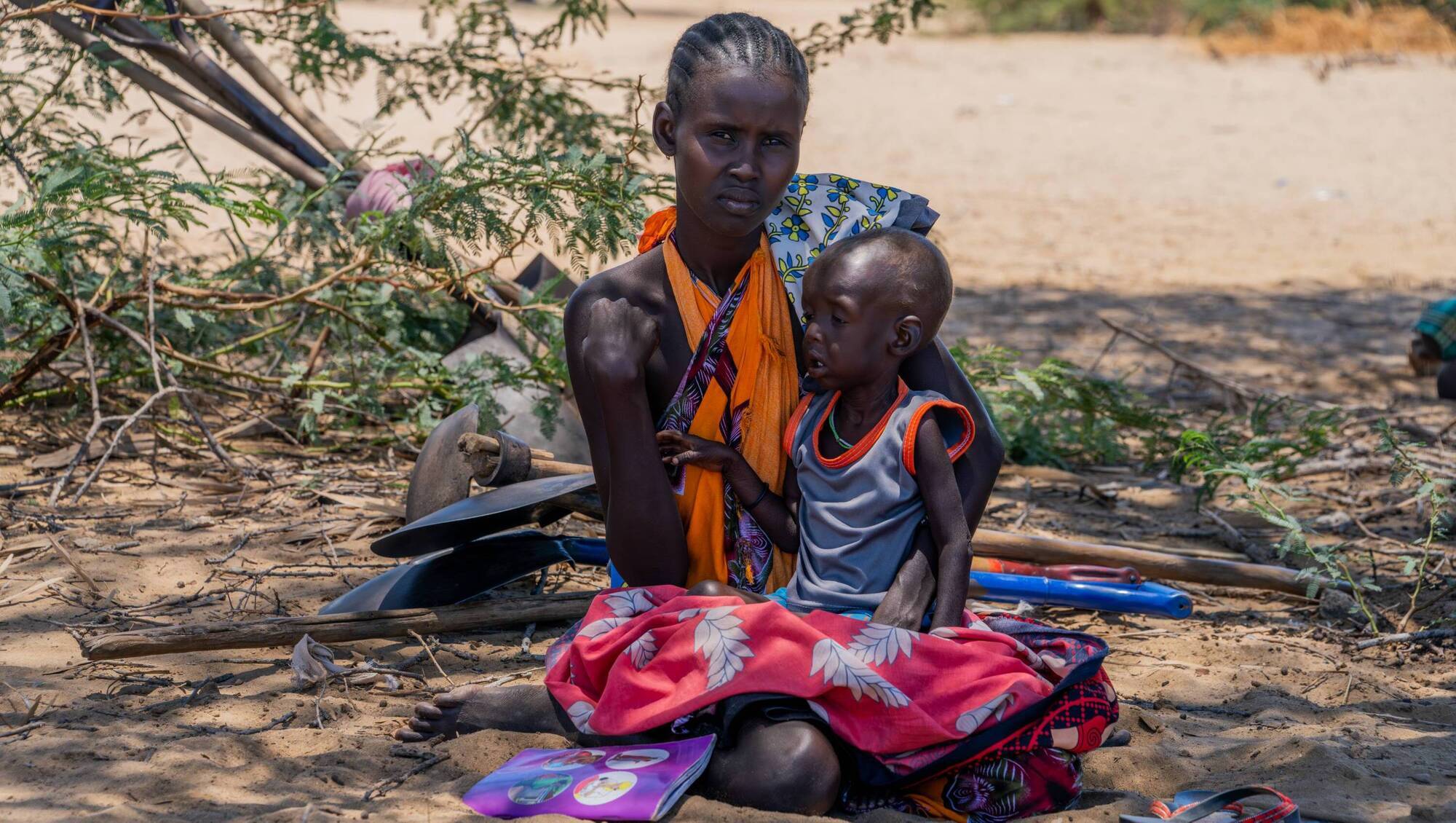
Joyce Lopua with baby Cynthia, who contracted malaria and is suffering from severe pneumonia. Pictures: Eugene Ikua/Concern Worldwide
Recurring droughts have seen malnutrition, food shortages, livelihood loss, illness, attacks and displacement increase across Kenya.
Turkana county, in northwest Kenya, has an overall poverty rate of more than 75%, making it the most poverty-stricken region in the East African country.

Moses Raminya, Concern Worldwide’s programme manager for the Turkana region, pointed to a severe drought in 2022, the worst in over 60 years.Â
More than half of the population are pastoralists, keeping mainly goats, which they rely on as their main source of income, but herds are dwindling as the land becomes increasingly barren.
One programme operated by the Irish charity is a cash transfer project, which began in November 2025 and includes 144 households across Turkana.
James Ebongon, emergency response coordinator with Sabcone, an NGO that works with Concern on the project, said: “These days droughts occur regularly. In the past they occurred only occasionally.
The cash transfer project, implemented in areas where health data shows high rates of malnutrition among children or pregnant/lactating women, provides funding to be used for food, 5,021ksh per month (about €33.50), based on the average price of a basket of essential goods.
This cash is then spent in local shops operated by other members of their community, so it stimulates the area’s economy more than if the charities provided food directly.
Through the project, Loroo village has seen malnutrition reduce from 36% in 2023/24 to 26% now, though Mr Ebongon says anything above 15% indicates crisis levels, so the figure is still too high, and the project is set to be wound up soon due to international aid funding cuts.
One of the Loroo project participants, Nakuwa Lokaale, 20, said during drought periods, her husband can walk for up to 10 days with his animals, and “people spend days without food".
Nakoromwae Lochucht Ejore, 46, another participant, said two of her 20 goats had died since the start of the latest drought.Â
Before the previous drought they had 50 goats, and 45 died.
“When livestock suffer, people suffer,” she said.Â

Recognising threats to goats are direct threats to livelihood, Concern is supporting vaccinating livestock from a range of diseases, so their immune systems are better able to fight off illness even while weakened by malnutrition.
Isaac Echapan, who serves as programme manager for livelihoods with Concern in the region, said in a week, 108,000 goats have been vaccinated in Naoros village against Peste des Petits Ruminants (PPR), an epidemic disease in the region.
Animals are also screened and treated at these vaccination clinics for other diseases, such as brucellosis and anthrax, which can be passed from livestock to humans.
One shepherd at the vaccination clinic, David Aote Elipa, said a few of his goats had died during this drought, and while they try to eat them quickly, some may have had parasites or diseases.
“It’s risky, but this is what we rely on,” he said.
He can be away for up to year with the animals, and said he missed his family during this time, but the health of the animals was essential to their survival.
As well as providing more milk and meat, when goats are healthy, they can sell for up to 8,000 Kenyan shilling (KSH), which equates to €53, but this drops to 1,000ksh during a drought, less than €7.
Mr Aote Elipa lost a four-year-old son to malnutrition last year. He cannot let grief stop him from working.
Concern supports health interventions for children in Turkana, with mobile health clinics visiting communities every two weeks.
Healthcare is free, funded by the county government, but access to services is difficult, with most facilities in towns inaccessible to many communities. One clinic meets in the somewhat-shaded patch of ground under a large tree located in Nang'olekuruk.
The mobile outreach clinics vaccinate for diseases such as polio, TB, pneumonia, measles and yellow fever, offer anti-natal care to pregnant women and treat general illness.Â
They also screen children under five for malnutrition, and provide supplements to the most malnourished.

Josephine Kasile, who works with the Turkana government’s ministry of health, said due to funding cuts from international donors last June, it can no longer provide supports for children who are moderately malnourished, only severely malnourished.
Instead, they give nutrition counselling to families of moderately malnourished children, suggesting what their diet should entail, but the families often tell them they do not have enough food at home to follow this advice.
Joyce Lopua, 20, attended the clinic with her daughter Cynthia, who is one year old and has been in the programme for three months. She had been improving, but last week contracted malaria.
“She is not doing well, she has deteriorated and has not been eating for a week,” Joyce said.
After speaking to the , Joyce and Cynthia were brought directly to the doctor, who referred her to the stabilisation facility in Lodwar, which is 20km away. Joyce said the options were to walk, or pay to rent a motorbike.
Due to the emergency nature, Concern was able to take them directly to the facility, but later updated: “The child was admitted but still not responding well. She has been diagnosed with severe pneumonia and is still under observation.”Â
Patrick Moy, who also works with the Turkana government, said they knew they were not reaching people in far flung villages with their mobile centres, and they were concerned about what would happen when funding cuts took effect.
At an uplifting Concern project in Lokumwae, Turkana north, water officer James Koki said the county government drilled a borehole in 2019, providing access to safe, clean water.Â
Despite the droughts during this period, it has never gone dry.
The water had to be pumped by hand, which was time-consuming and tiring, and caused “pressure and congestion” around the pump, he said. They also saw sickness due to people and livestock using the same tap.

With support from Concern, last year they upgraded the hand pump to a solar pump, and installed a large tank which can hold 30,000 litres of water, as well as pipes leading to four separate taps in the area.
A trough was created for livestock, while one tap runs directly to a newly set up school. Pipes have also been utilised to create fertile land to sustain farming, and the community, who were previously reliant only on livestock, have now planted crops — maize, sorghum and vegetables.
The farmland is worked by people from the community, and like the water system, it is in the ownership of everyone who lives there.
The rate of diseases being transmitted between livestock and people has dropped from more than 30% to zero.
Through Concern, the residents have been trained in the operation and maintenance of the new system, and a water committee has been set up which collects 100 Kenyan shillings per month from residents to save in case they need to get a technician out.
If there are leftover funds, the committee plans to extend the pipeline, as the government is aiming to build a hospital in the area in the next five years.
Mr Koki said: “Everyone is willing to pay, and if you don’t have the money you could pay with a goat, which the committee sells, and you would be given a time, maybe you can drink for two years for free.”Â
The tank takes two to three hours to fill on a sunny day, and is located high above the ground so distribution is aided by gravity.
They have a local chairperson of the water committee whose job is to watch the tank, as the only indication it is full is overflow. The farm has been situated where the overflow spills out to make use of this water.
When the tank is full, he switches it off through a locked control panel. He has trained two people already in his role, and plans to train more.
All these improvements have resulted in the population of the village growing from 500 to 2,500 in six years.
Aktela Adome, who lives in the village, said prior to the installation of the borehole, they had to walk four hours to get water and then four hours home.
“It was taking more than eight hours, and it was on a daily basis. Ladies could not walk alone, they needed to bring a man, because you would be attacked. Sometimes they take the water, sometimes they attack the women or sexually assault them,” she said.
“When you had to pump the water you would pump from morning to evening and you could develop chest problems, but we are very happy now,” she said, adding they are pleased with the expansion of population, because there was more than enough land.
This community spirit was seen throughout Turkana.Â
In Nang'olekuruk, Joyce Lupua’s husband was doing manual work for the government, rehabilitating a borehole.Â
The community split the work between them, working a week then letting someone else take their place, so each family could earn some income.
In Loroo village, participants in the cash transfer programme said when they have no food, their neighbour will often share some of theirs, even if they have only a little themselves.
Ekiru Moses Amuygeno said he was not part of the cash transfer programme: “I am only just a beggar”.
He had come there that day because when people get support, they share with others, “because we are all one community. People share food with each other because they love each other, they are not selfish,” he said.
This sharing spirit can cause problems though, as Elizabeth Aule, mother of one-year-old Ivy who is severely malnourished, says at the health clinic in Nang'olekuruk.
She is given supplements for Ivy, but shares them with her other children, and says she knows she isn’t doing it correctly, but they are also hungry.Â
Her family have gone as long as two days without any food.
Like many in this village, her husband worked as a fisherman, but Lake Turkana is expanding due to climate change, meaning there is more shallow water than previously.
This shallow water is where crocodiles live, and after a neighbour of theirs lost his leg and hand to a crocodile attack three years ago, her husband and many others have been “too afraid” to fish.
In some areas, cash transfer participants are provided with funds to buy food, sanitary products, jerry cans to collect water, tabs to treat water and pellets to feed their goats.
Ewoi Lokamar, one of the people receiving this aid in Naoros, said they also have a problem with wild animals, that he has lost 13 goats in the last six months to hyena attacks.
“We try to hunt them down. It is a daily occurrence, affecting lots of herders,” he said.
While the water project in Lokumwae is now owned and managed largely by the community after an initial investment by Concern, with US Aid funding, many other programmes like cash transfers, vaccination of livestock and the health clinics are at risk as their current funding systems are set to stop very soon.
Asked how she felt when she heard the programme would be stopping due to international aid cuts, Elizabeth Aule in Nang'olekuruk said: “We understood. The funding was just a donation, maybe the people supporting us didn’t have the money anymore.”Â
But Alessandro Bini, Concern’s director for the region, says: “It is not the money that is lacking, it is a lack of priority.”Â
As well as the huge cuts to US foreign aid, there has been cuts across the world from the end of 2024, he said, partly due to an increase in right-wing European governments like in The Netherlands and Sweden.
“Even the Labour government in the UK has cut international funding by around 60% to 70%. Each cut is compounded on the other.
Nellie Kingston, Kenya’s country director, said that this support by the Irish Government is mirrored in the Irish people: “We’re very lucky in Concern, we have support across Ireland. So many people, not wealthy people, donate to us every month.
“Ireland is very good at empathising with others in need. When I was younger, in school doing history, the talk of the famine and war of independence — there were people with a living memory of what it was like to be malnourished. I remember seeing malnourished children in Ireland in the 1970s.
“It’s in the DNA of the country, we share a history more with the colonised countries in Africa than the uncolonised countries in Europe.”Â
Faith is very important across Turkana.Â
In Loroo village, Ewoi Lookapelo Lookamol said: “We pray to God to look after our children, we pray for rain, for our livestock, and for peace.”Â
This area is peaceful, so when they pray for peace, they’re praying for other countries, she said.
Elizabeth Aule in Nang'olekuruk said: “God will take care of me for the rest of my days, because it is beyond me.”Â
But the future is uncertain in Turkana, Mr Bini said: “The local government doesn’t have funding for a lot of the vital activity, everyone is frantically looking around for another donor, but there is no replacement.”Â
He said the US government had provided $2bn in aid funding, to be distributed through the United Nations across the entire world for the next six months, and they are unsure if more is coming after that. He added the US was spending $1bn a day on the war in Iran.
“An increase spend on defence is taking from international aid, and we are not talking about it enough. Countries are more interested in killing people than saving them.”
To learn more about Concern Worldwide’s work and how to help, visit concern.net.