Will the great educational talking shop result in a plan or just more homework?
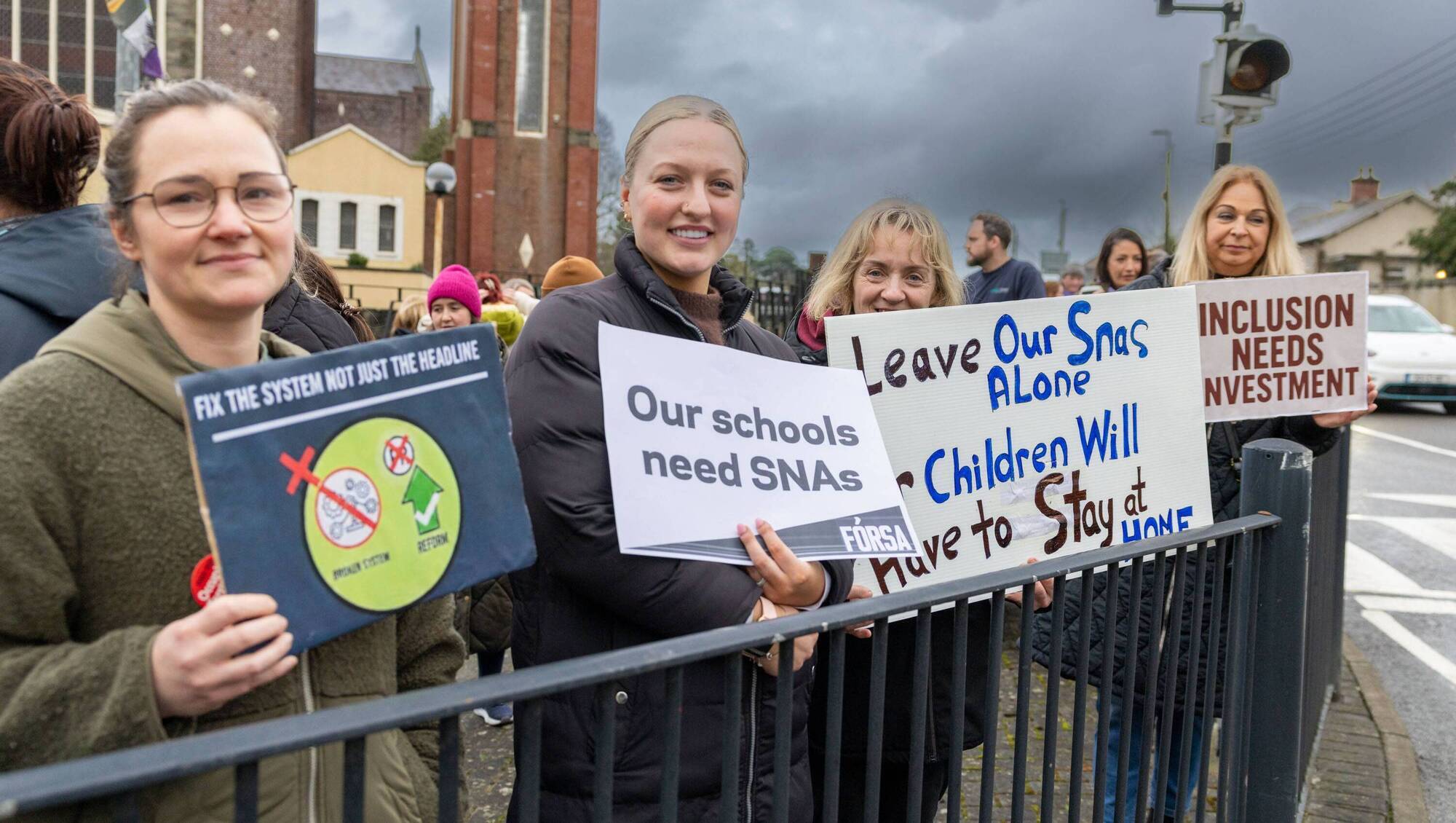
School staff delivering their message at the SNA protest in Portlaoise on February 25. File picture

The upcoming National Convention on Education — the first of its kind since 1993 — is a moment of profound, if fragile, potential. It is being sold to us as a “once-in-a-generation opportunity” to reshape the Irish classroom. Yet, as delegates prepare to meet later this month, a shadow of scepticism looms large over the school gates.
After decades of departmental silence, this sudden urge for a national conversation feels less like a proactive vision and more like a tactical distraction from a system currently in freefall.
There is a distinct irony in the urgent pace of educational reform in this country. It has taken approximately 240 days, or eight full months, to move from the minister’s grand announcement in July 2025 to opening the doors this March.
They spent eight months preparing to talk, only to give the public a mere 45 days to actually say something. It is a classic administrative masterclass: long on the choreography of the event and remarkably short on the time allowed for the substance.
The timing of this convention has raised some deeply uncomfortable questions for those of us on the frontline.
If the goal is a collaborative redesign of our schools, why was the lead-up to this “conversation” dominated by attempts to slash special needs assistant (SNA) supports?
In February, nearly 200 schools were notified of significant cuts to their allocations, sparking a wave of anxiety for families and staff alike. While the subsequent pause and the €19m funding patch are a relief, they leave me wondering: why seek to dismantle vital supports on the very eve of a convention meant to protect them?Â
It felt less like a fresh start and more like a cynical attempt to lower the baseline of “minimum support” before the public even had a chance to speak.
For this convention to truly mean something, its success won’t be measured by the prestige of its delegates or the quality of its seminars. It will be measured by whether it produces immediate, tangible change that ends the exhausting cycle of “policy-by-backtrack”.

We cannot have a system where parents and principals must spend every spring fighting just to maintain a lifeline for our most vulnerable students. We need to move beyond temporary patches and instead legislate for a “minimum essential support” level. This would ensure that no school sees its SNA numbers drop below a safe, functional ratio without a transparent, clinical audit. Furthermore, we must bring therapeutic services —speech and language therapists and psychologists — directly into school clusters. Placing these professionals where the children are would bypass the years of red tape that currently stall a child’s development.
We also need to address the teacher supply crisis with more than just rhetoric. Currently, we have a “world-class” system on paper, yet I see schools regularly forced to drop subjects because there is simply nobody to teach them. To fix this, we must ensure that newly qualified teachers can walk straight into secure, full-time jobs upon graduation. For too long, our best young talent has been left to fish around the murky waters of part-time hours and temporary contracts.Â
The blame here does not lie with my fellow principals; we are doing our best to piece together timetables with the hours we are given. The solution must be structural. By overhauling and reducing pupil-teacher ratios, the Government would provide schools with the staffing autonomy to offer full-time contracts as a standard. Without this, the “gig economy” of piecemeal hours will continue to drive our graduates abroad.
Ultimately, every challenge we face comes back to a fundamental lack of investment. Ireland currently invests just 2.9% of its GDP in education, a figure that sits in the shadow of the OECD average of 4.9%. This is why schools are still forced to ask for “voluntary” contributions just to keep the lights on and the radiators warm. The convention must demand a legislative commitment to a five-year funding escalator to reach international standards. We need a “core costs guarantee” so that every capitation grant covers 100% of a school’s running costs — heat, light, and insurance — without exception.
If the recommendations of this convention are simply brought before yet another committee or lost in a maze of subsequent meetings, we will have failed a generation. We don’t need another talk shop or a list of aspirational goals to be filed away. We need a funded, practical blueprint for action. For the principal trying to staff a classroom and the parent fighting for their child’s rights, the time for “conversation” has long since passed. We are ready to work, but we need the Government to finally commit to the tools we need to do the job.
- Nathan Barrett is Principal of Stratford College.
CONNECT WITH US TODAY
Be the first to know the latest news and updates