Colin Sheridan: Defence Forces funding increase must not erode Ireland’s neutrality
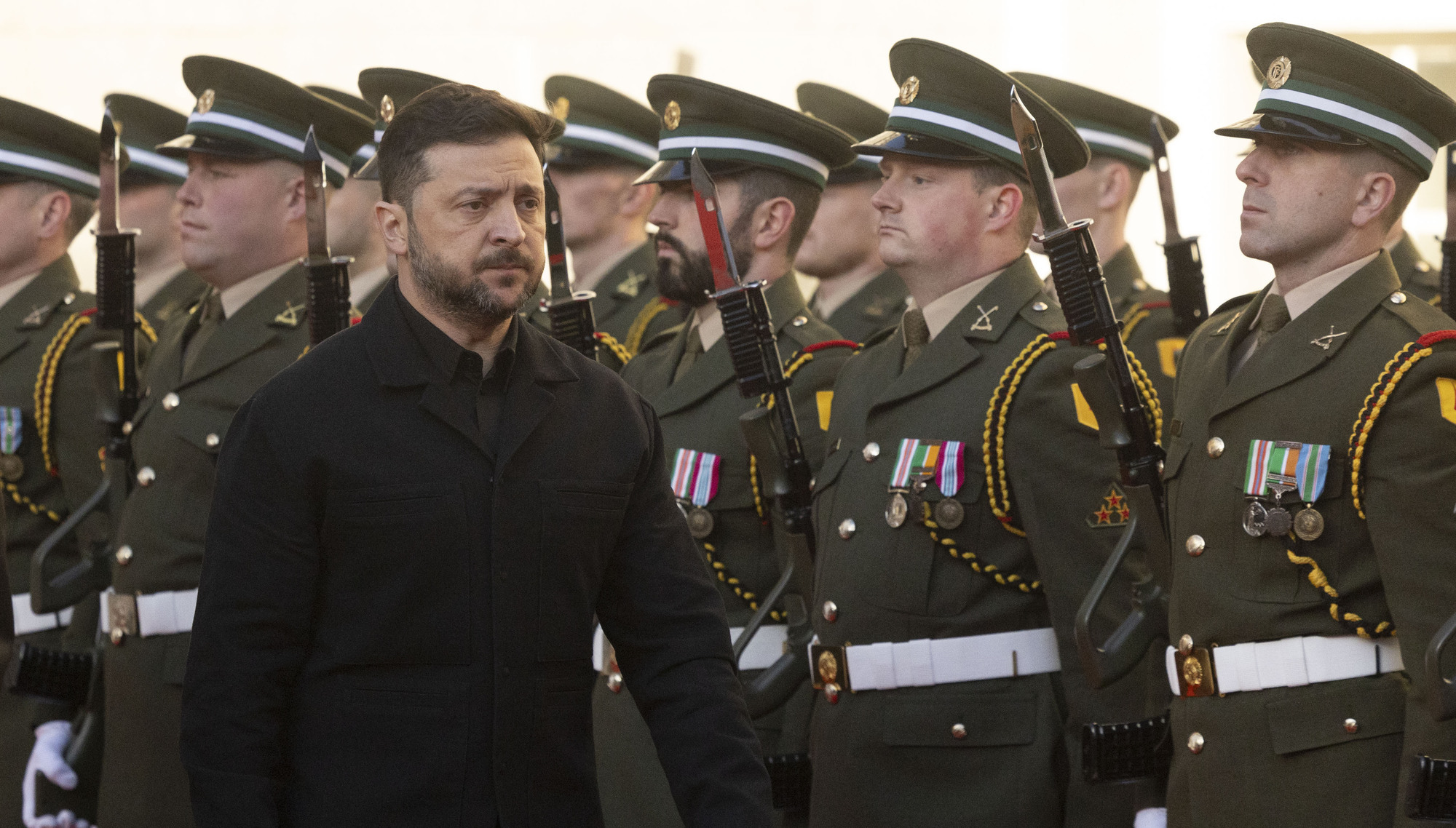
Ukraine's president Volodymyr Zelenskyy inspecting the Irish Defence Forces. Imagine a defence force where investment in language training, cultural literacy, and soft-skills development was as central as investment in hardware, writes Colin Sheridan. File Picture: Sam Boal/Collins Photos
On a recent viewing of — Stanley Kubrick’s bitter satire about the absurdity of Cold War brinkmanship — one line stood out: “War is too important to be left to politicians.”
The people most invested in militarisation always argue it’s too serious for democratic debate, which is exactly why it must be debated. In Brussels, Berlin, Paris, and Dublin, a contrived fear fills the air.
As a retired officer of the Irish Defence Forces, I have heard these arguments before. I know the language of threat, and I know how powerful it is in shaping policy.
Having seen defence politics from the inside, I also know that fear can be manufactured. I know that the national response should be proportionate, not reflexive.
In practical terms, Ireland’s defence budget has been rising after decades of relative modesty — from about €1.1bn in 2022 to around €1.35bn in 2025, with a plan to reach €1.5bn by 2028 and potentially €1.7bn by 2030 under the National Development Plan.
Relative to our economy, that is still a small figure.
Defence expenditure sits at around 0.24% of GDP, by far the lowest in Europe
Yet the speed and scale of the increase are still significant for a neutral country.
I do not dismiss the very real need to protect Irish troops abroad, to ensure they have adequate force protection equipment, or to address obvious capability gaps in areas such as radar, maritime surveillance, and cybersecurity. The world is not a benign place.
However, there is a distinction between investing in effective, mission-consistent capabilities, and being swept up in a continent-wide militarisation drive that looks increasingly more political than defensive.
Much of the contemporary push for rearmament rests on narratives not backed by clear strategic necessity.
As Andrew Feinstein, an expert on the global arms trade, has observed: The politics of fear is a time-tested tactic to justify ever-bigger weapons programmes.
“We have to have an enemy,” he told me. Historically, when one enemy fades, another is invented or repackaged.
This is not to say Russia poses no risk. It is to say that policy should be driven by sober assessment, not perpetual dread.
Ireland’s geography — an island on the edge of Europe — does present unique considerations. However, geography does not automatically translate to militarisation.
We are surrounded by Nato members, we share airspace protection arrangements with allies, and we rely on a network of international security ties that does not require us to mirror the force postures of larger powers.
In this context, spending tens or even hundreds of millions on equipment that does not align with our strategic needs should prompt sober reflection.
For me, the real gap in how we are choosing to allocate defence funds is this: We are underinvesting in our human capital — the skills, languages, cultural understanding, and diplomatic capacity that make a small neutral nation genuinely effective in the world.
Security isn’t just about radars and sonar. It’s about understanding people, societies, histories, and contexts. It’s about building bridges, not just barriers.
Imagine a defence force where investment in language training, cultural literacy, and soft-skills development was as central as investment in hardware.
We would be singular in Europe — a nation known not for stockpiling missiles, but for cultivating expertise that gives us influence far beyond our size.
If security is about reducing vulnerability, then equipping our people with understanding and trust-building skills may yield far more in terms of genuine security than another weapons system
I recognise this stance will be unpopular among many of my former colleagues.
In military circles, there is often a default assumption that more capability is always better — more jets, more radar, more kit, equals more security. Yet, lived experience teaches otherwise: Capability without purpose is vanity, not defence.
As Ireland debates its role in the shifting European security architecture, we should resist the siren call of uniformity.
Fear can make even nations as proud and thoughtful as ours see threats where none exist, or overshoot solutions in ways that entangle us in priorities not our own.
Neutrality for Ireland is not about being powerless. It is about being purposeful.
Let us spend wisely — not just on the things that go “bang”, but on the people and skills that make peace a durable choice.

CONNECT WITH US TODAY



Be the first to know the latest news and updates