New law would permit Irish Defence Forces board vessels 200 nautical miles from coast
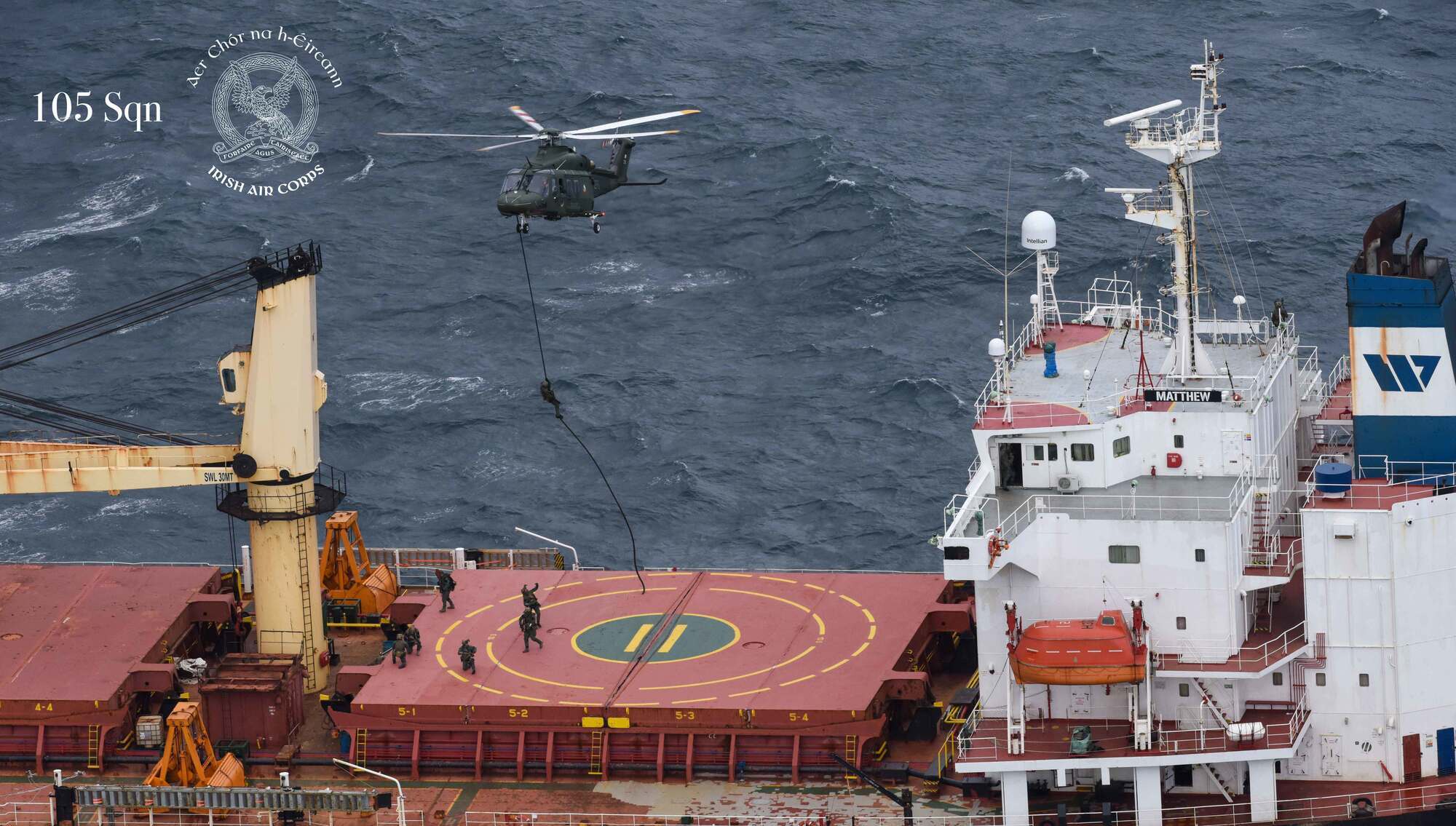
Army Ranger Wing personnel boarding the MV Matthew in July 2025 when they seized 2.2 tonnes of cocaine worth €157m. The new legislation would permit such boardings up to 200 (370km) from the coast. Picture: Irish Air Corps/PA
Proposed new powers will permit the Defence Forces to board suspect vessels as far out as 200 nautical miles from the coast.
The provisions, which the Government hope to have enacted before the summer, will not just apply within Ireland’s territorial waters — 12 nautical miles from the coast — but also within Irish-controlled waters, known as the Exclusive Economic Zone (EEZ).
Experts have welcomed the new legislation but some have expressed doubt over the exercise of powers in the EEZ, where the legal entitlements of coastal states are more constrained and limited than in their own territorial waters.
On Wednesday, Defence minister Helen McEntee published the heads of bill of the Amendment of the Defence Act 1954, which she said will formally assign to the Defence Forces specific functions in safeguarding and protecting the State’s rights in the territorial sea and exclusive economic zone.
She said members of the Naval Service will be given clearly defined unilateral statutory powers at sea to counter threats to Ireland's maritime domain, including the ability to:
- Board vessels operating in Ireland’s maritime zones;
- Inspect documents, equipment and activities on board vessels;
- Direct a vessel to leave a specified area or alter its route where necessary;
- Require a vessel to cease activities that may threaten critical infrastructure or the marine environment.
Ms McEntee said: “Following the launch of Ireland’s first National Maritime Security Strategy last week, one of my key priorities is ensuring the Defence Forces have the powers they need to respond to emerging threats in our waters, particularly from vessels linked to the Russian ‘Shadow Fleet’.
“Ireland’s maritime domain is of critical strategic importance. Major undersea cables that carry huge volumes of global internet and financial data pass through our waters, while gas pipelines, electricity interconnectors and planned offshore renewable energy infrastructure are also located in our maritime area.”
She said it was important to get this legislation “quickly” through the Oireachtas before the start of Ireland’s EU Presidency on 1 July.
Former Naval Service commander Tony Geraghty welcomed the bill and said the speed at which it was being developed “reflects the pace at which maritime security threats to Ireland, and Europe, are evolving”.
He said many European states already have similar legal frameworks in place.
“It will be particularly interesting to see how far offshore these powers will extend — whether they apply only within Ireland’s territorial waters, the 12-nautical-mile limit of the State, or whether they will extend further into the contiguous zone and the Exclusive Economic Zone,” Mr Geraghty said.
“Extending enforcement powers into those areas would be significantly more challenging from a legal and operational perspective.”
He added: “However, legislation alone will be of limited value without the capacity to enforce it.
"Maritime interdiction and vessel boarding operations of this type typically require coordinated efforts involving naval units, helicopters, air surveillance, and special forces.”
UCD assistant professor in the history of war Edward Burke said: “This new proposed legislation is very welcome. However, it is staggering that it is not already in place.
"For years, the alarm has been sounded on a lack of national security legislation, direction, integrated command and control and oversight powers when it comes to responding to threats in Ireland’s maritime and air domains.
“Ireland has been very fortunate to date to have escaped a catastrophic incident due to such shortcomings.”
Under UN law, known as UNCLOS, the coastal state has the following rights in the EEZ:
- Exploring and exploiting, conserving and managing natural resources;
- Economic exploitation and exploration of the zone;
- Establishment and use of artificial islands, installations and structures *marine scientific research;
- Protection and preservation of the marine environment.
Maynooth University's deputy director of the centre for military history and strategic studies Rory Finegan said there was considerable legal issues, in addition to the well-known limited capacity of the Naval Service.
“Irrespective of the operational challenge in both monitoring and boarding such vessels, a plethora of new legislation is necessary to legally underpin such a policy granting the DF [Defence Forces] explicit statutory powers under an amendment to the current Defence Act (1954)” he said.
He said such legislation will require multi-agency and Departmental co-operating cross cutting the Department of Defence and Department of Foreign Affairs.
He said: “Other European states have seized such "Shadow Fleet" vessels creating precedent for such boardings, but boarding such vessels within our EEZ requires a robust legal underpinning influenced by possible environmental concerns, actual evidence of illegality and the perceived threat to critical infrastructure. Also, while such vessels operate in the "Grey Zone," the legality of boarding them also remains murky.”
He added: “Risk mitigation of possible escalation must also be considered, there might be prompt Russian retaliation. There is also the significant issue that such vessels are themselves being 'shadowed' by Russian submarines, a far from inconsequential factor potentially fraught with danger.”
Read More
Richard Collins, Professor of Law at Queen’s University, said the powers in relation to territorial waters are “largely uncontroversial” except that there should be a “legitimate basis” for suspecting a vessel is operating in a way prejudicial to the peace and security of the coastal state.
Otherwise, he said, foreign flagged vessels have right to "innocent passage" and should not be interfered with.
He said that, in the EEZ, boarding powers are “more limited”, to ensuring compliance with regulations related to the exploitation and conservation of living and economic resources.
He said: “There are additional rights related to the protection of the marine environment, which could come into play depending on the state of the vessel or what it is doing — undersea gas pipeline sabotage being a good example — plus if interference with cables / pipelines, and those cables/pipelines are determined to be "installations" coastal states may be within their rights to enact safety zones around them and implement the law accordingly.
He added: “Beyond that, more controversially, some propose treating such acts of harm to cables and pipelines as acts of piracy — and thus attracting near universal jurisdiction — which might be enough to give boarding rights in any maritime zone or on the high seas.
"Many disagree with this reading of piracy for very specific legal reasons.”
Prof Collins said boarding can happen where the coastal state doubts the nationality of the ship — questions over the flag or in relation to flagless vessels — and said existing interdiction of shadow fleet vessels has been justified on this ground.
He said directing a vessel to leave could happen if the coastal state deems the ship is not engaging in innocent travel.
“In the EEZ this would be harder to justify but could be in relation to above harms outlined, or particularly in relation to safety zones justification,” he said.
Read More


CONNECT WITH US TODAY



Be the first to know the latest news and updates