Colin Sheridan: Austin Appelbee's 'quiet heroism' is worth more than any poster boy bravery

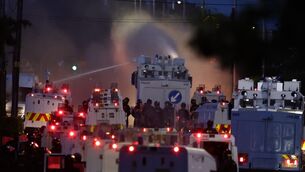
When the Beirut blast hit, I was clueless. Not because I lacked training, but because reality has a way of shattering training into useless fragments. File photo: AP/Hussein Malla

This week’s story about Austin Appelbee, the 13-year-old Australian boy with an Irish mother who swam for hours to get help after his family were swept out to sea, has been living in my head.
Not because it’s cinematic, although it is, but because it reminds us of something we don’t like to admit: most of the time, we don’t rise to the occasion. We default to whatever is already in us.
And what was in Austin — in that moment — was action. No “risk assessment”. No “stakeholder management”. No “strategic alignment”. No “let’s circle back”. Just a child, in the ocean, making the only decision available: I’m going to swim.
We dress bravery up in all sorts of language, but the truth is, when it’s real, it’s usually messy and counterintuitive. It often goes against what you were told to do. It ignores the rules. And it doesn’t pause to consider the optics.
In Ireland, we saw something similar in the story of Sara Feeney and her cousin Ellen Glynn, swept out into the Atlantic while paddleboarding off Furbo in Galway five summers ago.
They were missing for almost 15 hours, before being found clinging to a lobster pot, 17 miles from where they had set out. Two details always stuck with me.
The first is what the girls did: they tied their boards together. It’s so simple it almost sounds like something a child would do. But it’s also quietly brilliant — the sort of decision that doesn’t come from confidence, but from clarity.
The second is what saved them: a fisherman, Patrick Oliver, and his son Morgan, heading out not because they were instructed to, but because they could not live with the alternative.
Even the rescue broke protocol. The search had a pattern, a route and a logic. The fisherman followed a hunch, calculated wind and drift, and went west across the bay. That hunch, plus two paddleboards tied together, meant two young women came home alive.
It’s hard not to notice the pattern: ordinary people, placed in extraordinary circumstances, doing something that no leadership seminar would ever be brave enough to recommend.
Because the problem with most “leadership doctrine” is that it’s written for safety.
It’s written for predictability, for meetings and boardrooms and performance reviews — in a world where consequences are manageable.
But the ocean doesn’t care about your competence framework, and neither does panic. And neither does a city that suddenly explodes.
I was in Beirut in August 2020 when the port blast happened. I’d spent more than 20 years in uniform. I’d clocked hundreds of hours of leadership training — acronyms, models, the comforting illusion that if you rehearse enough, you’ll be ready.
And when the blast hit, I was clueless. Not because I lacked training, but because reality has a way of shattering training into useless fragments. In the seconds afterwards, I watched people do things that still make my throat tighten.
One of them was a homeless Syrian man I used to pass every day in Gemmayze. He sat in the same doorway, feet tucked under him, waiting.
Sometimes I gave him change. Sometimes I ignored him, irritated by my own hurry, and by his perpetual need. And if I’m being honest, I sometimes reduced him to a stereotype — “performative poverty”, as if poverty ever needed performance.
On the evening of the blast, I saw him running barefoot through broken glass and blood — his blood, other people’s blood, it doesn’t matter. He helped one person, then another, then another.
At one point, he carried the child of a friend who was too injured to do it themselves. It’s almost too neat, too morally instructive an anecdote, too perfectly arranged to shame me into better behaviour. But it happened.
And it haunted me because it didn’t fit the world I thought I understood. When I returned months later, there he was again. In the doorway. In the same pose.
The heroism gone with the glass swept up from the street. Not because it wasn’t real, but because bravery doesn’t usually come with a new life. Sometimes it comes and goes, leaving you exactly where you were.
There’s another story from that night that I carry with me carefully, because it belongs to someone else’s grief. Sarah Copland lost her son Isaac in the blast.
She has spoken about how, when she and her husband realised the extent of Isaac’s injuries, they ran into the street trying to reach a hospital. Beirut that night was chaos — nobody knew what had caused the explosion, and many assumed the city was under attack.
A car stopped. Inside was a driver, his wife, and their family. Somehow, they made room for Sarah — seven months pregnant — her husband, and little Isaac. They drove them from hospital to hospital, trying to get help.
They didn’t speak English and Sarah didn’t speak Arabic. But they didn’t need language for the one thing that mattered: we will not leave you here. They eventually got them to a hospital, where Isaac died.
Sarah never saw that family again. She doesn’t know who they are. But in the middle of the worst trauma a parent can experience, she remembers them.
Their quiet heroism. Their decision to stop when they could have kept driving. Their willingness to take on danger they didn’t understand, for a stranger they couldn’t speak to.
This is what I mean when I say bravery is often instinctive, and it doesn’t arrive with a press release.
And that’s where my suspicion of the leadership industrial complex comes in.
We are surrounded by it. Leaders Eat Last. The 7 Habits of Highly Effective People. How to Win Friends and Influence People. Team dysfunctions. Mission statements. Personal brands. TED talks that promise transformation in 11 minutes.
It’s not that every leadership book is nonsense, though I suspect most are. Some of it is useful. But much of it is filling a space we’ve convinced ourselves needs filling: the space between who we are and who we think we should be.
And in doing that, it can stymie the most important thing we have in a crisis — our ability to act.
Psychologists have long studied why people freeze in emergencies, and one of the most sobering findings is the bystander effect: the more people present, the less likely any one person is to intervene.
We look to others for cues. We wait for leadership to arrive. We assume someone else knows what to do. In other words, we outsource our instincts.
Modern leadership culture can train us into a similar paralysis, convincing us that action must always be sanctioned. That courage must always be strategic. That doing the right thing is only real if it comes with a framework.
Austin Appelbee didn’t have a framework. He had a family in the sea.
The Galway cousins didn’t have a leadership model. They had two paddleboards, the Atlantic and a head full of Taylor Swift songs.
My Syrian friend didn’t have a rank. He didn’t even have a home. He had two bare feet and a heart that moved faster than fear.
And the family in a car didn’t have a plan. They had a choice: stop, or don’t.
None of these people wanted to be tested. That’s the part we often forget when we tell stories about heroism. Nobody wants the ocean nor the blast nor the dreaded phone call. Nobody wants to learn what they’re made of in the worst moment of their lives.
But when those moments come, something honest is revealed — and it’s rarely what we’d put on a poster.
Maybe that’s the only kind of authentic leadership worth talking about: the kind that happens when there’s no audience, no reward, no promotion, and no time.
The kind that is simply: I will do something. I will do it now. I will do it anyway.
And perhaps the best thing the rest of us can do is recognise it when we see it — not as an inspiration hashtag, not as a LinkedIn lesson, but as a reminder of what human beings can be when the room is on fire.

CONNECT WITH US TODAY



Be the first to know the latest news and updates