From guarantee to risk: how Trump has changed Europe’s relationship with Nato
As Trump unsettles alliances, Europe and Ireland face the implications of a world where Nato no longer feels permanent
From guarantee to risk: how Trump has changed Europe’s relationship with Nato

The immediate Greenland confrontation appears, for now, to have eased, but the European reaction to it has been unusually raw.

For most Europeans alive today, Nato has never been a choice. It has been a condition. It has sat in the background of politics like gravity: unseen, rarely debated, but quietly shaping everything.
Governments rose and fell. The European Union expanded. Borders softened. Armies shrank. The Cold War ended. The War on Terror came and went. Russia re-emerged. China surged.

Through all of it, Nato remained — a permanent Atlantic weather system, exerting pressure, stabilising temperature, keeping storms largely offshore.

However, in recent weeks, something unfamiliar has crept into European political life: Not panic, exactly, but vertigo. The sense that what once felt structural is starting to feel contingent.

A US president musing aloud about forcibly taking Greenland. Threats of punitive tariffs against European allies. Public contempt for Nato’s internal logic. A gathering storm at Davos where European leaders spoke less about shared destiny than about exposure. French president Emmanuel Macron framing Europe as a power that must be able to act alone. Canadian prime minister Mark Carney warning that the era of comfortable assumptions is over.

Then, just as suddenly, a detente.

After days of diplomatic crisis, Donald Trump announced a “framework” on Greenland, pulling back from threatened tariffs. The immediate confrontation eased. Markets steadied. High up in the Swiss Alps, the diplomatic temperature dropped.

On one reading, it confirmed the optimists’ view. Matthew Kroenig, the vice president of the Atlantic Council, told the Wall Street Journal at the height of the row: “I think, in a few weeks, this will all be solved.”

Trump, he says, escalates to negotiate, then retreats when the costs become real. The system absorbs the shock. Life goes on.

But even as the Greenland storm subsided, another front opened.

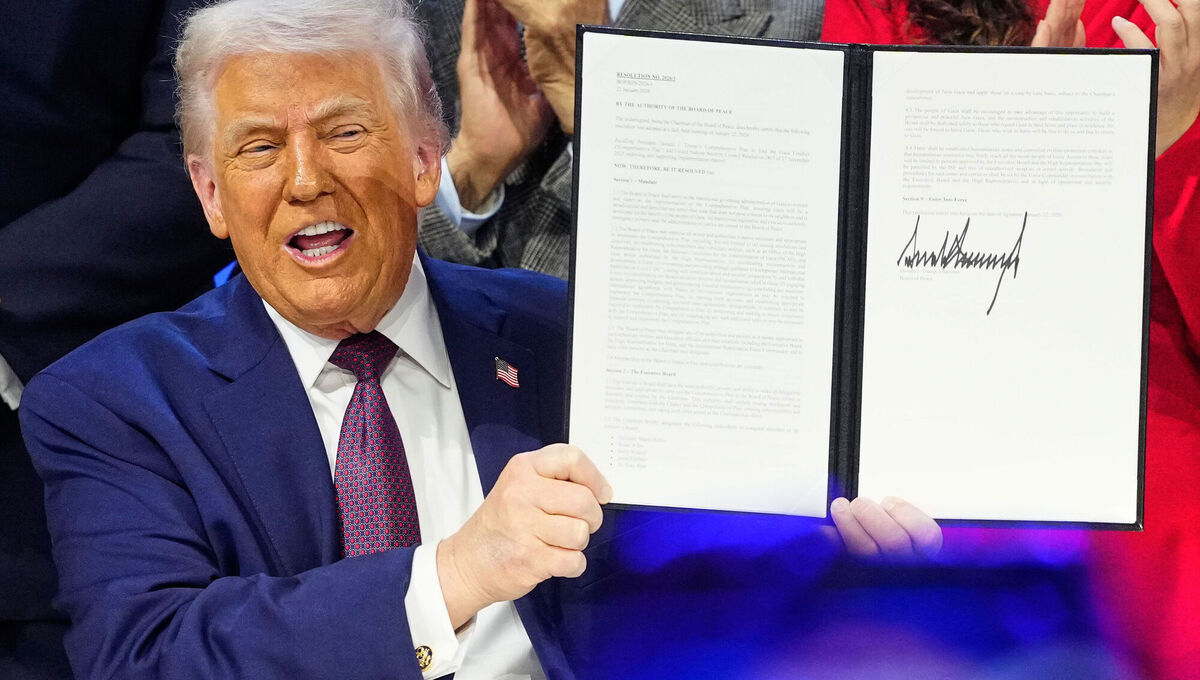
Thursday afternoon in Davos, Trump formally launched what he calls a “board of peace”, signing a founding charter for a new American-led international body intended to oversee conflict resolution and post-war arrangements.

It was initially conceived around Gaza, but has now been pitched in broader global terms. Several major European allies declined to sign.

Critics warn the initiative could bypass or weaken existing United Nations structures, replacing multilateral process with US-chaired arbitration.

Donald Trump holds the charter at a signing ceremony on his board of peace initiative at the World Economic Forum in Davos, Switzerland. 	Picture: Markus Schreiber/AP
Donald Trump holds the charter at a signing ceremony on his board of peace initiative at the World Economic Forum in Davos, Switzerland. Picture: Markus Schreiber/AP

At the same time, Trump described the Greenland framework as granting the US “total access” to the island — language that goes well beyond tariff de-escalation, hinting at deeper strategic ambition. Denmark moved quickly to restate that its sovereignty is non-negotiable.

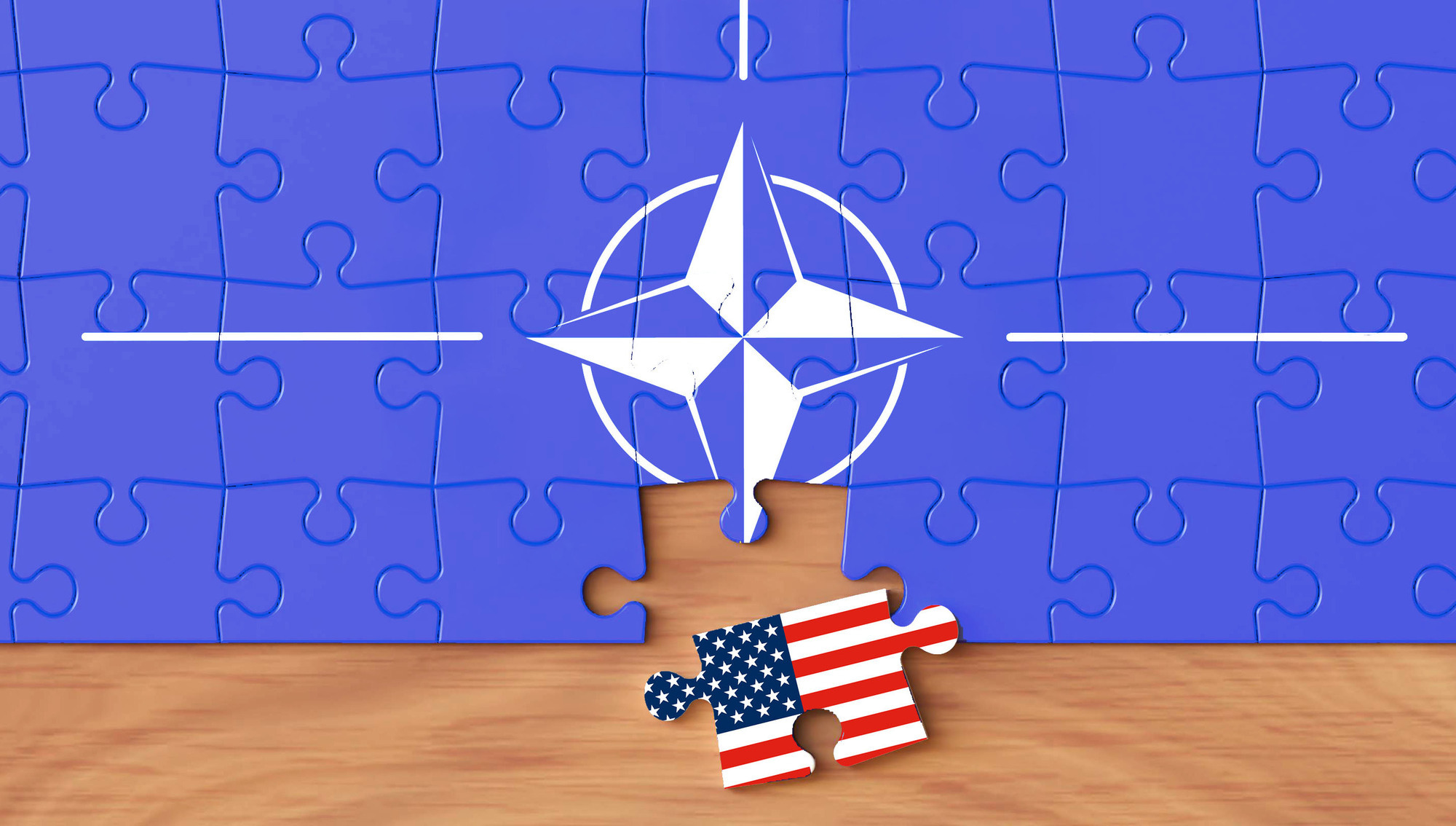
The confrontation may have cooled. The architecture underneath it has not. For Europe, this is not really about Greenland. It is about whether the world that made Nato feel natural is being quietly dismantled. As the Wall Street Journal put it this week, Europe is being forced to confront “the unthinkable”: That its major ally of more than 70 years is starting to look like one of its most urgent strategic risks.

The psychological shift may matter more than any single deal.

Nato was not just a military pact, it was a political revolution

Founded in 1949, it emerged from exhaustion and fear. Europe lay shattered, the Soviet Union was expanding. The US faced a choice it had never before accepted in peacetime: Whether to bind itself permanently to another continent’s security.

Article 5 — the promise that an attack on one would be treated as an attack on all — turned American power into a standing guarantee.

It did not merely deter Moscow; it re-engineered European politics.

It embedded the US inside the continent’s recovery and made it possible for old rivals to demilitarise their relationships with one another. Along the way, a lot of people made an awful lot of money.

Nato, however, did not only protect Europe from the Soviet Union.

It protected Europe from itself. It removed the need for Germany, France, Britain, and others to build security systems against each other. It allowed armies to shrink, borders to soften, and political imagination to expand.

The European Union did not replace Nato; it grew inside the environment Nato created. Countries wanted in because membership was not simply protection it was certification.

Constitutional neutrality

Ireland’s relationship with this system has always been more complicated.

Constitutionally neutral and militarily unaligned, shaped by our own experience of sovereignty, the State chose not to enter the alliance, but we never stood outside the environment Nato created.

Irish peacekeeping, intelligence co-operation, interoperability, and deep EU integration placed Ireland alongside Nato states even while remaining formally apart. Neutrality was not isolation. It was a posture made viable by the wider strategic climate. That climate only existed because Nato did.

The alliance’s greatest success was not the wars it fought — many of them disastrous — but the assumptions it sustained.

It created the background condition that allowed European societies to believe war had been tamed, power politics civilised, and security bureaucratised. That may now be changing.

The immediate Greenland confrontation appears, for now, to have eased, but the European reaction to it has been unusually raw.

“Donald Trump has destroyed Western cohesion,” Carlo Calenda, an Italian senator and long-time Atlanticist, said earlier this week.

Ivan Krastev, the Bulgarian political scientist, went further: “Nato, for Europeans, was a religion … Suddenly, we understand that if American commitment to European allies is not real, no treaty is going to defend you.”

That is not the language of routine alliance management but the language of emotional rupture

It reflects something many European officials are reluctant to say publicly: That even if Trump backs down, the fact that he escalated at all has consequences.

Alliances rely on the sense that some things are politically unthinkable. The unthinkable has now been spoken. By Trump.

This is why Kroenig’s reassurance, though plausible, may miss the deeper point. Yes, this dispute may be “solved”. But what happens when the next one arrives? And the one after that?

What happens when similar cycles run not for weeks but for years? Three more years of Trump as Trump would not mean three more years of one crisis. It would mean three more years of repeated shocks to assumption.

If the sense of permanence erodes, Europe’s strategic future does not collapse into chaos. It reconfigures. The most obvious gravitational pull is the European Union. Joint procurement, defence funds, and talk of “strategic autonomy” have already moved from abstraction toward policy. A Nato that feels unreliable would accelerate this trajectory.

But the EU is not Nato. It has no shared strategic tradition, no unified command instinct, and no credible nuclear umbrella.

Its members inhabit very different security realities. A genuinely post-Nato Europe would not produce a single replacement alliance.

It would fragment into overlapping security ecologies: Nordic defence compacts, eastern European military blocs, Franco-German industrial-military integration, UK-linked coalitions, EU-level frameworks layered over national forces. Such a system might function, but it would be slower, noisier, and more politically fragile than the clarity Article 5 once imposed.

For countries like Ireland, this shift would be profound. A Europe forced to speak the language of defence more explicitly would also force smaller states to clarify positions that have long remained strategically ambiguous.

Neutrality, alignment, partnership, deterrence — all would acquire sharper edges

Ireland’s security has never rested on Nato membership. It has rested on Nato’s environment. If that environment changes, the intellectual scaffolding of Irish defence policy will eventually have to change with it.

One of the most seductive responses in Europe is to frame all of this as personality rather than politics. Trump is erratic and transactional. Trump is an aberration. Outlast him, and the system will reset.

There is truth in this: The US foreign policy establishment remains overwhelmingly Atlanticist. Congress continues to fund European deployments. The Pentagon still plans around Nato structures. Now, it seems to have turned conditional.

The US strategic centre of gravity has been shifting for years: Toward the Indo-Pacific, toward domestic renewal, toward competition with China. The post-war bargain, in which Europe’s security was treated almost as a matter of American identity, no longer commands automatic loyalty across the US political spectrum. Trump did not invent that drift, but he absolutely weaponised it.

It is still entirely possible that Nato survives this period intact.

Institutions often do. The most consequential change may already have occurred: The shift from permanence to contingency.

Europe is planning for uncertainty while America is debating the price of guardianship. Smaller states are recalculating their margins. In that sense, we may already be living in a post-Nato psychology even if a post-Nato world has not yet arrived.

For Ireland, that matters. Our security culture has been built on the assumption of a stable background order that neutrality operates within a wider Western guarantee, that European integration rests on Atlantic power, that distance from alliances does not mean exposure. If that background order weakens, Irish debates will not remain abstract. They will become practical.

The real question is not whether Nato collapses tomorrow. It is whether the era in which Europe outsourced its ultimate security has quietly begun to close.

It it has, the task ahead will not simply be to replace an alliance. It will be to relearn how political trust, collective defence, and strategic credibility are built when the guarantees that shaped three generations can no longer be taken for granted.

x

More in this section

Revoiced

Newsletter

Had a busy week? Sign up for some of the best reads from the week gone by. Selected just for you.

Cookie Policy Privacy Policy Brand Safety FAQ Help Contact Us Terms and Conditions

© Examiner Echo Group Limited