Scott Lucas: Call to fight not a reaction, but a refrain
Can Americans resist the politics of violence and consider how to co-operate with each other
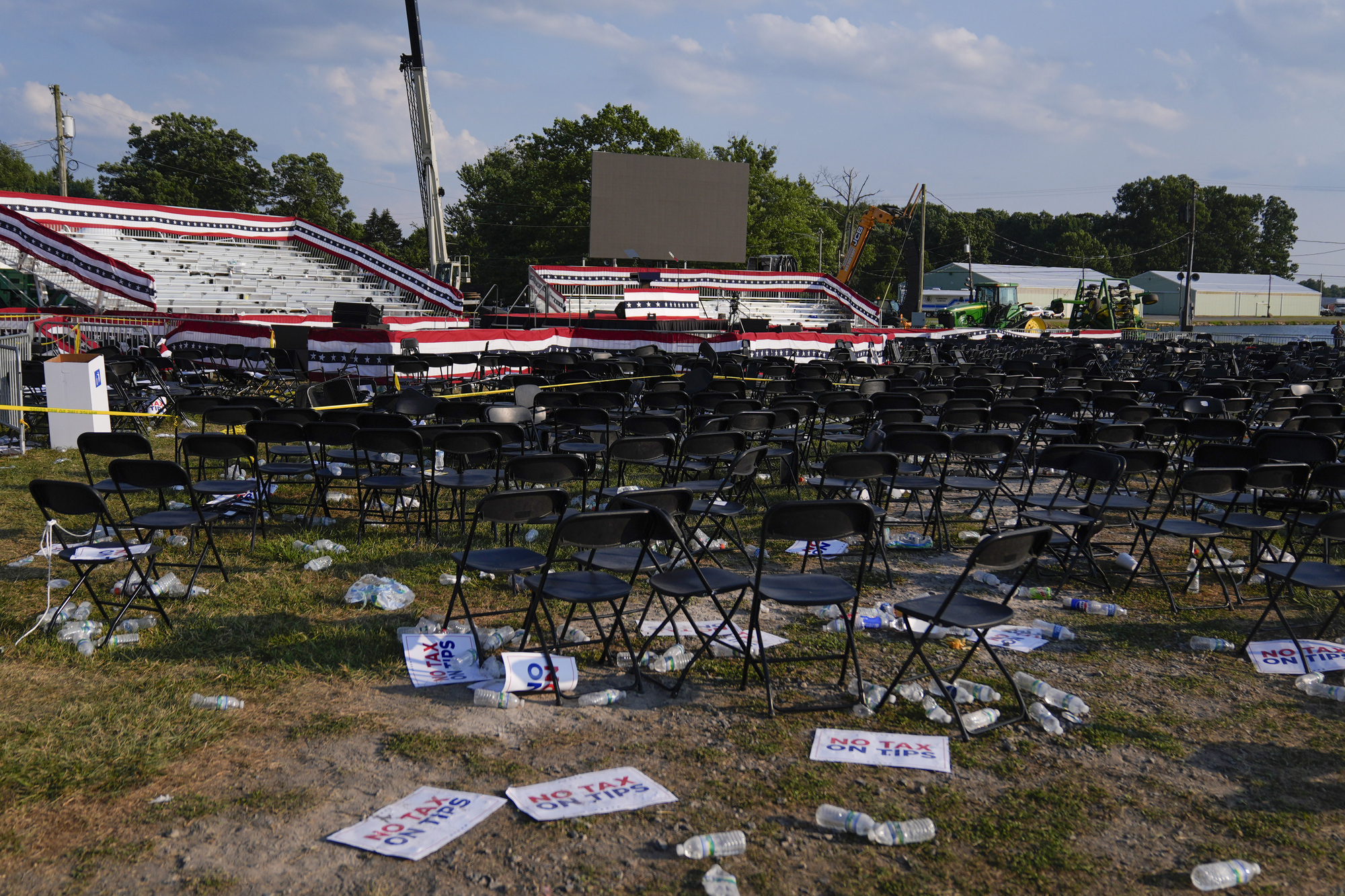
As the protection detail tried to bundle him off the stage in Butler, Pennsylvania, he shouted, 'Wait! Wait! Wait!!!' Then, with his fist pumping upwards, he directs his supporters, 'Fight! Fight! Fight!'.

As the protection detail tried to bundle him off the stage in Butler, Pennsylvania, he shouted, 'Wait! Wait! Wait!!!' Then, with his fist pumping upwards, he directs his supporters, 'Fight! Fight! Fight!'.

The photograph by Evan Vucci of the Associated Press is already iconic. 

His ear grazed by a gunman's bullets moments earlier, Donald Trump rises above the secret service agents trying to shield it. 

His right cheek is spattered with blood, his arm is raised with a clenched fist, his mouth is open in an exclamation.. Between him, an American flag flies in a flawlessly blue sky.

But just as important, perhaps more so, are Mr Trump's words seconds before that image. 

As the protection detail tried to bundle him off the stage in Butler, Pennsylvania, he shouted, "Wait! Wait! Wait!!!" Then, with his fist pumping upwards, he directs his supporters, "Fight! Fight! Fight!!!"

Having just avoided becoming a victim of political violence, Mr Trump immediately, perhaps instinctively, was seizing on the opportunity for his "politics of violence". 

It is an approach that was fundamental in his first stay in the White House and may lead to his second.

Political violence is engrained in America's history. I learned in school about the four assassinated presidents: Lincoln, Garfield, McKinley, John F Kennedy. 

I vaguely remember the murders of Martin Luther King and Bobby Kennedy, and was transfixed by the paralysing in 1972 of Democratic candidate George Wallace — the segregationist governor of my state of Alabama — in a parking lot in Maryland. 

As an aspiring journalist, I wrote about the two attempts on the life of president Gerald Ford and John Hinckley nearly taking that of Ronald Reagan.

That history is now being fuelled by the proliferation of guns, social media, and vitriol.

In 2011, Democratic US senator Gabrielle Gifford of Arizona was critically wounded outside a Tucson, Arizona grocery store. She survived; six other victims did not.

In 2017, Republican representative Steve Scalise was seriously injured during a Congressional baseball game. In 2020, Michigan governor Gretchen Whitmer escaped a kidnapping plot.

And, bringing us to Mr Trump, on January 6, 2021, his supporters stormed the US Capitol.

Trump's "Fight! Fight! Fight!!!" on Saturday was not a reaction. It is his refrain: as he said on that January 6, 2021 outside the White House, calling on his audience to enter the Capitol and stop the confirmation of Joe Biden as president. Picture: Evan Vucci/AP

They roamed the halls, pledging attacks on legislators such as House Speaker Nancy Pelosi and shouting, "Hang [Vice President] Mike Pence".

For the Donald's rise to power has been based on intimidation and threat. He stalked his 2016 opponent Hillary Clinton across a debate stage. 

He called for violence against hecklers at his rallies, against other demonstrators and movements like Black Lives Matter, against migrants and asylum seekers, against the media, and against the abstract "Left" — loosely defined as anyone who criticized his views or policies.

If his supporters carried out his injunctions, he did not denounce the threat to lives. He celebrated it and mocked victims.

When the skull of Nancy Pelosi's husband Paul was fractured by the hammer blows of an intruder — an intruder who was looking to maim and possibly kill the Speaker, Trump responded, "How’s her husband doing, anybody know?... She has a wall around her house — which obviously didn’t do a very good job."

Those who raided the Capitol and sought to inflict pain or worse on legislators are his "patriots", being held as "hostages" if they are charged with crimes.

Trump's "Fight! Fight! Fight!!!" on Saturday was not a reaction. It is his refrain: as he said on that January 6, 2021 outside the White House, calling on his audience to enter the Capitol and stop the confirmation of Joe Biden as president: 'We fight. We fight like hell. And if you don't fight like hell, you're not going to have a country anymore'.

An hour before the rally on Saturday, Trump sent an email. It said simply, "All Hell Breaks Loose".

A call to arms 

Most Republicans joined Democrats, including presidents Obama and Biden, in the rejection of political violence in American society after Saturday's attack.

But some Trumpists wasted no time in whipping up the call to arms against "enemies". 

Working as an analyst for the UK's Times Radio two hours after the shootings, I listened to Julio Rosas, an activist working for the right-wing The Blaze, assail the "mainstream media", "Democrats", "the Left", the US Justice Department, the courts, and Black Lives Matter.

It was not an act. Rosas was merely answering the dog whistle issued not just by Trump but by Donald Trump Jr's statement about "the radical left". 

Senator Tim Scott, a possible vice-presidential running mate, went after both "the radical Left and corporate media". Senator JD Vance, another VP hopeful, said the culprit was the "Biden campaign". 

Representative Steve Scalise — the survivor of the shooting in 2017 — targeted both "Democratic leaders" and "far-left lunatics". Representative Mike Collins of Georgia tweeted, "Biden gave the orders."

It is likely that the rhetoric will be amplified throughout the Republican National Convention, from Trump and Trump Jr to far-right conspiracy theorists like Representative Marjorie Taylor Greene to Tucker Carlson, the polemicist fired by Fox News who now promotes autocrats like Russia's Vladimir Putin and Hungary's Viktor Orbán as well as The Donald.

Meanwhile, the other spectacle — will Joe stand aside? — will continue as Democrats debate whether to persuade Biden to withdraw for another candidate in November's 2024.

Democrats continue to debate whether to persuade president Joe Biden to withdraw for another candidate in November's 2024. Picture: Jacquelyn Martin/AP

The cost of this, even before Saturday's events, was that — in the most important peacetime election in the US since 1865 — issues have barely had a look-in. Women's rights, including abortion rights; climate change; the economy; immigration; health care; foreign policy cases from Russia's invasion of Ukraine to NATO to mass killing in Gaza; and — significant in light of Saturday — gun control have been sidelined. 

The feeding frenzy of US outlets has been about the mental state of one candidate while giving a free pass to the mental state of the other, who happens to be convicted felon, sex abuser, fraudster, and coup plotter.

Can the US media belatedly focus on dialogue around the issues rather than pursue headlines about division and confrontation? Can the American people resist the command to "Fight!" and consider how to co-operate?

The answer for many, inside and outside the US, is probably No on this damaging weekend. But in Congressional, state, and local elections which are just as important as the presidential contest, there are those who still seek a Yes.

In October 2016, a woman named Michelle Obama told an audience in New Hampshire: "We cannot allow ourselves to be so disgusted that we just shut off the TV and walk away. And we can’t just sit around wringing our hands. 

Now, we need to recover from our shock and depression and do what women have always done in this country. We need you to roll up your sleeves. We need to get to work.

Because remember this: When they go low, we go high."

It is a struggle, but we need to see the light from that distant political galaxy. For if we do not, it is darkness — of political violence, of a man who has pledged to "act like a dictator on day one" if he returns to the White House, who has sworn to wreak retribution on his "enemies" — that awaits.

  • Scott Lucas is professor of international politics at the Clinton Institute, University College Dublin

x

More in this section

Revoiced

Newsletter

Had a busy week? Sign up for some of the best reads from the week gone by. Selected just for you.

Cookie Policy Privacy Policy Brand Safety FAQ Help Contact Us Terms and Conditions

© Examiner Echo Group Limited