Ciara Phelan: South Korea gives ministers food for thought on how to improve Ireland

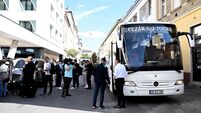
Higher Education Minister Simon Harris (right) visits the site in Seoul's Itaewon neighborhood where 159 people were killed in a Halloween crowd crush last year. Irish man Kevin Conlon (left) has a business in the area.
Ireland and South Korea have many similarities was one of the key messages delivered as part of the Government’s first trade mission in Seoul.
But the countries are very different when it comes to the services provided by the State, the treatment of its citizens, and safety.
Taoiseach Leo Varadkar, on the last day of his visit to Seoul, said he was pleased to meet the small but vibrant Irish community in Korea, to hear about their stories, and to witness the bond they have with their new home.
Life for the Irish in South Korea is very different from that in their home country. In fact, it’s a wonder why more Irish aren’t here due to the quality of life, despite the threat of North Korea.
Although inflation is beginning to be felt in the centre of Seoul, citizens and foreign nationals living there are attracted to the cost of living, safety, and social medicine.
Much like back in Ireland, housing emerged as a critical issue in last year’s presidential election as millions of Koreans struggle to get on the property ladder.
But, unlike at home, the 26 million people living in the Seoul greater metropolitan area live and rent in apartments with a price range of between €500-€600 for a studio apartment, something unheard of in Dublin or other cities in Ireland, where costs are an average of double that.

South Korea has also previously ranked first in the OECD for healthcare access; one of its biggest advantages is social medicine. One Irishman explained how Koreans and Irish people living here primarily go to hospital quite frequently for health checks and receive a sufficient and quick service as a result of their financial contribution.
This leads to an unnecessary number of visits to hospitals but sick people don’t face waiting days to get a bed or lying on a trolley in a hospital corridor. Health insurance helps but accessing health services at hospitals is quick and cheap, as easy as having the option to get a procedure done the same day a patient makes an appointment.
One of the biggest advantages of living in South Korea, particularly Seoul, is the low crime rates and the premium safety and security felt by those residing there.
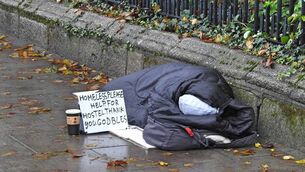
Unaccompanied teenagers can socialise in the city centre in the evenings without any real fear of an unprovoked attack. The city has no patience for drug use and the elderly population is very well thought of with grandparents put on a pedestal. A very different scene to that in Ireland at this present time.
In contrast, the major political issues facing this current government is access to healthcare, the cost of living and increased safety concerns. In his remarks made at the Team Ireland Reception in the Conrad Hotel in Seoul on Thursday night, Mr Varadkar told potential business partners that the State is “working hard to position Ireland as the place you want to invest in and do business with.”
However, despite the many fantastic things Ireland has to offer to businesses such as a stable economy and being an English-speaking country with close ties with the US, it’s hard to defend doing business here is not without its challenges, particularly with the housing crisis.
Although government ministers held numerous engagements with high-level political and commercial officials in a bid to expand investment, trade and employment, perhaps while flying home from Seoul last night, they were given food for thought about how they should examine challenges back at home in terms of healthcare, crime and housing after their visit to Seoul.
Nonetheless, the trade mission, the first of its kind, could yet prove to be successful for this Government. South Korea is home to the largest and most influential companies in the world now like Hyundai, Kia, LG and Samsung, enormous global companies that have huge reach.
“And in many ways, the South Korean mindset to business is very similar to Ireland's,” Trade and Enterprise Minister Simon Coveney said.
This is the second-largest supplier in the world of electric vehicle batteries, the largest supplier of televisions in the world. So it's a big, big market for items and for the companies we have here,” he added.
Agriculture Minister, Charlie McConalogoue, held several meetings in a bid to penetrate the beef market in South Korea which, if successful, would be a major win for Irish farmers.
He admitted it was “not possible” to put a timeline on when Ireland’s application might be accepted as it is “in the hands of the political system” in South Korea.
“It’s really a new approach to how we do trade and political missions,” the Taoiseach said.
He said trade between the two countries has increased fourfold in the past 10 years and now there were great opportunities for farmers and the food industry as well as big opportunities around education and research with Ireland's universities and language schools.

“Trade Mission Week allowed me and my Ministerial colleagues to meet with important Korean decision-makers and business leaders. I explained Ireland’s story as an innovative country with a proven track record and a world-class supplier of goods and services, and an internationally renowned investment partner,” Mr Varadkar said.
On his second day in Seoul, Mr Varadkar held a bilateral meeting with South Korea’s president, Yoon Suk Yeol. Among the issues discussed were gender equality and LGBT rights in the context of the societal progress Ireland has made in the last 20 years.
The global impact of Russia’s war on Ukraine was a major topic of discussion, along with the escalating conflict in the Middle East, the humanitarian crisis in Gaza, and the Hamas attack on Israel.
“Relations between Ireland and Korea are excellent and have never been stronger. In my meeting with President Yoon we discussed how we can deepen our political, economic, educational, and cultural ties,” he added.
He extended an invitation to President Yoon to come and visit Ireland. Let’s hope if he does come, he will find our country just as attractive as some of our politicians claim it to be.

CONNECT WITH US TODAY



Be the first to know the latest news and updates