Ukraine’s long-awaited counteroffensive has finally begun — but to what end?
Although its strategic objectives remain unclear, there are legitimate reasons behind the timing for this counteroffensive by Ukraine against Russia.
Ukraine’s long-awaited counteroffensive has finally begun — but to what end?

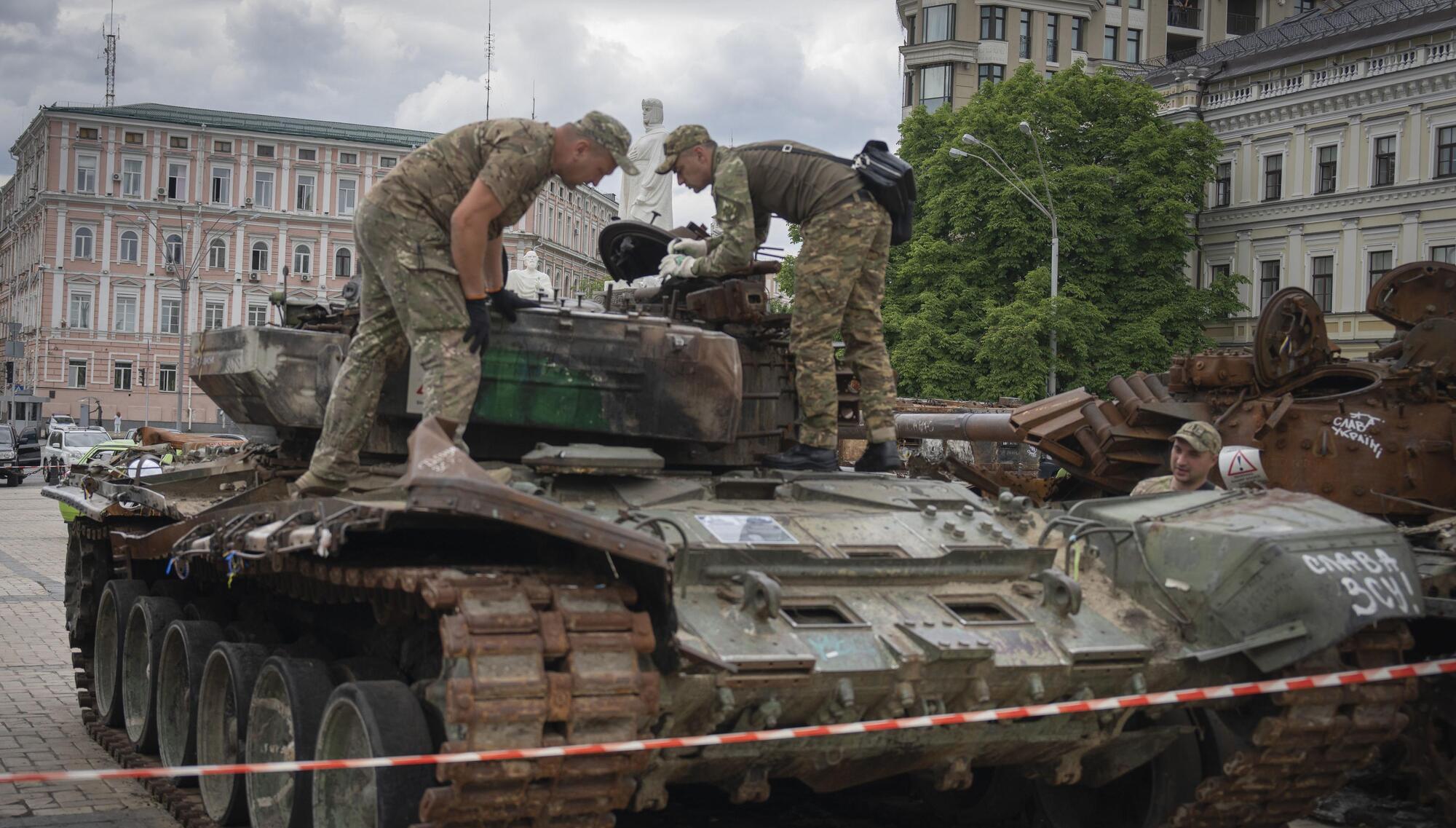
Sappers inspect a damaged Russian tank installed as a symbol of war in central Kyiv, Ukraine. Picture: Efrem Lukatsky/AP

A few days into the news that the Ukrainian/url] army has recaptured territories from the Russian occupying forces, Kyiv’s counteroffensive still has plenty to intrigue us. 

Announced in autumn 2022, this summer 2023 campaign has been a long time coming. So much so that it almost came to seem like Godot in Samuel Beckett’s play: its arrival seemed imminent, but never came. At the beginning of June 2023, it appears to have finally averted the “Godot curse”. 

The Russian Ministry of Defence, then Kyiv officials, have admitted that it has indeed begun.

The reason why Ukraine has been trumpeting about this large-scale operation for so long, without it actually materialising, is that, at the tactical level, it is essential to keep the details of the military action vague so that it can benefit from the element of surprise. 

Why now?

However, a number of questions remain about this counteroffensive.

Why this summer and not later? After all, waiting a little longer could have enabled the Ukrainian army forces to enjoy the military equipment promised by the West. Sanctions, as well as the sheer weight of an occupation that now spans 20% of the Ukrainian territory, could have further sunk the Russian war effort.

Secondly, and most importantly, what are Kyiv’s strategic objectives? Is it to seek a decisive victory? Or is it to prepare the ground for negotiations in which Ukraine would enter from a position of strength? By speculating on the ‘when’ and ‘where’ of these operations, we may have neglected to consider the ‘why’.

The launch of the counteroffensive was discreet and gradual. But it followed a carefully-considered timetable and geography.

The timing depended on a number of internal and external considerations.

For the Ukrainian military command, it was essential to maintain and amplify the momentum gained by the recapture of Kherson and the long blockade of Russian forces in the battle of Bakhmut. At the end of the winter and the thaw, the Ukrainian armed forces took the initiative.

A Ukrainian soldier on the frontline near Bakhmut, in the Donetsk region, Ukraine, on June 5, 2023. Picture: Iryna Rybakova via AP

There are a number of advantages: the state of the terrain — neither frozen nor muddy — means that forces are more agile, giving them the opportunity for surprise and breakthrough; the gradual arrival of military equipment; and the fact that the tactical roles have been reversed, with the Ukrainians now leading the offensive and the Russians defending.

In other words, the timetable for operations will no longer be dictated by the Kremlin, but by Kyiv’s tactical analyses.

Political dimension

From a political viewpoint, the timing responds to several imperatives.

Ukraine’s general elections have been slated for the autumn: the outgoing president cannot move toward that deadline without attempting to recapture occupied territories.

When it comes to Western opinion, the start of the invasion and the discovery of war crimes committed by Russia are still sufficiently fresh for there to be no ‘Ukrainian fatigue’. Within European governments, support for the Ukrainian state remains massive and unquestioned.

Above all, Ukraine had to attack before the United States embarked on its pre-election schedule in the autumn. Indeed, there is no doubt that American politicians, once launched into the presidential campaign, will either forget about Ukraine or debate the funds granted to Ukraine to defend itself.

Ukrainian president Volodymyr Zelenskyy gestures during a meeting with US president Joe Biden on the sidelines of the G7 Summit in Hiroshima, Japan, on Sunday, May 21, 2023. Picture: Susan Walsh/AP

The chosen geographical areas also make sense, beyond the element of surprise necessary for the success of such operations.

It would appear Ukrainian forces are attacking in the south, towards Crimea, but also in the Donbas region and Bakhmut area in particular. 

The destruction of the Nova Kakhovka dam has helped to build up a Russian “bastion” beyond the Dnieper river. But it would also be mistaken to overestimate its impact: in any case, the Ukrainian armed forces would have had to cross the Dnieper line under challenging conditions.

For the Ukrainian army, the focus is now on preventing a possible Russian advance towards Odessa in the south-west, make its presence felt in the south and take back the illegally annexed Donbas region.

By dint of wondering about the “when” and “where” of this counteroffensive, we have put the structural reasons for this operation on the back burner. After all, launching the reconquest with weapons in hand was no easy task. Since the beginning of the invasion, Ukraine has suffered considerable human, territorial, financial, and industrial losses.

If the Ukrainians have decided to take action now, it is because they believe that the Russian Federation is neither on the brink of economic collapse, nor of a political revolution, nor militarily demobilised. Expecting salvation from sanctions, hypothetical regime change, desertions, or the exhaustion of the Russian defence ecosystem is, in Kyiv’s eyes, illusory.

On the other hand, the counteroffensive depends upon a certain view of relations with the United States, Nato, and the EU: Kyiv believes that the country receives all the more support the more it shows its determination to recover its sovereignty by its own means. And it is right to do so: the West sent out the bulk of its financial and military aid after Ukraine managed to save its capital from occupation in April 2022.

What will be the outcome of these operations by Ukrainian forces? 

While tactical successes and setbacks are unpredictable, strategic gains can be estimated. Two major options are now open.

Either the Ukrainian offensives make real inroads into some of the territories conquered, occupied, and fortified by the Russian armed forces, and then the war will take a real turn in 2023. 

If these breakthroughs are successful in the Donbas, Ukraine will be able to consider that it has won a decisive battle by preventing the enemy from turning the eastern part of its territory into an annexe of mainland Russia. 

Cancelling, at least in part, the illegal annexations of September 2022; challenging the integration of the Donbas into Russian territory; inflicting a blow to the separatist militias … these are the outcomes that could prevent Ukraine from being partitioned. 

If the offensives succeed in the south of the country, the fate of Crimea, annexed in 2014, will be called into question.

A Ukrainian soldier carries a US-supplied Stinger as he goes along the road, in Ukraine's eastern Donetsk. Picture: Efrem Lukatsky/AP

The other alternative would consist of questionable successes on the military front. 

In this case, after the 2023 general elections in Ukraine, the strategy of war of attrition will undoubtedly prevail. Forced to recognise their powerlessness in the current state of affairs, the Ukrainian authorities would then have to re-examine their position in order to regain their territorial integrity: taking a long-term view, nibbling into Russian strongholds, exerting diplomatic pressure, engaging in partial negotiations, etc.

If the head-on strategy fails, a strategic rethink will have to be considered. But the fact is that the Ukrainian authorities have chosen a massive and rapid reconquest as the horizon for 2023.

No 'decisive battle'

The military operations currently under way call for the utmost caution.

It is neither written that this counteroffensive will break down Russian defences nor that it will lead to a complete recapture of the territory. 

Surprises can arise from a number of factors, including direct and official involvement of Belarus, Ukrainian strikes deep inside Russian territory, disinformation campaigns to discredit individual Ukrainian officials, and internal struggles within Russia, among others.

But we also know Ukraine will not resign itself to territorial amputations without a fight. This promises a protracted war effort, given the scale of the territorial losses and the Russian war effort. 

And the search for a “decisive battle” is illusory: Moscow was fooled into thinking it could take Kyiv in a matter of days. Kyiv is well aware that several waves of offensive action are needed to challenge the Russian occupation.

  • The Conversation

More in this section

Revoiced

Newsletter

Sign up to the best reads of the week from irishexaminer.com selected just for you.

Cookie Policy Privacy Policy Brand Safety FAQ Help Contact Us Terms and Conditions

© Examiner Echo Group Limited