Pádraig Hoare: How many more climate reports do we need before world leaders act?
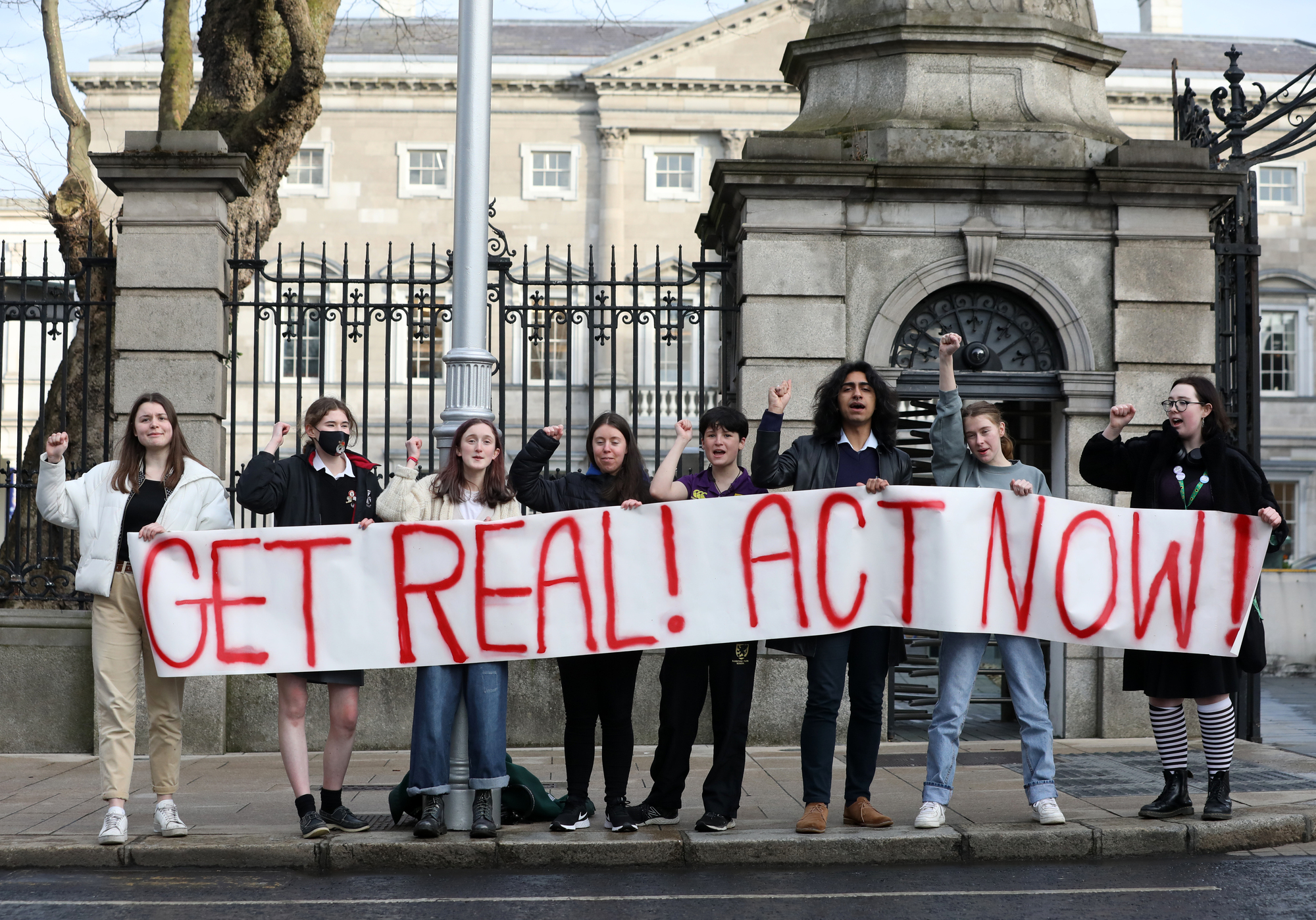
Following the publication of the IPCC report this Monday, Fridays For Future Dublin held a snap demonstration at the gates of Leinster House to protest the lack of action in relation to climate change. Photo: Sasko Lazarov/RollingNews.ie
Good scientists aren't prone to hyperbole, typically detesting media sensationalism and anti-intellectual rhetoric - so when some of the world's finest minds say we're hurtling towards self-destruction, it's worth paying attention.
This isn't the first rodeo for the hundreds of scientists across the world forming the UN's Intergovernmental Panel on Climate Change (IPCC). How long, how long must they sing their song, before world leaders and the lay public alike listen to their grim words?
The planet has already passed the point of no return for some of the effects of climate change and has a narrow window to avoid even further pain for billions of people.
While to some it may sound like sensationalism and doom-mongering, the 34,000 cited references in the IPCC report put together by professors, doctors, and other experts in their field tell a different story - this is pure science.
Professor Debra Roberts, co-chair of the IPCC, said: "Our report clearly indicates that places where people live and work may cease to exist, that ecosystems and species that we've all grown up with and that are central to our cultures and inform our languages may disappear."
Academia, for all its faults, has no time for sentiment - the conclusions are based on cold, clear, and unambiguous evidence.
"Increased heatwaves, droughts and floods are already exceeding plants’ and animals’ tolerance thresholds, driving mass mortalities in species such as trees and corals.
"These weather extremes are occurring simultaneously, causing cascading impacts that are increasingly difficult to manage. They have exposed millions of people to acute food and water insecurity, especially in Africa, Asia, Central and South America, on small islands and in the Arctic,” the IPCC said in its latest findings.
This, bear in mind, is less than eight months since its previously grim projections of passing 1.5 degrees global warming, and less than four months since world leaders at Glasgow's Cop26 climate change summit pledged to cooperate to radically reduce global emissions in the coming decades.
How long, how long must they sing their song?
Since Cop26, we have a US Congress strangled by political posturing from a maddeningly anti-science Republican Party, and a ruling Democratic party held to ransom by two of its own senators, Joe Manchin and Kyrsten Sinema, blocking President Joe Biden's already weakened climate mitigation package from passing into legislation.
In Europe, we see emissions return to almost what they were pre-pandemic and closer to home, no consensus on tackling emissions from agriculture in Ireland because of the political fallout.
More pressingly, the IPCC report this week must fight for every inch of newspaper space and every minute of television time due to the actions of a reckless Russian president in his neighbouring Ukraine.
Poignantly, the tragedy of Ukrainian refugees will be replicated over and over again in the future as communities all over the world are forced from their lands because of a force even more powerful than Russian tanks and mortars - the force of climate change.
It is also sad that Russia's dominant position when it comes to oil and gas has emboldened Vladimir Putin's imperial ambitions, gambling that he would ride out the storm geopolitically because of the West's reliance on fossil fuel.
If environmental factors weren't reason enough to strive for a renewable energy future, then geopolitical reasons have now bolstered the case.
Unfortunately, the perilous change in climate doesn't hang around for political cycles. It doesn't stop for peace talks or ceasefires. Hurricanes don't take breaks to go campaigning, monsoon rains don't stop for election day.
Climate change just marches on, growing stronger from the insidious energy that humans feed it. When we talk about saving the planet, we aren't talking about the big blue sphere on which we eke out a brief existence - that will be just fine.
It's the people living on it, and the animals and creatures that most of us profess to love and cherish.
CLIMATE & SUSTAINABILITY HUB
CONNECT WITH US TODAY



Be the first to know the latest news and updates