The golden years: how many All-Ireland medals have these Kerry stars won?
It is 50 years since Kerry's coming of age — when football’s ‘golden years’ begun in 1975.
The golden years: how many All-Ireland medals have these Kerry stars won?

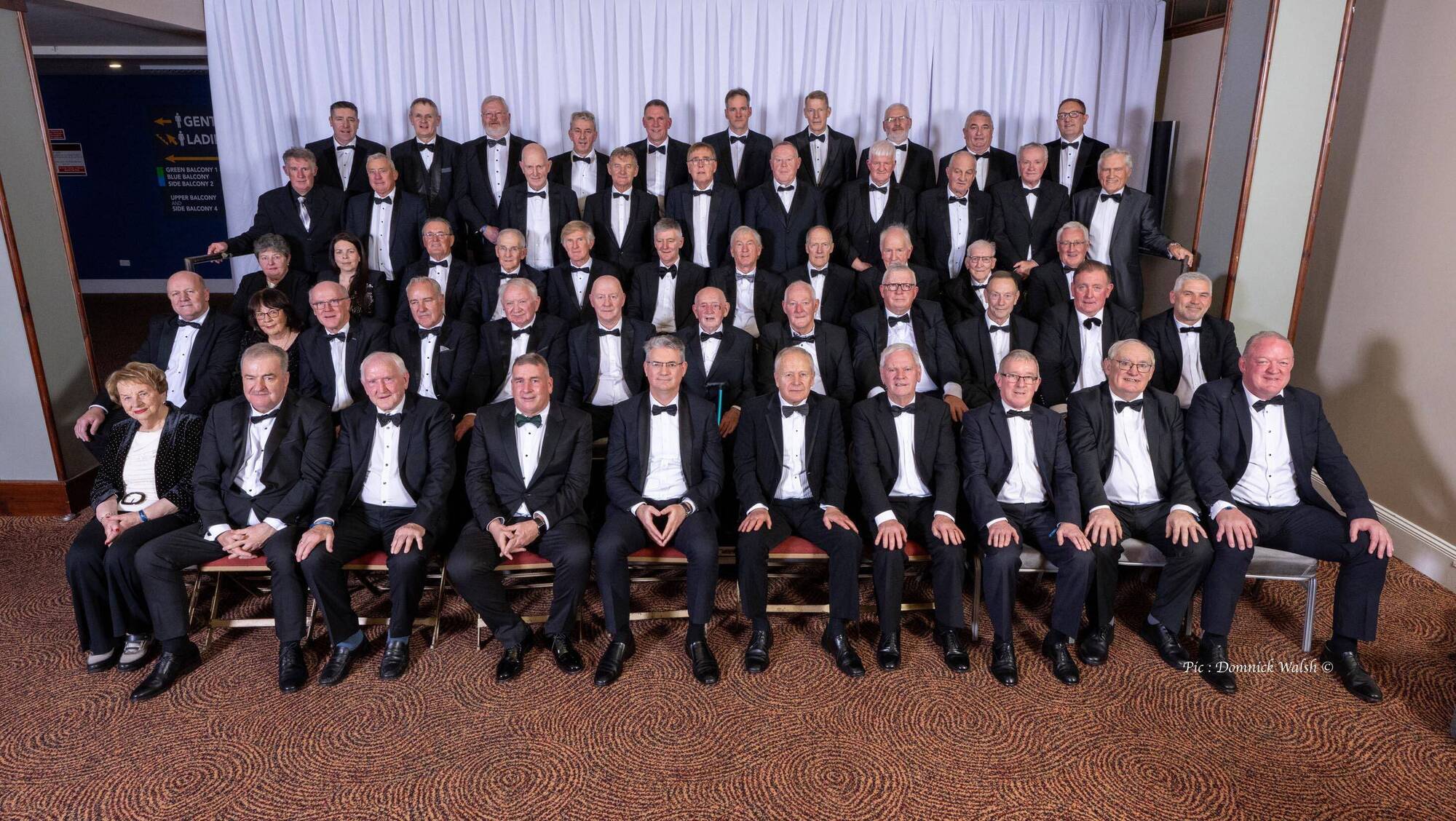
GOLDEN GENERATION: Front row, from left: Peggy King representing the late Kerry GAA chairperson Frank King, Willie Maher, Pat McCarthy, Patrick O’Sullivan (Kerry GAA chair), Edmund Scanlon (CEO, Kerry Group), Mickey Ned O’Sullivan, Kevin Griffin, John L McElligott, Johnny Mulvihill, Mick Galwey. Second row, l-r: Jack O’Shea, representative of John Long, John Higgins, Timmy Dowd, John Bunyan, John Kennedy, Eddie ‘Tatler’ O’Sullivan, Charlie Nelligan, Paudie O’Mahony, Tommy Doyle, Ambrose O’Donovan, Stephen Stack. Third row, l-r: Mary Egan representing the late John Egan, Claire Kirwan representing Sean Walsh, Patie O’Mahony, Brendan Lynch, Vincent O’Connor, Bernard O’Sullivan, Ger O’Keeffe, John O’Keeffe, Jimmy Deenihan, Pat O’Shea (Selector), Pat Spillane. Fourth row, l-r: Mick Spillane, Denis Ogie Moran, Ger O’Driscoll, Patie Mahony, Ger Lynch, Jerry O’Sullivan, Paudie Lynch, Batt O’Shea, Mikey Sheehy, Ger Power. Fifth row, l-r: Darragh Ó Sé representing Páidí Ó Sé, Karl O’Dwyer representing his late father Mick O’Dwyer, Eoin Liston, Pat Sheahan, Tom Spillane, Dermot Hannifin, Sean Liston, Donie Hartnett, Noel Kennelly representing the late Tim Kennelly. Pic: Domnick Walsh

THE great and the very good of Kerry football gathered last week to celebrate the 50th anniversary of their coming of age — when football’s ‘golden years’ begun in 1975.

Over the next 11 years, Kerry would win eight Sam Maguires, and notoriously denied a ninth and the five in a row by a last minute Seamus Darby goal for Offaly in the 1982 decider at Croke Park.

The occasion was a Gleneagle Hotel fund-raiser for Kerry’s Centre of Excellence at Currans, and the players of the golden years were formally recognised.

Chairperson of organising committee John O’Dwyer — fittingly son of the late Kerry manager Mick O’Dwyer — explained: “Earlier in the year, the minor team celebrated the 50 years, so it kind of emanated as a seed in [chairperson] Patrick O’Sullivan’s brain that we should do something to reflect the past, celebrate the present, and look forward to the future.

“We hope to raise a few euros as well for development in Currans, and also to celebrate the few that are still around. We’re missing a few — Páidí O Sé, Tim Kennelly, and John Egan — who have passed.”

Fighting fit however was ‘the prince of fullbacks’ John O’Keeffe, who reflected on the 1975 triumph against all the odds.

“I would say the youth of the team was important,” he said. “I had played with the team of the 60s and early 70s, and was that bit older than most of lads. This was a complete new influx of young players. I suppose the vitality they brought to the whole scene. And the enjoyment as well, that we had in training and with Micko directing affairs.

“I don’t think it ever came into our conscience that we were going to win an All-Ireland. I think we were just beginning to get a team together and just let it happen.

“After a while, I think people realised, we realised ourselves that there was a lot of talent in that panel.

“And at that stage, I think the most important game for us really would have been the Munster final against Cork, who had beaten us quite regularly, just up to 1975. And little did we know that we were going to turn them over in that fashion in Killarney that summer.

“Even after that, I think we didn’t really know if we would be good enough. We never really discussed All-Ireland at that stage even. It was because everything was quite new to that squad. And apart from Brendan Lynch and me, all the others were new to the scene.”

On O’Dwyer, Johnno reflected: “I felt with Micko, we felt very self-assured I think with Micko. Because we knew that he had been an outstanding player himself and I knew him quite well. And any ideas he brought to the training sessions, we totally bought into them. Everyone felt like this was the right direction to go in.

“And it was quite obvious at that stage that Micko, I think he felt that I have a lot of talent here. These are really skilful players, so let’s get them fit.

“I think he heard on the grapevine that there was a lot of physical work going on in Dublin as well by Heffo. So Micko, I think he said, ‘look, if we want to match Dublin, we have to be as fit as them’. And at that stage, Dublin were four or five years ahead of us in maturity. So strength wise and fitness wise, he realised that we need to get up to that mark to compete with them. We all bought into that idea without a problem.

“And then it became obvious, because we used to play a lot of backs versus forwards in training. And the fact that we as backs had to match up with an outstanding forward line brought us on. But I think it brought the forwards on as well.”

O’Keeffe felt that 1975 win over the Dubs laid the foundations for the glory years that followed: “The win did a lot for us, even though the average age of the team was quite young. Maybe we weren’t mature enough to realise that this was not going to happen. We’re not going to turn teams over that easily.

“It just seemed to come together very easily for us in 1975 for some reason. But it’s so difficult to replicate it. I think we got our lessons in 1976, 1977. But the team was so young that there was time for maturity. There was no doubting the talent in the team; it was just a matter of putting it together. And Micko was the right person at the time.”

It is well remembered that a move against O’Dwyer was barely suppressed after the 1977 semi-final defeat to the Dubs.

“No, there was definitely no player unrest,” O’Keeffe stresses. “I think looking back, we didn’t realise there was that type of pressure on Micko at that point. We had total confidence in him. And I think [chairperson] Gerald McKenna really grasped that as well.

“There was no doubt that we would have been very disappointed if Micko was ousted at that stage. We had no inkling that was happening in the background.

“There was one thing about Mick O’Dwyer; we did an awful lot of kicking, just accurate kicking. In between hard runs or even in the warm-ups and that, there was always about 15-20 minutes kicking, catching, kicking, unopposed. Huge emphasis on finding your man and that with 30-40 yard kicks. And that’s what you need in the modern game as well, isn’t it?”

More in this section

Cookie Policy Privacy Policy Brand Safety FAQ Help Contact Us Terms and Conditions

© Examiner Echo Group Limited