Daniel McConnell: Severe consequences are promised, but what can Ireland do?
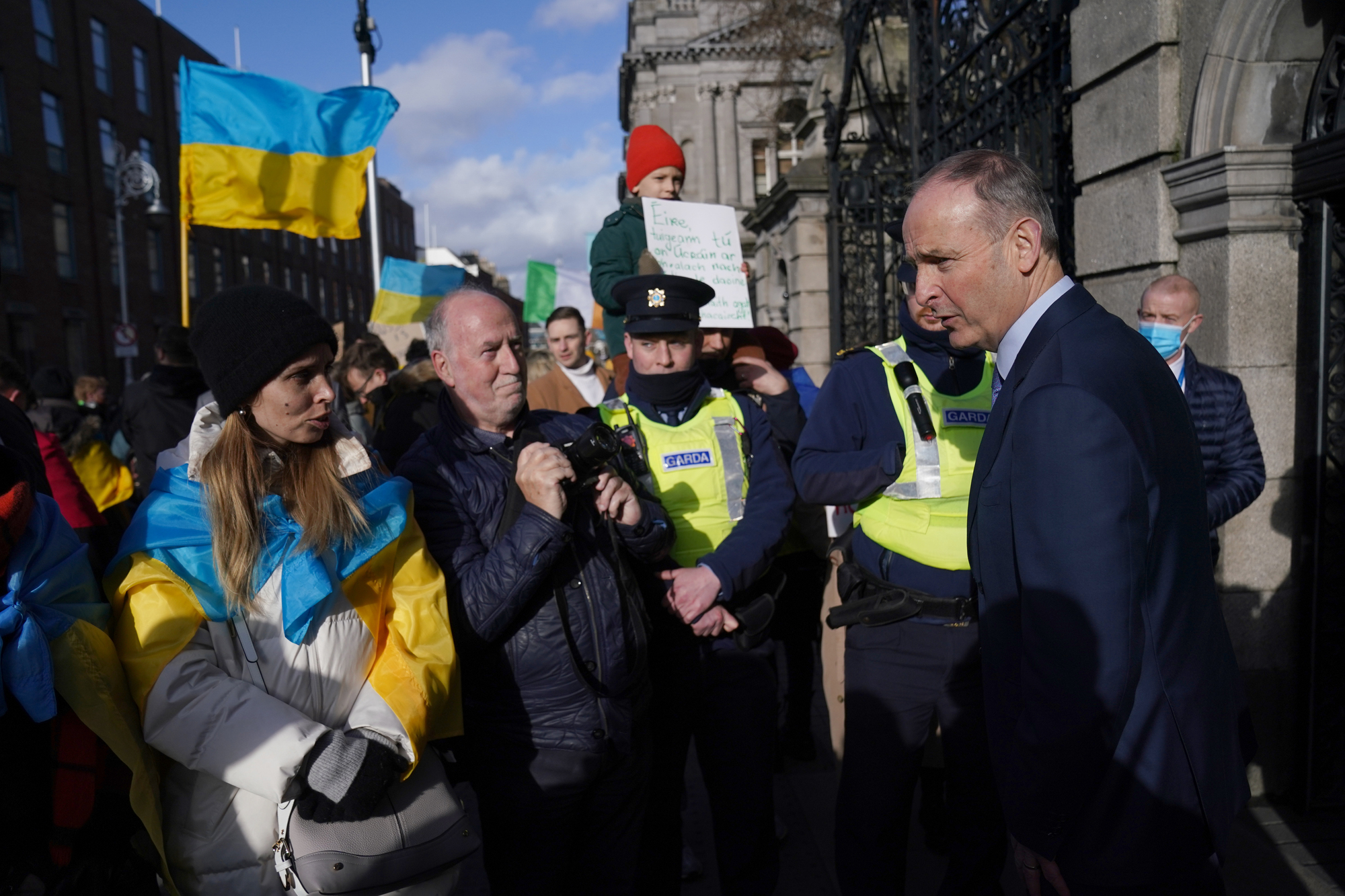
Taoiseach Micheál Martin meets people attending a demonstration outside Leinster House to protest the Russian invasion of Ukraine. Mr Martin was strident in his criticism of Russia. Picture: PA

As we all awoke yesterday, the sense of disgust toward Russia’s invasion of Ukraine was nearly universal.
A rare moment of consensus emerged not just on the Irish political system, but throughout the EU.
Since the Russian military exercises saga off the Cork coast a few weeks ago, a much greater debate on Ireland’s defences has begun.
This is especially so because now we find ourselves standing in Europe in a post-Brexit world without the aid of our nearest neighbour.
As we watched the shocking footage of the invasion on Thursday, there was plenty of tough-talking from leaders such as EU Commission president Ursula von der Leyen, US president Joe Biden, and British prime minister Boris Johnson about how this aggression would not stand.
An emergency summit of EU leaders was called in advance but also in anticipation of Vladamir Putin’s aggression.
What is now patently clear is that Putin, despite intense efforts by the likes of French president Emmanuel Macron to avoid war, was hell-bent on invasion all along.
At home, Taoiseach Micheál Martin was strident when speaking to reporters and in his criticism of Russia. Especially so when you consider Ireland’s long-held neutral status.
The Taoiseach said the additional sanctions under consideration in Brussels against Russia, Putin, and his “henchmen” will be “the most severe package we have ever considered”.
Such sanctions will target strategic sectors of Russia’s economy, blocking access to markets and technologies to weaken Russia’s economic base, he said.
“President Putin and those who support him will be held accountable,” he said.
“It will be aimed to hit Putin and his henchmen where it hurts the most. Actions have consequences and the consequences for them will be severe.”
Asked whether Russia’s ambassador is about to be expelled, the Taoiseach said that was one of many options under consideration. Of the ambassador, Mr Martin was as cutting as he has ever been about a political figure.
“He represents a government that has lied to the world and the people he engaged with,” he said.
“The intelligence, let’s be frank, was saying this was planned for quite some time. This was denied by the ambassador, the representative of Russia, even though they clearly were planning such a comprehensive attack.”
This hardline stance from Mr Martin was in line with the strong tone he adopted in Berlin earlier this week when he stood beside German chancellor Olaf Scholz as the latter announced the freezing of the Nord Stream 2 gas pipeline.
Again, one suspected that Mr Martin feels the need to take a harder line to allow us to recalibrate our position in Europe post-Brexit.
Foreign Affairs Minister Simon Coveney was equally blunt in his comments on morning radio shows, saying Ireland cannot be neutral in the face of such aggression toward Ukraine.
He said although Ireland is not militarily aligned, the State is not neutral, and Russia can expect retaliation.
“When some people read the question of Irish neutrality, yes, Ireland is a neutral country,” he said.
“We’re militarily non-aligned, but we are certainly not neutral on an issue like that when there is blatant aggression happening on the continent of Europe.”
The opposition was, for once, in near unison when it came to condemning Russia’s aggression.
Following a period of prolonged selective mutism on this issue, Sinn Féin joined the ranks of condemnation. Their belated conversion was not immune to criticism from Tánaiste Leo Varadkar, who used the occasion to score some cheap political points on Pearse Doherty.
Up to 10,000 Ukraine nationals live in Ireland and about 100 of them gathered in freezing conditions outside Leinster House to plead for help. Mr Varadkar went out to meet them, but conceded there is little, if anything, Ireland can do.
Many Ukrainians want to get out of their country, as nobody will want to live under a Putin dictatorship. This is a major refugee crisis for which Europe is frankly very ill-prepared.
As former UK ambassador John Everard said, we’re now well beyond the stage where sanctions will have any kind of effect.
Mr Coveney conceded as much during an afternoon radio interview.
While the sanctions announced are a major economic blow to Russia, that rests on the very shaky assumption that Putin gives a fig about the Russian economy, as Mr Everard put it.
Quite clearly he doesn’t, and like in the 1930s, we are facing the inevitability that only military force will be enough to stop this large aggressor in his tracks.

CONNECT WITH US TODAY



Be the first to know the latest news and updates