Dorcha Lee: Russia and Belarus pile the pressure on Baltic states
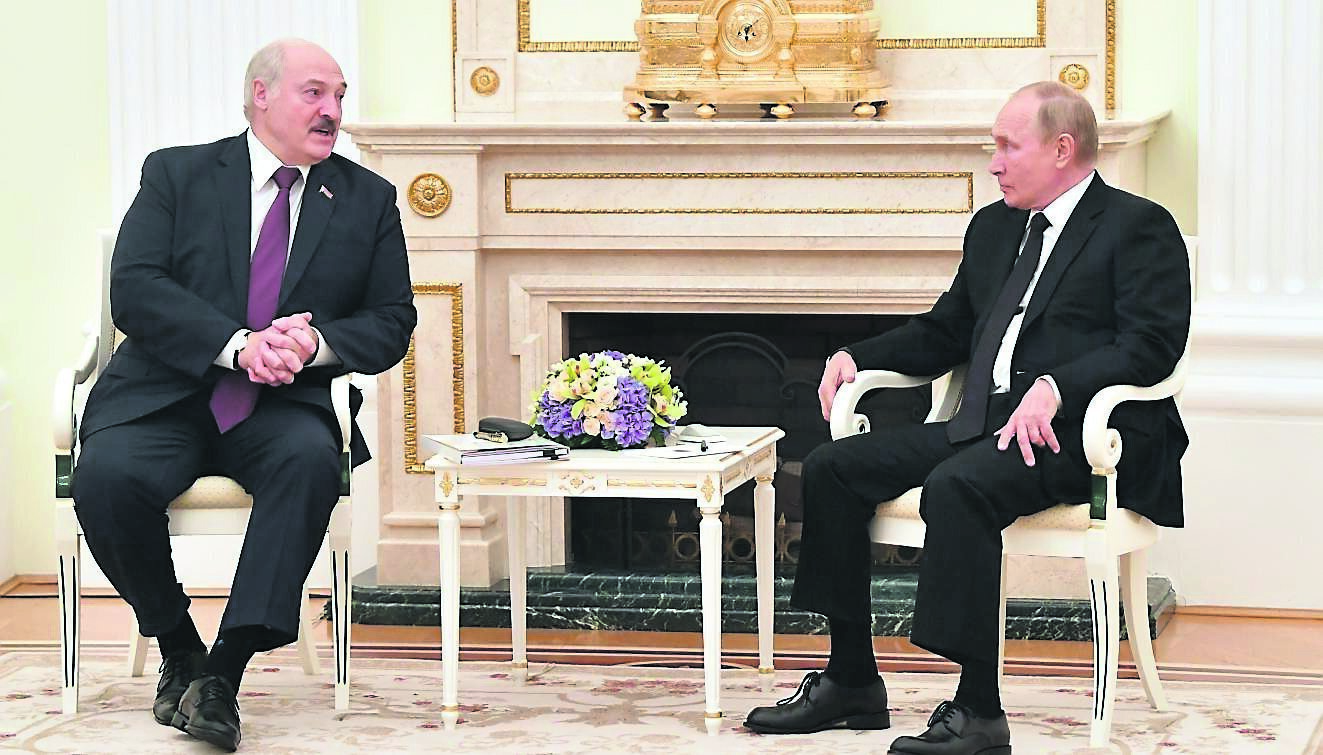
Belarusian president Alexander Lukashenko and Russian president Vladimir Putin struggle to contain the eastward spread of Western influence and, in turn, direct their hybrid war against Lithuania, Latvia, and Estonia — the front line of the new Cold War. Picture: Mikhail Voskresensky/AP
The spotlight of international attention flickers sporadically along the front line of the new Cold War. From the Baltic to the Black Sea, Russia is struggling to contain the eastward spread of Western dominance, over lands and peoples that once were in its sphere of influence. These same countries are equally trying to consolidate their independence from Russia. For most of these nation states, membership of both the EU and Nato remains the dream ticket to freedom.
Russian president Vladimir Putin is an accomplished judo player who faces his opponents with the patience, concentration, and steely discipline of this martial art. His strategic objective is to reunite ethnic Russian speakers under the banner of Mother Russia, including restoring Russian historical hegemony over those countries of Eastern Europe that were previously under Soviet or Russian influence.Â
That influence has already being enhanced in the Donbas region of Eastern Ukraine, in a proxy war that has claimed 14,000 lives since 2014, and also in Crimea, where Russian military intervention went unchallenged. In Georgia, Russia has increased its control of Abkhazia and South Ossetia, in the aftermath of the 2008 Russo-Georgia War.
The unrelenting Russian pressure of hybrid warfare continues to be directed at the three Baltic States — Lithuania, Latvia, and Estonia. Hybrid warfare, in this case, includes the build-up of Russian forces on the borders of the Baltic states, combined with state-sponsored cyberattacks and misinformation campaigns from Russian media and websites.

Following last year’s political crisis in Belarus, Lithuania backed the Belarus opposition. President Lukashenko sent his troops to reinforce the 679km border with Lithuania, ostensibly to guard against any incursion by Nato-backed Lithuanian forces. This is not so far-fetched as it sounds: There was some discussion, last year, that Lithuania might create a safe corridor in Belarus for opposition members and their families to flee the regime. Fortunately, wiser counsel prevailed.
However, president Lukashenko’s diversion of a Vilnius-bound Ryanair flight in May to the Belarus capital, Minsk, in order to arrest a Belarus dissident, could well become the catalyst for his downfall.Â
The consequential EU sanctions will ultimately hurt his regime. Lukashenko could not have picked a more popular airline in Europe. Ryanair has long become a potent symbol of freedom to travel for all Europeans.
Lukashenko responded to the EU sanctions by allowing thousands of migrants to cross from Belarus into Lithuania, even facilitating the movement of Iraqi and Afghan migrants by increasing the number of weekly Baghdad-Minsk flights from one to five.Â
Both sides have closed the border, as best they can. The Belarus border force has already ended cooperation with its Lithuanian counterpart. The Lithuanians are at their wits end on how to respond to the migrants, being torn between fear and compassion. In the meantime, international TV crews are snooping around at night with flashlights, in the Border area, searching for groups of migrants to interview.
Of the three Baltic states, Lithuania is particularly vulnerable to possible Russian intervention through Belarus, across the southern Lithuanian road network to seize the port city of Klaipeda.Â
With a supporting attack from the Russian exclave of Kaliningrad in the south, they would have a clear run to the Baltic Sea. The landscape in Southern Lithuania is so flat as to be virtually undefendable. The few hillocks along the route, still have the shattered concrete remains of Second World War defensive positions.
Nato membership is essential for all three Baltic republics to maintain their independence. In view of the increased level of Russian activity, Nato has assigned a battle group of approximately 1,000-1,200 troops to each of the three states, and in Poland. These battlegroups are multinational. They are not strong enough in themselves to make a material difference in the event of a Russian intervention but, crucially, would serve to ‘multinationalise’ the situation.
Unless they have time to build up conventional forces in the area, the three Baltic states could be overrun in a matter of days.Â

Unfortunately, Nato has let its conventional military capabilities decline over decades, to the point where the only remaining Nato option to stop a Russia advance now, would be to use tactical nuclear weapons. This would be a US decision, which would not be taken lightly, knowing that Russia is the only country in the world capable of destroying the US with its nuclear and thermonuclear arsenal.Â
As in Afghanistan, Somalia and Vietnam, the US will ultimately put its national interest first. Would president Putin risk intervening in the Baltic states? I think not, unless he is sure of winning without provoking a nuclear response.
In the interest of peace and stability, direct conflict between Russian and Nato forces — on land, sea, or in the air — must be avoided at all costs.
•Â