Spirit of 1968 still has the power to inspire
Ten years before Thatcher and Reagan lurched the world to the right, the young people of Paris took to the streets with a very different view of the world, says
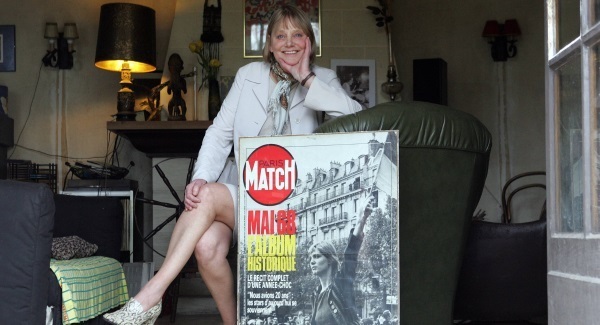
Today, Caroline de Bendern, a British woman, is 77 and lives in France.
A former fashion model, it was while she was pursuing that career in Paris during the tumultuous events of May 1968 that a photograph of her went viral (though of course that word wasn’t in common usage back then).
“Recreating a 19th century masterpiece of ‘Liberty leading the People’, a statuesque portrait of Caroline de Bendern emerged as a defining image of the protests that swept Europe in the summer of 1968,” wrote Abigail Frymann Rouch in The Guardian last year after interviewing Ms de Bendern as she prepared to carry an EU flag in an anti-Brexit march in London.
But it was in Paris 50 years ago that the then young model first symbolised the national mood.
“The image of her holding the Vietcong flag — at the height of opposition to the US war against Vietnam — over a sea of young protesters, was reproduced worldwide.”
Last week, during five days in the French capital, I saw that image again on newsstands as papers such as Le Monde, Le Figaro, and Liberation used it to advertise supplements to mark the 50th anniversary of protests, demonstrations, and violent street clashes that evoked memories of the Paris Commune of 1871.
In May 1968, 27-year-old de Bendern was a fashion model living in the Latin Quarter, near the Sorbonne University, which would become one of the centres of the student protests.
She was really an innocent bystander until, on May 15, she decided on a whim to join a march to the Place de la Bastille, where the French Revolution started on July 14, 1789. When she got there, one of the student leaders hoisted her on to his shoulders and asked her to hold a flag for him.
“The flag of Vietnam suited me,” de Bendern recalls years later. “In protest against the Vietnam War.” Within minutes, the attractive blonde Englishwoman was surrounded by photographers.
“The instinct of the fashion model that I was awoke in me. I started to play a role. Lots of ideas went through my head. I even thought of the French Revolution — me the daughter of a good English family! My body stiffened. I held my arm up and my expression became serious. That’s when the photograph was taken.”
Fifty years on, May 1968 remains a watershed moment. Some galleries in the city have mounted exhibitions, and the black and white photographs of students in the Latin Quarter ripping up cobblestones and tossing them over barricades at riot police are emblematic of a defining episode in modern French history.
And the photograph of de Bendern — which has been compared to the famous 1830 Eugène Delacroix oil painting, ‘Liberty Leading the People’, — remains the single most enduring image.
Looking back, she says she never regretted her involvement.
“We were bubbling with dreams,” she says. “The world was opening up to us. Young people felt strong, inspired and also impatient.”
The protests had started at the university faculty at Nanterre on the outskirts of Paris. In his book, The History of Modern France, Jonathan Fenby says student discontent was spurred on by overcrowding and the selection process backed by the government of Charles de Gaulle, who had been president of France for 10 years.
Fenby writes: “The faculty in the Paris suburb of Nanterre became the fulcrum of agitation stemming from anger at rules in sexually segregated hostels where students were not allowed to receive visitors in their rooms or make any alterations such as hanging pictures.
“A galaxy of groups mobilised, calling for a new social and human order with a greater place for the individual.” Among the leaders of this galaxy was a red-haired, baby-faced German student. He was 23-year-old Daniel Cohn-Bendit, who would soon be nicknamed ‘Danny the Red’ by the media. Today he is an MEP for the German Green party.
But the real problem was the ageing man in the Elysee Palace.
“In the tenth year of his governance of France, the 77-year-old President of France had lived too long in his own cocoon,” according to Fenby.
“How could he grasp the appeal of the teachings of Herbert Marcuse, the Structuralists, and the other gurus of the protestors? As they got on a plane for a visit to Poland, Madame de Gaulle asked him joyously: ‘So, it’s true, you are going to ban miniskirts?’ Told that such a measure would not be feasible, she showed deep disappointment.”
Parallels with Éamon de Valera and the repressive climate of Ireland of the 1950s and 1960s spring to mind. In France, workers were to join the students; strikes were widespread, in the end involving 10m workers.
“It’s my departure they are calling for,” a dejected de Gaulle acknowledged to his ministers. On May 27, with the Communist daily L’Humanité calling for “a government of the people”, a deal was reached between the government, unions and employers for an average salary increase of 10% and a reduction in working hours.
As for the students, they won concessions from the education minister.
“At last, I have slept,” de Gaulle told Pompidou, his prime minister. An end to the protests, the sit-ins, and the factory occupations seemed in sight.
“Unconvinced, the CIA director Richard helms told Lyndon Johnson France was on the brink of disaster and possible civil war,” says Fenby. But the demonstrations petered out, and de Gaulle would hang on for another 11 months.
That impatience for change, for reform, that de Bendern talked about wasn’t confined to France in 1968.
“The turmoil left an indelible mark on France,” says Fenby, “which was echoed by events elsewhere — the Prague Spring, which would be put down by Soviet tanks, the campus revolts and anti-Vietnam demonstrations in the United States and cries for freedom on their own terms by young people in many other countries, primarily in the developed world.”
Things were also beginning to stir in Northern Ireland where young Catholics, drawing inspiration from the civil rights movement in the US and events in Paris, were starting to mobilise.
The first civil rights march took place in Derry on October 5, 1968, the marchers defying the ban on processions in certain parts of the city. Fifty people were taken to hospital after clashes between police and marchers.
A process was gathering momentum that would change the North forever — but at terrible cost in the end, when the peaceful movement for reform and constitutional change, spearheaded by the likes of John Hume, was hijacked by the Provisional IRA, who turned it into an “armed struggle” which their apologists continue to “justify” to this day.
Elsewhere, too, the desire for reform — and the violent opposition to it — would claim high-profile victims. A month before the protests and marches that brought Paris to a standstill, Martin Luther King — who had re-energised the civil rights movement with his famous ‘I have a Dream’ speech at a huge rally in Washington DC in 1963 — was assassinated (April 4, 1968) in Memphis.
And on June 5, 1968, Robert Kennedy, having declared himself a candidate for the presidency, was assassinated in the Ambassador Hotel in Los Angeles.
In a four-part Netflix documentary entitled Bobby Kennedy for President, one commentator, speaking in 1968, says that “no American in this century has ever been so likely to be president as Robert Francis Kennedy”.
The final line in the four-part series is Kennedy quoting Tennyson: “Come my friends,” he intones, “tis never too late to seek a newer world.”
It seemed for a while that such a world was possible — the students in Paris, as well as the marchers in Derry, certainly thought so. Instead, within just over a decade, we were in the era of Margaret Thatcher and Ronald Reagan where politics in Britain and in the USA moved sharply to the right.
CONNECT WITH US TODAY



Be the first to know the latest news and updates