How the storm grew over Team Sky
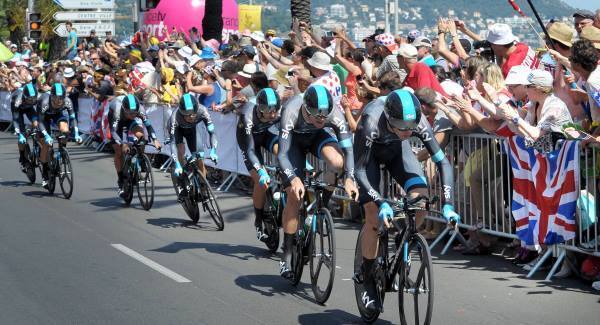
They claimed they’d do things different, cleaner than the rest. But Team Sky look like the dirtiest of all, writes Barry Ryan.

How the storm grew over Team Sky

They claimed they’d do things different, cleaner than the rest. But Team Sky look like the dirtiest of all, writes Barry Ryan..

Even in British cycling’s melodious summer of 2012, as Bradley Wiggins won the Tour de France with Team Sky and British riders dominated at the London Olympics, there were some discordant notes.

When Team Sky was launched ahead of the 2010 season, manager Dave Brailsford had announced the lofty objective of winning the Tour with a clean British rider within five years. He also claimed he would not hire doctors who had previously worked in professional cycling, supposedly to ensure that the sins of cycling’s doping past would have no place in his new team.

After a lacklustre inaugural season, however, Brailsford rowed back on that pledge, and began to appoint doctors already working in the peloton, including one Geert Leinders. In May 2012, it was reported that Leinders had been involved in the systematic doping programme in place at a previous employer, the Dutch squad Rabobank.

Questioned about Leinders during the 2012 Tour, Brailsford kicked for touch, vaguely pledging to launch an inquiry into the doctor’s precise role at Rabobank. Come the World Championships in Valkenburg that September, Brailsford was even more evasive.

“Well, I think we’re addressing the issue,” he said uneasily, before shutting down a follow-up question. “We’re here to talk about the Worlds, aren’t we?”

A couple of weeks afterwards, quietly parted company with Leinders, who would later receive a life ban for his activities at Rabobank. That autumn, meanwhile, as Lance Armstrong’s downfall dominated headlines, the team carried out a further, more public purge as it doubled down on its avowed ‘zero tolerance’ policy, firing two members of management who had confessed to doping as riders in the 1990s.

A glance at the staff and riders employed by Sky in 2012 suggests that Steven de Jongh and Bobby Julich were hardly the only men with questions to answer, but their dismissal seemed to play well at home. “Sky can claim to be delivering on their vow to build a scandal-free team,” wrote the Telegraph.Brailsford and Wiggins were knighted in the New Year’s honours list. The band played on.

Formal accusations

For Team Sky, the past 18 months of scandal have felt akin to the final adagio of Haydn’s ‘Farewell Symphony’, where, one by one, the musicians stop playing and leave.

With each fresh development, observers who previously lauded them as paragons of virtue have been quietly (or brazenly, as the case may be) walking those opinions back.

The British parliament’s digital, culture, media, and sport select committee report into doping in British sport, published on March 5th, contained relatively little new information about Team Sky, but the force of the MPs’ formal accusation of wrongdoing seems to have stopped the music altogether. The effect is only amplified by a separate but no less important blow to the team’s credibility.

In December, it emerged that Chris Froome, the man who succeeded Wiggins as Tour de France champion and Sky’s leader, had tested positive for salbutamol on last year’s Vuelta a España.

By now, there must scarcely be a sports columnist left in Britain who hasn’t called for Brailsford’s head. The fall in Wiggins’ stock has been just as precipitous. His carefully cultivated Mod styling and ‘just-a-lad-from-Kilburn’ schtick resonated with the British public — and advertisers — in a way the Kenyan-born Froome never could.

Froome has won the Tour four times, but Wiggins is the undisputed figurehead of British cycling’s golden era. The apogee came in July 2012, when the Sun printed cut-out Wiggins sideburns on its front page on the eve of the London Olympics.

In the wake of the select committee report, the same newspaper’s banner headline was blunt: “Wiggo doping shock: Sir Brad given power drug boost.”

As recently as Rio 2016, when he brought the curtain down on his career by becoming Britain’s most decorated Olympian, Wiggins was being feted as a national treasure. His long lap of honour was interrupted that September, when Russian cyber-hacking group Fancy Bears broke into the World Anti-Doping Agency’s (Wada) computer system and leaked details of therapeutic-use exemptions (TUEs) obtained by athletes from western countries, in apparent retaliation for Wada’s investigation of state-sponsored doping in Russia.

TUEs are dispensations granted to athletes to take otherwise banned substance to treat illness or injury, and some revealed by the Fancy Bears covered the seemingly banal, such as the administration of anaesthetic drugs during surgery.

Wiggins’ file, however, warranted closer scrutiny. On three occasions — June 2011, June 2012, and April 2013 — he had been granted dispensation to take an injection of the powerful corticosteroid triamcinolone acetonide. Wiggins claimed he had needed the drug to treat hay fever, but the NHS has long recommended against triamcinolone injections for that purpose due to the potent side effects.

The timing of each request was also curious. The 2011 and 2012 applications were made in June, just before the Tour, while the 2013 request came in April, immediately before the Giro d’Italia. In other words, before the main objective of each season.

In the peloton, triamcinolone is better known by the brand name Kenacort, and its renown has little to do with its anti-inflammatory properties. Kenacort and other corticosteroids have been used as performance enhancers since the 1970s, as they help to strip away excess weight without sacrificing power. Their value in the high mountains of the Tour, where power-to-weight ratio is the ultimate arbiter, is obvious.

Wiggins initially looked to dismiss the story, his representatives risibly claiming there was “nothing new” in the Fancy Bears hack. This was patently untrue. In his 2012 autobiography, Wiggins had gone so far as to claim that he had never received an injection.

Ten days after the story broke, Wiggins finally addressed the issue in person, claiming the injections were a medical necessity. “This wasn’t about trying to find a way to gain an unfair advantage, this was about putting myself back on a level playing field,” he told the BBC’s Andrew Marr.

Bradley Wiggins speaking with the BBC's Andrew Marr.

That explanation was echoed the following day by Brailsford, but while they insisted they had respected the letter of the law, they had violated its spirit.Indeed, some cycling teams had already decided that the rules on corticosteroids were not stringent enough.

In 2007, a group of primarily French teams formed the Movement for Credible Cycling (MPCC), which adheres to additional, voluntary regulations that prohibit riders from competing while they are being treated with corticosteroids. Team Sky has declined repeated invitations to join the MPCC.

At first, it looked as though Brailsford, Wiggins, and Sky might ride out the storm, and they even caught a break when Sam Allardyce’s abrupt dismissal as England manager bumped them from the back pages. The following week, however, the story was reignited by a mysterious new element.

According to the Daily Mail, a jiffy bag was delivered from Team Sky’s Manchester base to team doctor Richard Freeman on the final day of the 2011 Critérium du Dauphiné at La Toussuire in the French Alps, and its contents were allegedly administered to Wiggins on the team bus after the stage. The incident took place two weeks before Wiggins was granted the first of his TUEs.

The Mail report did not name the substance administered, but if it was an injection of triamcinolone, then it would have constituted an anti-doping violation.UK Anti-Doping immediately opened an investigation to establish the contents of the jiffy bag, and soon afterwards, the parliamentary select committee signalled its intention to make inquiries. This wasn’t going to go away.

Chauvinistic nonsense

Team Sky developed out of Brailsford’s management of British Cycling’s all-conquering, lottery-funded track programme, and the cornerstone of its origin myth is a sense of British exceptionalism.

For most of its history, professional cycling has been dominated by mainland European nations, and when Sky was launched, the subtext was clear: As a British team, it would adhere to Corinthian ideals of fair play of the kind supposedly not to be found on the continent.

This is, of course, chauvinistic nonsense.“We won’t appoint foreign doctors. We’ve only appointed British doctors who have not worked in pro cycling before. We want to minimise risk,” Brailsford told Cycle Sport in winter 2009, seeming to infer that ‘British’ was a byword for ‘clean’ and ‘foreign’ commensurate with ‘dodgy’.

In those early years, Sky courted journalists with little or no cycling background, inviting them to spend time with Brailsford and his staff, who would describe how their coaching philosophy, built around the so-called ‘aggregation of marginal gains’, offered an effective, legal, and fair alternative to doping.

Warming down after races and training at altitude were neither novel nor the sole preserve of Team Sky, yet the narrative of Brailsford’s superior attention to detail gained traction, and soon came to be passed off as an article of faith by many who should have known better.

The appointment of Leinders was the first clear indication that Sky was not going to live up to its self-proclaimed standards. In the years that followed, as the team, bankrolled by the biggest budget in cycling, became the most dominant in the sport, the chasm between words and actions widened.

“The whole point of our team is to try and demonstrate that it is possible to cycle clean and compete at the highest level,” Brailsford said in 2015, yet Team Sky has only ever released but the most limited data to prove that point. Brailsford’s personal definition of transparency was always nebulous; he outlined it more clearly when he tried to eject a reporter from a press event on the 2017 Tour.

Nothing, however, would undermine Team Sky’s credibility like its handling of the jiffy bag affair. When questioned by the Mail about the matter, Brailsford did not divulge the contents, and claimed that Simon Cope, the British Cycling women’s coach who delivered the jiffy bag, had been travelling onwards to accompany Emma Pooley on a training camp in the Alps.

It was soon established that Pooley had been competing in Spain at the time, which only added to the sense that Brailsford was deliberately withholding information. Damningly, it later emerged that he had also offered the Mail’s Matt Lawton an alternative story about a rival team if he killed his jiffy bag.

File image of David Brailsford.

In December 2016, Brailsford was called before the parliamentary select committee, where he finally intimated that the jiffy bag had contained the legal decongestant Fluimucil, but the team could produce no evidence to support the claim.

Brailsford’s explanation was queried in the final report published this month: “If the package did indeed contain Fluimucil, why was someone asked to bring it out from Manchester, when one of the pharmacies where Team Sky had previously sourced this same drug was just a few hours’ drive away in Switzerland, at the Pharmacie De La Plaine, in Yverdon?”

Embarrassment followed in salvoes for Team Sky in early 2017. UK Anti-Doping revealed Freeman had received a shipment of testosterone patches at the team’s Manchester headquarters in 2011, which Sky claimed had been delivered in error — an explanation reportedly disputed by the General Medical Council in its ongoing inquiry into Freeman.

UK Anti-Doping’s jiffy bag investigation — since closed without any charge — also showed Sky had ordered far more triamcinolone between 2010 and 2013 than was required for Wiggins’ three TUEs. The team’s records account for no more than 10 of the 55 doses ordered. The select committee’s conclusion on Sky’s use of triamcinolone was stark.

“We believe that this powerful corticosteroid was being used to prepare Bradley Wiggins, and possibly other riders supporting him, for the Tour de France. The purpose of this was not to treat medical need, but to improve his power to weight ratio ahead of the race,” they wrote.“We believe that drugs were being used by Team Sky, within the Wada rules, to enhance the performance of riders, and not just to treat medical need.”

Wiggins has decried the inquiry, led by Tory MP Damian Collins, as a “witch hunt”, complaining that he was not invited to a hearing to defend himself and that the conclusions had been based largely around testimony provided by an anonymous witness.

Unfortunately for Wiggins, the most damning line in the entire report is attributed, and to a very familiar source: Former Sky and British Cycling coach Shane Sutton, once a close confidant. Sutton was removed from his position as technical director of British Cycling’s track programme in 2016 amid allegations of bullying and sexism, and since being placed outside the tent, the Australian has thrown some heavy words rather lightly.

“What Brad was doing was unethical but not against the rules,” Sutton said of Wiggins’ TUE applications. Therein lies the crux of the select committee’s criticism of Sky: In pushing the regulations to the very limit, they stretched their own credibility far beyond breaking point.

Even Wiggins has conceded he can’t deny that his use of corticosteroids enhanced performance. “Intention, that’s the key to it,” he told the BBC. “Was there a performance enhancement? There may well have been, yeah, but they were the rules at the time to treat this problem.” And the jiffy bag? “God knows. Your guess is as good as mine,” said Wiggins, who stressed that he was not treated with triamcinolone on the Sky bus that afternoon in June 2011.

The explanations offered by Brailsford and Sky over the past 18 months have done even less to retrieve the situation. Instead, a team that counts Alastair Campbell as an informal media adviser has blundered from one faux pas to the next as though its every action is being scripted by Armando Iannucci. The immediate damage is reputational. Doping is not a criminal offence in the UK, and the committee’s powers over Team Sky extend only as far as publicly embarrassing them.

UCI president David Lappartient, however, has suggested cycling’s governing body will re-examine the legitimacy of the Wiggins TUE applications. “If you are using substances to increase your performances, I think this is exactly what is cheating,” said Lappartient, who replaced the Briton Brian Cookson — himself a former member of Team Sky’s advisory board — last September.

It is unclear if Lappartient’s pledged inquiry is anything more than PR bluster, but then, for the UCI, a possible anti-doping violation by a still-active Sky rider is an even more pressing concern.

Testing times

To have one British Tour de France winner accused of wrongdoing may be regarded as a misfortune; to have both looks like more than mere carelessness. Sky’s firefighting is not limited to events from the beginning of the decade.

A more recent development is even more likely to engulf the team: Chris Froome’s positive test for salbutamol during last year’s Vuelta. If Wiggins’ late transition from track star to Tour winner was remarkable, Froome’s sudden metamorphosis was arguably the most startling in the history of cycling.

In summer 2011, a 26-year-old Froome was seemingly surplus to requirements at Sky after being overlooked for Tour selection for the second season running, but a surprise second place at the Vuelta earned him a new contract. He placed second to Wiggins at the 2012 Tour, and then surpassed his old leader’s achievements by winning four of the next five Tours.

Froome’s disquieting dominance aroused considerable suspicion, though he always politely pleaded innocence, and was even initially reticent to support Brailsford publicly in early 2017. After the salbutamol positive, both men are back in the same boat, straining to save their careers.

Salbutamol, familiar to many from asthma inhalers, is listed by Wada as a ‘specified substance’, which means a positive test does not trigger an automatic suspension. Instead, Froome has a chance to provide an explanation for the abnormally high level of salbutamol in his system, and he can compete until the case is resolved.

He has a lot of explaining to do. His sample contained a hefty 2,000ng/ml of salbutamol — twice the allowed threshold — yet he insists he did not take more than the permitted number of puffs from his salbutamol inhaler, which he claims to have used throughout his career to treat asthma.

Froome has hired Mike Morgan, who represented Maria Sharapova in her doping case, for the legal process, which would have been confidential had the story not been leaked to the press. The case will be as lengthy as it is costly, and seems destined to go all the way to the Court of Arbitration for Sport.

Despite the uncertainty over his status, Froome looks set to ride the Giro and Tour, to the bemusement of race organisers and rivals. After all, if Sky had signed up to the additional regulations of the MPCC, Froome would be withheld from competition until a verdict was reached.

The personal backing of Team Sky’s patron James Murdoch, son of Rupert, has allowed Brailsford to cling to an otherwise untenable position over the past 18 months. A formal doping sanction, however, would be the ultimate test of Murdoch’s support, especially as Froome has ruled out pleading guilty to negligence and accepting a reduced ban. The stakes are even higher than the committee hearing. This time, it’s all or nothing.

The movie’s over

Team Sky’s rise overlapped with the fall of Lance Armstrong, and that coincidence sufficed for some to laud Brailsford’s team as the bastion of a new, cleaner cycling. Others felt a nagging sense of deja vu.

In July 2016, Floyd Landis, the man who helped eviscerate the Armstrong myth, returned to Paris for the first time since he had worn the yellow jersey on the Champs-Élysées ten years previously, when he was later stripped of Tour victory after testing positive for testosterone.

Rather than watch the final stage from the roadside, Landis spent the afternoon in the lobby of the Hyatt Regency Hotel, and only intermittently glanced at a muted television as a beaming Froome pedalled towards glory.

“We know the script. We’ve seen this before,” said Landis. “We also know the ending, which is fine. You just enjoy it, and then the movie’s over and you start a new one.”

x

More in this section

Revoiced

Newsletter

Sign up to the best reads of the week from irishexaminer.com selected just for you.

Cookie Policy Privacy Policy Brand Safety FAQ Help Contact Us Terms and Conditions

© Examiner Echo Group Limited