Michael Clifford: Questions persist over Nóirín O’Sullivan’s evidence
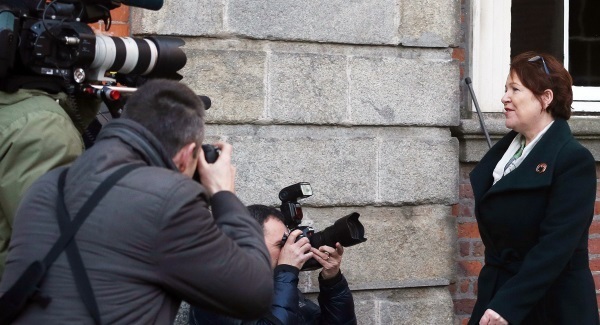
Nóirín O’Sullivan gave a flavour of what it feels like to be at the centre of a media and political storm, in which various people are calling for her resignation, writes
At times yesterday morning, she appeared to become emotional when talking about being “isolated” at the time. On a human level, it would be difficult not to have sympathy for somebody enduring that plight. Some of her evidence on the matter, however, was curious.
Tribunal lawyer Kathleen Leader brought her through the days after publication of the O’Higgins report into Sergeant Maurice’s McCabe’s claims of malpractice in the force.
The report was published on May 11, 2016. Two days later, the published a front page story of how documents showed there had been an attempt — behind the closed doors of the O’Higgins commission — to attack Sergeant McCabe’s motivation in bringing his complaints.
The story was based on a document submitted to the commission which stated that in a meeting in 2008, Sgt McCabe had stated that he brought his complaints only because of a grudge against another officer.
The Disclosures Tribunal has heard that this document — central to a controversial strategy to attack Sgt McCabe — had contained an error and should not have portrayed Sgt McCabe in this way. The error was not spotted by the senior garda, Superintendent Noel Cunningham, who had attended the meeting. The tribunal has heard that he didn’t print out the document, and read it on his phone, but didn’t spot the error because of poor eyesight.
He also signed off on the document before it was handed into O’Higgins, but claims he wasn’t given a chance to read it at the time.
The error suggested Sgt McCabe was guilty of “blackmail”, as characterised by a tribunal lawyer. Yet nobody ever contacted Sgt McCabe thereafter to apologise, or explain, or repair. On the day the document was handed into O’Higgins, he stepped down from his role in charge of the traffic unit in Mullingar because he said he felt “under threat”, and that if anything went wrong, management would “come down on him like a ton of bricks”.
Yesterday, Ms O’Sullivan described the story as erroneous but didn’t say how or where it contained errors. She said the article started “what I can only describe as vortex”. She was thereafter used “as a political football”, with a line-up of opposition politicians calling for her resignation.
Over the following days, other media stories based on leaked transcripts from O’Higgins followed. “The primary purpose of the leaks was to damage my reputation as commissioner,” she said.
This is curious. Five days after the story, a leak of an O’Higgins transcript to RTÉ made the top story across the media. This was an exchange in which Ms O’Sullivan’s lawyer sought to correct the record and point out that he had been instructed to challenge Sgt McCabe’s “motivation and credibility but not his integrity”. Whoever was responsible for the leak it was quite obviously designed to cast Ms O’Sullivan in a better light and relieve the pressure she had been under.
“At this point in time, I was completely isolated,” she told the tribunal.
Another curious element of Ms O’Sullivan’s evidence was a statement that part of the swirling controversy included innuendo that she had used the O’Higgins commission to attack Sgt McCabe over an historic “allegation of sexual abuse”. (This allegation, originating with the daughter of a colleague whom Sgt McCabe had reported for ill-discipline, was found to have no substance and even no credibility by the Director of Public Prosecutions).
Such innuendo would indeed have been shocking had it been about. At the time, however, there was not a hint anywhere in the public domain about anything to do with sexual abuse allegations against Sgt McCabe.
The historic allegation was known to a very small number of people who operated in the gardaí, media and politics. But beyond that bubble, there was nothing in the public domain about it. The allegation was first mentioned in the public domain in February 2017 and was not around in May 2016.
Not just that, but had there been, it would have been far more damaging to Sgt McCabe than the former commissioner. Innuendo around allegations of that nature, particularly against somebody discommoding the centres of power, could have been devastating for the whistleblowing sergeant. As a result, it was curious that Ms O’Sullivan would suggest that it was around at the time and that it was designed to damage her.


CONNECT WITH US TODAY



Be the first to know the latest news and updates