Greece: Humanitarian values sorely absent in crisis
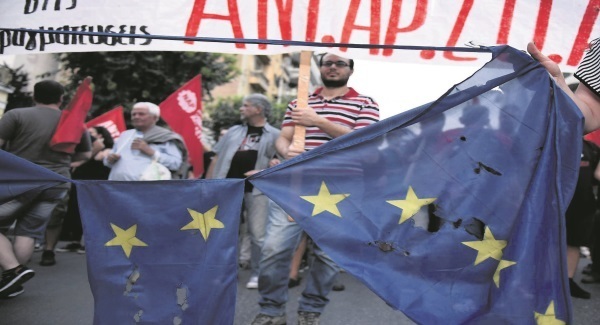
A corrupt ideology continues to push austerity on Greece, but if the country is to leave the eurozone, its politics and economic management must change, writes Michael Kinsella.           

Greece: Humanitarian values sorely absent in crisis

THE failure of Greece to repay €1.6bn to the IMF has accelerated the prospect of a crisis becoming a catastrophe.

If the troika doesn’t want Greece to leave the eurozone — as it continues to proclaim — then they have an extraordinary way of showing it.

The Franco-Germany axis, evidently versed neither in history nor in irony, has attempted to circumvent Syriza in the run-up to Sunday’s referendum and have now threatened the Greek people directly: a no vote on July 5 will, they insist, mean exit from the eurozone.

Given the EU’s incessant intimidation, the threat may well act as an inducement rather than a corrective. Indeed, a return to the drachma could be exactly what is best for both parties.

The interim imposition of strict capital controls by Greek authorities has revealed in a small but powerful way how quickly an ostensible political union can develop into an economic colonisation.

There are many Greeks unaffected at the imposition of a daily €60 withdrawal limit — mostly because the majority of those suffering in a country with 50% youth unemployment simply do not have €60 to withdraw at all, let alone every day.

Standard & Poor has warned that a Greek exit from the euro would likely mean a tandem liquidity and asset crisis. This would force banks to close, mean the non-payment of government employees, the loss of social welfare and the rationing of basic resources for the public at large.

Indeed, as Standard & Poor’s point out, “a serious foreign currency shortage for the private and public sectors, [will] potentially lead to the rationing of key imports such as fuel”. Not just fuel, but food.

So, seeing the unfolding drama as a purely economic crisis misses a key point. What should be at issue is not alone what Greece can produce for debt servicing — but what the people of Greece need to get by and to rebuild their economy, ie food, sanitation, shelter, water.

This is not alarmist. European Commission president Jean-Claude Juncker himself pledged some €2bn as recently as recently as March to alleviate — in his own words — “Greece’s humanitarian crises”. It is beyond perverse to perpetuate a problem that one is supposedly trying to alleviate.

Greek prime minister Alexis Tsipras must hope he survives a referendum that will act as a de facto vote of confidence in Syriza’s handling of the crisis so far. His televised national address to the people was uncomfortable viewing; the pressure on him was evident.

But then, the troika do pressure very well. German chancellor Angela Merkel et al are too savvy to accept the wording of the referendum on Tsipras’ terms; that is, on whether, or not, the Greeks should accept further austerity.

In pushing it as a vote on euro membership, Merkel and the troika are seeking to convince the Greek people they are one and the same, thereby ratcheting up the pressure for a yes vote.

Politics has a way of inducing historical amnesia, ethical lessons ignored in favour of short-term political expediency. Some readers may remember the concerted international effort on the part the G8 not 10 years ago to relieve third world nations of outstanding liabilities — a deal that lifted at least 18 chronically bankrupt countries out of unpayable debt.

It was a deal brokered in Cologne, Germany. It was an occasion of much back-slapping and mutual appreciation. It meant, in the words of many EU leaders, that they were living up to their humanitarian responsibilities.

That the irony — many of the current European and G8 leaders, alongside creditors and financial chiefs, involved in attempting to extract further austerity from Greece were involved in, and given kudos for, brokering that deal.

It is a cruel and corrupt ideology that would pursue an “odious debt” from Greece at the risk of making a third-world nation out of their neighbour — a country at the heart of Europe’s intellectual heritage — to facilitate the interests of an international financial system that sees every financial collapse as an opportunity: The stripping of assets, the annexation of cheap land, the appropriation of asset portfolios embedded with the sweat, dread, failed marriages, and hunger of many.

The Greek crisis has something of the long goodbye about it — a relationship made up, by turns, of incompetence, bad faith, condescension and futile invective from both sides.

A Greek acceptance of the troika’s demands for additional austerity on July 5 will lead to more cuts and a further, potentially disastrous, test of Syriza’s frankly sophomoric diplomacy. Rejecting those same demands will mean a modicum of financial autonomy in its exit.

The majority of voters on Sunday do not wish to leave the euro — while those in control of it are making it impossible for Greece to do so.

If Greece is to leave the eurozone and return to the drachma, its politics and its economic management will have to change. It cannot have the same coterie of individuals guiding the economy that it had in the past.

A younger generation now acquainted with the humanitarian effects of such behaviour, and educated in how best to provide needs ahead of luxuries, will be in the morally and strategically strongest position to provide the public service leadership the country so urgently requires.

Michael Kinsella received his doctorate in ethics from University College Dublin, and teaches philosophy there. His blogs can be read at ‘Silent Planet’ on WordPress

x

More in this section

Revoiced

Newsletter

Had a busy week? Sign up for some of the best reads from the week gone by. Selected just for you.

Cookie Policy Privacy Policy Brand Safety FAQ Help Contact Us Terms and Conditions

© Examiner Echo Group Limited