‘Road to the Rising’ tramples on our history
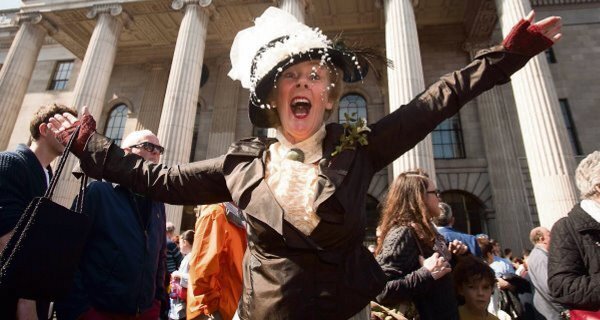
I WAS in O’Connell St in Dublin on Easter Monday and I ran out of it. Or I would have if there had been the space. The street we used to think (wrongly) was the widest in Europe was too crowded for that. Admittedly the weather was unseasonally beautiful but that wasn’t the reason for the crowds.
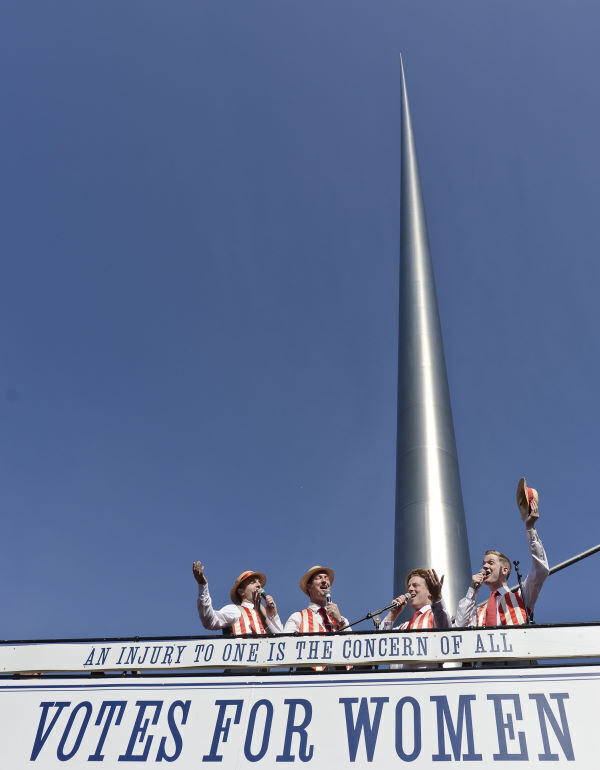
They were “celebrating” Easter Monday 1915, a supposed recreation of Dublin (and Ireland) a year before the events which would change our history forever. And what I saw as a commemoration of that entirely ordinary Monday of 1915 was a disgrace, a tatty shambles of fake “craic” and jollity.
It was remorselessly crass and gombeen-like, the sort of thing that, in the days when we might have had some claim to a bit of dignity concerning our national holidays, would have made us sneer at US organisations such as the Loyal Sons of St Patrick and the Ancient Order of Hibernians, a piece of fake pageantry that would have fitted happily into a reel of The Quiet Man.
READ MORE: Capital resplendent as Dublin’s denizens remember Rising .
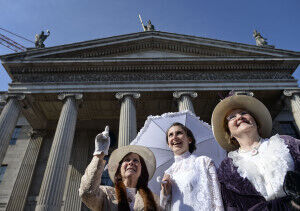
People had been invited by the organisers, by Dublin City Council, by the executive of the city who earn their livings by coming up with “promotional” ideas, even by the minister for arts and culture, to get into the spirit of things, dress in period costume, and find out all about their roots and the way things would have been in the spring of 1915.
Cue a mess of dressing-up box tat, mainly grubby ankle-length skirts, somewhat battered hats last seen at the cousin’s wedding six years ago, and badly applied fake moustaches. They were worn by people who, at a bet, have not the slightest interest in, or knowledge of, life in Dublin or anywhere else on the island in 1915. Nor would the jolly sideshows have done anything to fill the gaping knowledge gap.
And we are still a year away from the centenary of 1916; what sort of Donnybrook Fair of undignified shamroguery will have been unleashed by the time we reach the 100-year date? There are many shades of opinion on the significance of 1916. Those with views which are at best ambivalent, or even antagonistic (and there are many), are increasingly finding, as nationalist/patriotic fervour already reaches boiling point, that their voices are regarded with contempt as entirely “illegitimate” in the national consciousness.
Perhaps that is inevitable and even excusable as the centenary of the Rising approaches. It was, after all, seismic and pivotal... even if only in its aftermath. But to paint “ordinary life” in our capital city a year before the Rising took place as a series of jigs and reels at a cheap funfair is as undignified as it is crassly commercial: The aim is to boost the tourist trade, and there was damn all reason for tourists to visit Ireland in 1915.
Despite the successful post-independence reconstruction of our history, Ireland was a country at war in 1915. Thousands upon thousands of families were living with the gnawing anxiety of a son or husband in the trenches. These were young men who had joined not the “British army”, but “the army”. We were part of the United Kingdom, and the majority of our citizens had no problem with this. It was the foolish decision to execute the Proclamation signatories which turned the tide in their favour.
READ MORE: MICHAEL CLIFFORD: 1916 commemorations: Why Rising to the occasion is not easy .
There would have been little to celebrate for those families with sons at war during Easter 1915: Church services of all denominations would have been paramount in their minds as they prayed for the safe return from the trenches of sons, husbands, and brothers. And in the reeking tenements of all our cities, families would have huddled together in filthy, foetid conditions and longed for spring to take hold. Again, post-independence revisionism told us that the city tenements were the product of deliberate English cruelty.
We ignore the fact tenements of London, Liverpool, Glasgow, and Birmingham were every bit as bad as our own. The urban working poor everywhere lived in dire poverty, kept that way by their God-fearing employers. Just steps from O’Connell St, (or Sackville St as it was then) children coughed up their tuberculosis-ridden lungs, their mothers died giving birth to a seventh, eighth, or ninth child, sometimes simply for want of hygiene. Their husbands, if they had tick in the pub, or a few pence to spare, drowned their sorrows, trying to forget that the next day, they would stand wearily on the docks, hoping they would be among the lucky ones to get a day’s “casual labour”. If not, they and their families would once again go to bed hungry.
The shadow of the Great Strike of two years earlier still hung over the people at Easter 1915: The men and women who had been starved back to work, their pathetic hopes for a living wage unrealised, were still pariahs. They were condemned from the pulpits as godless communists by the priests who had dragged small children back to starving hovels during the strike when there was an attempt to send them to England for the duration, where their fathers’ fellow trade unionists offered to feed and house them. These conditions weren’t imposed by the “Anglo-Irish” or “landlord class”.
The poor of our cities were exploited at Easter 1915 by their co-religionists, the Catholic merchant classes who saw the poverty of others as their opportunity, as they had seen the same opportunities to make money during the Great Famine.
And in the suburbs of our cities and the comfortable farmhouses beyond them, the Rosary was said, and thanks was given that Ireland was a holy place, preserved by the grace of God from contamination from the outside world. How could it be otherwise? Illiteracy was the order of the day, encouraged by the Church authorities as a protection from Godless information.
That was Ireland at Easter 1915. The conditions may have warranted a revolution: There would be one in Russia two years later. But in Ireland, the tiny group who would become revered as martyrs after the setting up of the Free State cared little for the privations their fellow citizens suffered.
It was a flag that consumed them, a flag that meant nothing to the war-weary, miserable people who trudged along Sackville St on Easter Monday 1915. And those conditions got no better after independence, not even in the 1930s, when working and living conditions for the urban poor began slowly to improve around Europe. They remained static in Ireland during an economic war also waged for the principle of a flag.
And a century later, last Monday, Irish people were encouraged by their own to trample on their history in the name of commerce, to “celebrate life as it would have been in 1915, on the Road to the Rising.” Thousands of us, for shame, obliged.
DISCOVER MORE CONTENT LIKE THIS
CONNECT WITH US TODAY



Be the first to know the latest news and updates