The US involvement in Iraq: Did they make a difference?
AS IRAQ descends deeper into chaos I often wonder how it looks through the eyes of Anthony Thomas.
The first time we met, Anthony was in a policeman’s uniform moving into the house next to mine in Washington. Two years, later he was in a US army uniform on his way to Iraq.
We became firm friends after he and his wife Tina moved in. It was in the years after 9/11 and we’d speak about everything except politics and the looming Iraq war, knowing we were at opposite ends of the spectrum. Then, early one morning, war and politics collided.
It was 2005, two years after the US invasion of Iraq. A knock came to my door and two men showed me their credentials. They were US Department of Defence background investigators. Their job was to determine if someone is fit for a top secret security clearance and they wanted to speak with me about Anthony, who was planning to serve in Iraq.
I was rushing out to work so we arranged to meet later at a hotel near my office. There, over coffee, they quizzed me for about 20 minutes on what I knew about Anthony and his private and public lives and whether I had ever seen any unusual comings and goings at his house.
I told them I couldn’t speak highly enough of Anthony. Yet I dreaded each word, knowing it would mean he would soon be leaving Tina, imperilling his life, and setting off for a war that I abhorred.
When he did leave one beautiful June morning in 2006, Tina was bereft. As we waved him down the road to a waiting taxi I knew there was nothing I could say or do that could comfort her. We simply went back to her house and she cried herself to sleep on a sofa.
As she drifted off, a calendar fell from her lap and I could see that day had been crossed off. It helped, she said, to do that every day. It helped, too, that, as a scientist at the National Institutes of Health, she had a demanding job to fill the days until November came and she could hope to see Anthony home on leave from his one-year assignment.
For Anthony, it was slightly different, he told me when we spoke recently about what had happened in Iraq and what is happening there now. He was bereft that morning, too, he said. But he had served in the first Gulf war 15 years earlier. Now, at the age of 36, he wanted to move from law enforcement into a career in army intelligence. He’d joined the army reserves and the way to fast-track his ambition was to go to Iraq.
“That morning when I caught a cab to the airport and travelled across to the military base [Fort Lewis in Washington State], I definitely wasn’t happy to be leaving,” he says. “It was different from when I was 18 in the marine corps and was excited about it. It was also a difference of age and I was starting a new career. Some friends in the intelligence community suggested I get into an intelligence MOS [military occupational specialty] and start from there, which I did.”
Loyalty to former comrades was a factor, too. “This is something you encounter with veterans,” he says. “It’s to do with military culture. I’d served in the first Gulf war [1990-91] and in Somalia [1992-94], so you feel kind of drawn to it, like it’s your duty.
“So that day in June 2006 I didn’t want to leave, I definitely didn’t want to leave Tina, but it was something I felt I had to do. It’s not a sense of patriotism. It’s not a flag-waiving kind of thing. It’s more that because you know what’s going on you want to be there for the other people who are there. You want to get over to help them.
“The marine corps and the army are very different and active duty and reserves are very different. The marines are steeped in warrior culture; the army not so much, unless you’re in certain parts of it like the Green Berets or the Rangers. And doing military intelligence is very different from being an infantryman. You go and you train and gather intelligence but it’s very different from being on active duty.”
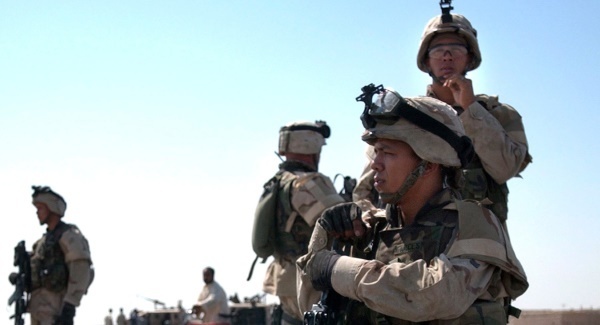
On his first day in Iraq, they were separated into four-man teams. “Two of us had served in the marines, one guy had served with special forces and we had a young kid and it was his first time,” he says. “We were assigned to FOB [Forward Operating Base] Falcon in western Baghdad. I never fired my weapon because that wasn’t our job. But we were constantly fired at. Every day they would mortar us, shooting mortars and rockets into the base.
“We went out in town a few times with the infantry guys but, for the most part, we were at the base so we weren’t getting shot at. Getting mortared was one thing, and we took casualties, but these other guys were the ones losing their buddies from roadside bombs.
“We worked with this young infantry guy who was an Iraqi-American. He was on our team as a translator. When he went back to his platoon and they were getting ready to leave Iraq, they hit a roadside bomb and he lost a leg.
“As a grunt you see lots of horrible things — the fire-fight, seeing your buddy go down, the evil men do — you see it all up close. You don’t see a lot from the top down. Military intelligence is totally different. You get a view of the battlefield. You get reports of what’s going on that you would otherwise not see. That was the biggest difference, your viewpoint of the battlefield.”
His state of mind was radically different too. Tina had become pregnant while he was home in November and now he was about to become a father.
“The biggest difference was when I was a kid in the marine corps I trusted the US government,” he says. “I was more innocent in that way — they said we needed to go to Somalia, so we went to Somalia, you believe what they tell you. But once you find out you’re bringing a kid into the world and you’re a little older you start to look at things differently.
“So the biggest difference was going back to Iraq and finding out that it was a bit more complicated than going over there and waving red, white and blue. You look around and wonder why are we here? What are we doing?
“When I was a marine I was a single guy, no kids. It didn’t matter, my life was my platoon. But when Tina was pregnant I began to think about what kind of world am I going to leave my kid. So you begin to look a little broader, a little wider, a little deeper, at what’s going on and you learn that sometimes the people in charge don’t have your best interests at heart.
“As a marine in the first Gulf war when we went into Kuwait, my platoon accompanied a bunch of doctors into Kuwait city and we were able to see the people genuinely felt liberated, there was a kind of heroic feeling to it. And then we left.”
A decade later, when the Iraq invasion started in 2003 Anthony, like many people around the world, had become more sceptical. Then he began to waver.
“In 2003, I remember having a conversation with a buddy of mine and saying I don’t think we should be going back,” Anthony says. “But, as time went on, I began to think that, after 9/11, there was a need to realign things over there. Kick some people out and install some people. The problem is not that we went in but that we dithered around and there was no clear end-goal.
“I’m not saying we needed to be cruel. But if you put young men and women in harm’s way and expect them to give up their lives, you make sure you have a solid goal, that you do everything you can to achieve that goal, whether it seems brutal or not. We didn’t do that in Iraq.
“We should have installed the guy we wanted and not allowed a democratic vote at that time... If you invade a country, you stabilise it before you get into other phases of establishing democracy. That’s what bothers me the most and that’s what’s led to today.”
So was it all worth it then? “My answer is no, on a macro level, it was not worth it,” he says. “Veterans, especially guys on the frontlines, make the point that you might join the military for mom and apple pie and patriotism, but when you’re fighting, you’re not fighting for any of that. You’re fighting for the guy on your left and on your right. So all the individual sacrifices were worth it because those men and women sacrificed themselves for their mates, but their sacrifice in terms of global politics, no it wasn’t worth it and I wished we’d have never gone because they would still be with us. The lives that were lost were lost for their buddies and to protect the platoon so their sacrifices will not ever be in vain because they died to protect their mates.”
What might America do now? “The only way you’re going to stop this is if every time these people raise their heads you send in the military, you kill as many of them as possible and then you leave,” Anthony says. “It’s having to do things that might seem brutal or even evil but are necessary. We’re not going to solve it by nation-building, we’ve tried that. But we [the US] do have the military might to take away the threat even if we have to keep going back and back to do that over and over.
“The way to do this is to weigh the American interests. It might sound hawkish but if you did that you’d actually have less conflict because you would only be willing to do it if you absolutely had to.”
And he believes he did what he had to do. “Our team accomplished our mission,” he says. “We handed over some pretty bad guys.” Anthony and his team were among the lucky ones. They returned home safely to their families and in Anthony’s case he met his son Christopher for the first time.
“It was August 7, 2007,” he says. “As soon as I got off the plane I found a phone and called. Christopher had just been born. I was elated. I wasn’t happy that I wasn’t there for the birth but I was elated.
“Tina’s heritage is Irish, so I went into one of the gift shops at Shannon to find things for the boy and on the plane they made the announcement that I’d become a father. Everyone was cheering. So I’ll never forget that. That’s what I remember Ireland for, the birth of my son.”
Anthony stayed in the Army Reserves for a few more years “and it did get me into intelligence so by 2009 I was gone”. He went to Afghanistan in 2010 and went back there again in 2012 as a private consultant.
So, any regrets? “It’s led to a lot of good things so it’s easier for me to say because I didn’t lose my friends. If I had I might feel differently about whether it was worth it or not.”
Thousands of others were not so lucky. Almost 4,500 American military died during the US involvement between 2003 and 2011 and some estimates put the number of Iraqi military and civilians who died directly or indirectly during the conflict at up to half a million people.
CONNECT WITH US TODAY



Be the first to know the latest news and updates