Fair is fair but not in case of Guerin review
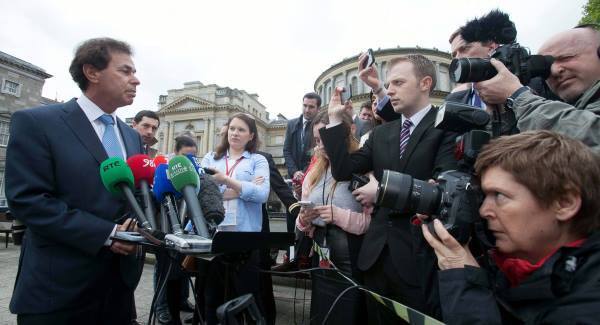
IN HIS review of the handling by the garda authorities of Sergeant McCabe’s allegations of garda wrongdoing, Sean Guerin SC inquired in an at-first-sight approach into the role of then justice minister Alan Shatter.
Mr Guerin asserts Mr Shatter seemed unable ‘to heed’ Sergeant McCabe’s complaints. His review suggests Mr Shatter did not take seriously enough Sgt McCabe’s complaints about the Garda Commissioner, that he simply accepted the commissioner’s view that the sergeant’s complaints had been investigated properly by An Garda Síochána, and that he did not engage in a reasoned exercise of his statutory functions in relation to the sergeant’s request for an independent inquiry.
There is a maxim in the law. Fairness or natural justice should not only be done, but should manifestly be seen to be done. Mr Guerin’s review violates this indispensable principle.
The requirements of fairness are flexible and conditioned by the context. The minimal requirements are notice of allegations against you and a chance to comment on or deal with the allegations.
Mr Guerin was aware of the importance of fairness or natural justice. In several places in his review he sets down his concern about whether the sergeant was denied fair procedures by the gardaí who investigated his complaints. Although he interviewed Sgt McCabe for 19 hours, he did not give Mr Shatter a fraction of a second to comment.
Undoubtedly, in conducting his review Mr Guerin was under a legal duty to act in a procedurally fair manner. There is a constant jurisprudence — domestic, European and international — according to which the right to procedural fairness is a fundamental right.
Why must fairness be done and be seen to be done? Part of the rationale is that fair procedures are essential for accurate fact-finding. A fact-finding process is a good one if it correctly discovers the relevant facts. In this case Mr Guerin did not allow Mr Shatter to state his side of things in relation to disputed or uncertain issues of fact, even though he was available to do so.
Another part of the rationale for fairness is this: Respect for the constitutional right to dignity demands that the person affected have a fair say and an objectively reasoned explanation of the outcome where an inquiry threatens their reputation, good name, livelihood or prospects.
Here Mr Guerin must have known that an adverse finding would inflict substantial harm on Mr Shatter. Yet he pursued a skewed procedure.
The essence of my objection is that Mr Guerin did not perform his basic duty of translating the right to fairness into concrete particulars appropriate to the nature of the review he was conducting.
Mr Guerin’s review was mostly papers based. The second-hand presentation of evidence to Mr Guerin in the form of documents from the Department of Justice had self-evident deficiencies. The papers made no reference to any oral discussions Mr Shatter had with department officials.
On this papers-based approach Mr Guerin asserts, for example, that he is unable to find a record of Mr Shatter’s reasoning on Segt McCabe’s request for an independent inquiry into his complaints. In fact, he is unable to illuminate Mr Shatter’s reasoning on any of the matters he inquires into.
The simple fact is that Mr Shatter himself would have been able to supply him with relevant evidence on his reasoning and his discussions with departmental officials.
This unfair procedure did not allow Mr Shatter to address himself to any of the issues on which Mr Guerin reached adverse conclusions. For example, Mr Guerin formed the view that Mr Shatter had deferred too easily to the view of the garda authorities that the sergeant’s complaints had been investigated properly.
If he had accorded Mr Shatter a fair say he would have had evidence that was counter to his assumptions. Mr Shatter would have been able to show that in relation to Sgt McCabe’s allegations about the operation of the fixed-penalty notice system, for instance, he had shown he was not willing to take the say-so of the garda authorities.
When he received garda reports on this issue Mr Shatter sought an independent report from the Garda Inspectorate. When he received further allegations from the sergeant Mr Shatter sought an independent report from the Garda Síochána Ombudsman Commission (GSOC).
Mr Guerin’s approach also denied Mr Shatter the chance to correct what seem to be errors of fact in his review. For instance: At paragraphs 19.89 to 19.90 Mr Guerin deals with the advice given by the Attorney General’s office to the department in relation to what steps they were legally obliged to take with regard to three booklets of documents submitted by Sergeant McCabe’s solicitors in relation to allegations of garda wrongdoing.
Mr Guerin says the advice to department officials was “to forward the two booklets relating to the complaints of malpractice and corruption to the minister without further ado”. Yet he says next that: “It is unclear whether or not the documents were ultimately forwarded to the commissioner.”
At first blush, this knotted analysis could be read to say that the legal advice was to give the booklets to Mr Shatter and that he sat on his hands. Or it could be read to mean that the booklets should be given to the Garda Commissioner. In fact, Mr Guerin makes an error here that damages Mr Shatter. Had he given Mr Shatter a fair say he would have avoided making this injurious error.
MR GUERIN questions Mr Shatter’s reference in a letter to Sgt McCabe’s solicitors on August 29, 2011, to the sergeant’s complaints being investigated by the GSOC. He asserts that this ‘seems unlikely’. If he had met the demands of fair procedures he would have been able to determine the significance of the reference to GSOC.
He took an unfair course of action even though Mr Shatter had a vital stake in his reputation, good name, and livelihood, which Mr Guerin had no right to gamble with.
This fatally defective procedure for taking evidence produced a grossly unfair outcome. It did so by consciously excluding evidence that could have directly and squarely disputed the elemental and injurious findings of fact in Mr Guerin’s at-first-sight review.
Two final points: First, why did Mr Guerin not obtain the ‘voluminous’ documentation that GSOC were willing to furnish him? His deadline was not rigid but allowed him to report ‘as soon as may be’. He does not explain his unseemly haste. He should clarify why he felt obliged to finish up the review without obtaining obviously relevant and important documents.
It is striking Mr Justice Cooke who is conducting a review of issues relating to GSOC under similar terms of reference with regard to deadline is painstaking about taking the time needed to furnish an objective and comprehensive report.
And, second: Mr Guerin seems critical of the fact that he had no information to indicate whether the sergeant’s booklets were passed on to the Garda Commissioner. This is curious.
He criticises Mr Shatter for asking the Garda Commissioner for information relating to the sergeant’s allegations. Yet he appears to be concerned that the advice of the Attorney General’s office to hand the booklets over to the commissioner may not have been followed.
This is problematic. It appears to be the case — Mr Guerin must clarify — that the Attorney General’s office advised that the booklets be handed over to the commissioner. Although Mr Guerin faults this legal approach, he does not take the Attorney General’s office to task. He singles Mr Shatter out.
The Guerin review is so irradiated with procedural unfairness it should not have been published in its current form. Nor should it have resulted in the resignation of a minister.
* Tom Cooney was a special adviser to the minister for justice from April 2011 to September 2013.
CONNECT WITH US TODAY



Be the first to know the latest news and updates