For Fianna Fáil, the rot has been stopped
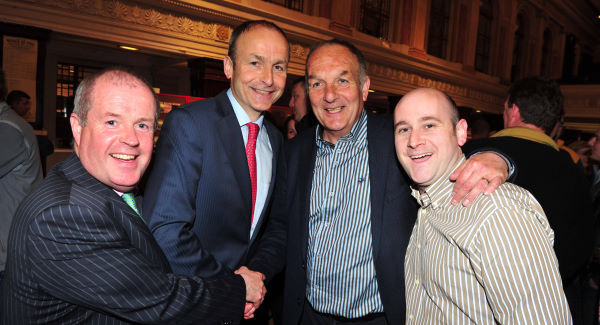
Fianna Fáil and Micheál Martin have declared if not victory then successful renewal in the aftermath of the local, European, and by-elections. New young councillors and an upswing in voter support after the Armageddon in 2011 are proof. In fact, the ultimate indication of recovery is convincing evidence that for Fianna Fáil, the rot has stopped.
In politics, it’s all about momentum. It is not about where you are; it’s about where you are going. For the first time since 2011, there are signs that Fianna Fáil is going somewhere instead of nowhere.
The significance of a turnaround for Fianna Fáil, any turnaround, is enormous. However, if the direction of the momentum is clear, the empirical evidence of its extent and ultimate destination is for now incomplete.
What makes the results most significant for the party and its leader is their context. The party’s position is stronger in relative terms than could have been anticipated even a few months ago.
In politics, it is not only about where you are and the direction you are going, it is the overall context. After Friday’s poll, that context is radically changed.
The demise of Labour, the reversal of Fine Gael, and the rise of Sinn Féin are the changed context that makes Fianna Fáil’s renewal and increased strength more significant that it would otherwise be. The historical context of these elections for Fianna Fáil are twofold. Firstly, it has achieved what is about equal to its second-worst result ever.
As recently as the local and European elections in 2009, a result of 25% in a national poll would have left the party aghast. But that was then and this is now. After its 17% share of the vote in the 2011 general election, a climb of over 7% to a similar level of support to 2009 is real progress.
The second context for Fianna Fáil is that in the new multi-polar Irish political environment, a party with well over 20% of the national vote is a major player in an enlarged, reconfigured spectrum. Fianna Fáil has survived its 2011 decimation, arrested its decline, delivered tangibly on a beginning of renewal in personnel, and, in an altered political context, albeit with much lower level of support, finds itself again playing in the political premier league.
It is not only an astonishing comeback in relative terms from 2011, it is a major step forward on what seemed possible even months ago. Political climate change is benefiting a party now also growing again in real terms.
In places like Cork, Sligo, and Tipperary, very significant gains were made. The Cork result will be gratifying for Martin and proof that his electoral appeal, which if not yet universal, has roots.
There is also the tantalising prospect of again being the largest party in local government. That benchmark was trumpeted when Enda Kenny and Fine Gael achieved it in 2009. With fewer councillors than Kenny claimed then and with about as many it elected itself in 2009, it may be an honour claimed by Fianna Fáil in 2014. All the goal posts have moved, of course, but it is still a significant score that may be put on the board when all the final results are in.
The election of new councillors, the injection of new blood, is another aspect of renewal. It will take time for their input and calibre to be felt. But anything, absolutely anything, will be preferable to the odour of political formaldehyde prevailing in the party since 2011.
Internally, especially in its parliamentary party, the atmosphere has been fractious, morale has been low, and too much of the decision-making has been inept. Part of this is borne of the sense of pointlessness in a party preconditioned for power, in circumstances where such political power seemed elusive. Now it is again a tangible possibility. This always influences the relationship between a leader and his party. Martin may ultimately be a man with political patronage to offer.
The election results give credence to the view that some voters have moved on from their anger at the party in 2011. Significantly, the rise of Sinn Féin means that, for the first time since 2011, Fianna Fáil will no longer be the nearly exclusive object of government and media attack in terms of economic policy. The next general election will be the third national poll since the economic crash.
In the interim, a lot of political time and effort will be spent attempting to hold Sinn Féin to account for the future, instead of exclusively pinning past blame on Fianna Fáil. Time is moving on.
The process of party renewal, however, is far from complete. An old guard remains deeply entrenched and so do old attitudes. Progress in Dublin, if appreciable, remains relatively modest. Some of the candidate-selection processes were inept, with Mary Hannifin emerging on the ticket in Blackrock and allowed her graft grievance onto an already developed sense of entitlement. The election of running mate Kate Feeney in that ward snatched a victory of sorts from defeat. But Hanafin is a big name and a media magnet, and is now the most prominent public face of the party in the capital.
As this newspaper went to print last night, the results of the effort to hold onto a European Parliament seat in the North, West, and Midlands were being played out. If neither sitting MEP Pat the Cope Gallagher nor running mate Thomas Byrne is elected, some of the brasso will be wiped off the shine so assiduously polished by Fianna Fáil over the past 48 hours.
For now, Fianna Fáil is a party in revival mode and its leader is stronger and more secure.
* Gerard Howlin is a public affairs consultant and a former adviser for Fianna Fáil.
For more in depth updates and analysis on the fallout from this year's election and access to our comprehensive results database visit our special Election 2014 section.
CONNECT WITH US TODAY



Be the first to know the latest news and updates