West has options to counter Russians march to restore greatness
NO SET amount of time must pass before journalism gives way to history, but normally historians write with the advantage of perspective that reflects the passage of years, decades, or even centuries.
Time is necessary for information to come to light, memoirs to be written, and the significance of events to reveal itself. What seems relatively trivial now may prove to have been anything but, just as what appears to loom large can fade in importance.
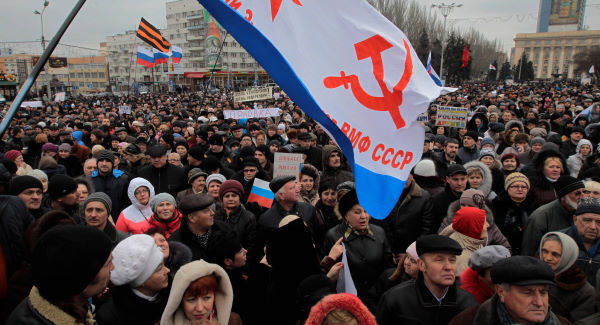
But, for better or worse, the West does not have the luxury of waiting to make sense of events in Ukraine, simply because there is no assurance that what occurred in Crimea is unique. Thousands of Russian troops remain on Ukraine’s eastern border; every day, there are new reports of unrest inside Ukraine, many allegedly instigated by Russia.
We thus need to move quickly to understand what recent events imply about Russia, its President Vladimir Putin, and the international order. It is no less important to apply the lessons swiftly.
Putin wants to restore Russia to what he regards as its rightful place in the world. He is angry over what he views as the humiliations suffered since the end of the Cold War, including the Soviet Union’s break-up and Nato’s enlargement — though he will never admit Russia actually lost the Cold War.
At the same time, Putin is preoccupied with perpetuating his rule and ensuring he does not suffer the same fate as former Ukrainian president Viktor Yanukovych, who had been his proxy in Kiev. He recognises that the restoration of Russia’s former greatness is a goal shared by many of his countrymen. Foreign policy can make for good domestic politics.
As a result, Putin can be expected to continue to interfere in Ukraine for as long as he can — and so long as it serves his aim of strengthening his grip on power at home. Western policy should seek to frustrate this strategy.
Countering Russian interference in Ukraine does not warrant incorporating Ukraine into Nato. Doing so would either require coming to Ukraine’s defence militarily, which would entail enormous risks and difficulties, or not making good on such a commitment, which would raise substantial doubts worldwide about the credibility of the US.
US President Barack Obama was correct in describing Russia as a regional rather than a global power — on its periphery, it is strong, and it has a substantial stake in Ukraine’s future.
Still, the West has options. One is to strengthen Ukraine politically (helping with elections and getting a new government up and running) and economically. The recently agreed two-year, €20bn aid package, largely funded by the EU and IMF, will help. Security assistance should emphasise intelli-gence and policing so Ukraine is less vulnerable to Russian attempts to sow discord and cause unrest.
Another option is to prepare a new round of economic sanctions against Russia — far stronger than those introduced following Russia’s invasion and annexation of Crimea. The new measures should target Russian financial institutions and limit what may be exported to Russia, and the US and EU should communicate their agreement on such sanctions to Putin, so that he understands the full price he will pay for destabilising Ukraine.
A public-diplomacy dimension to Western policy is needed. Russians might think twice about supporting their government’s foreign policy if they came to appreciate its impact on their standard of living. And they might be surprised to learn the full extent of Putin’s personal wealth, which should be publicised.
Steps can also be taken to weaken Russia’s energy stranglehold on Ukraine and much of Western Europe. The US, for its part, can begin exporting oil and increase its capacity to export natural gas. Europeans can take steps to introduce the technologies that have led to the boom in US gas production, and Germany can revisit its position on nuclear power.
Recent events should also serve as a wake-up call for Nato. People and governments need to rid themselves of the comforting illusion that countries’ use of military force to acquire territory is an anachronism. European defence spending and capacity needs to increase, as does America’s presence in select Nato countries — something that can be achieved even as the US increases its presence in Asia.
The strategy needed to resist Putin’s efforts to expand Russia’s influence beyond its borders — and to induce change within them — resembles nothing so much as the “containment” doctrine that guided Western policy for the four decades of the Cold War. Russia, a country of 143m people that lacks a modern economy, should be offered the opportunity to enjoy the benefits of international integration, but only if it acts with restraint.
This is not to suggest the advent of Cold War II. But there is a strong case for adopting a policy that has proved its effectiveness in confronting a country with imperial pretensions abroad and feet of clay at home.
* Richard Haass is president of the Council on Foreign Relations and the author of Foreign Policy Begins at Home. Copyright: Project Syndicate, 2014
CONNECT WITH US TODAY



Be the first to know the latest news and updates