Every Syrian deserves to be helped
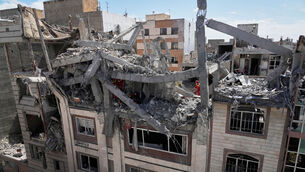
AFTER two years of extremely violent conflict, the Syrian population is faced with a humanitarian situation of catastrophic proportions: The previously well-functioning health system has collapsed, food shortages are commonplace, and water and electricity supply is disrupted.
The aid being provided to meet their basic needs and alleviate their suffering is falling drastically short.
The political complexity of the crisis is mirrored in the humanitarian response. The majority of aid to Syria is perceived to be on one side or the other.
In the government-controlled areas in Syria, aid distribution is restricted to the Syrian Arab Red Crescent, and other local organisations whose intervention capacity is saturated and restricted to certain geographical areas.
The UN is only able to channel aid through Damascus — and is reliant on an unlikely Security Council resolution to provide aid across borders without the government’s agreement.
At present, aid organisations including Médecins Sans Frontières/Doctors Without Borders (MSF), are left with no other option but to cross the border illegally into areas controlled by the opposition, setting up clandestine hospitals in basements, and delivering aid with the help of opposition networks.
This presents a substantial challenge as it is virtually impossible for aid to cross multiple front-lines at the scale required to meet the immense needs. In addition, the provider of aid becomes painted with a brush of political solidarity with one side or the other — and all aid becomes contested.
During the recent UN conference held in Kuwait, more than 60 countries committed to provide more than $1.5bn (€1.15m) in humanitarian aid for the Syrian population. This included a regional response for refugees, estimated at $1bn for 1.1m people who have fled Syria and another estimated $520m for 4m people “directly or indirectly affected by the current events” inside Syria. Essentially, only one third of the funds pledged will go directly to support those who remain within the conflict area.
The contrast between the funding for aid going to refugees and the actual amount allocated to Syrians inside the country illustrates that the current system is unable to respond to this humanitarian emergency at its source.
Providing humanitarian aid in wartime requires flexibility, innovation, and responsiveness both on the part of aid workers and institutional donors.
A negotiated agreement between all parties is urgently needed to allow life-saving aid to be delivered on the scale required and in the most efficient way, across front-lines and across the border.
Without this, aid cannot be extracted from the geopolitical complexity that has plagued this crisis and hampered the response.
Whilst we wait for the deadlock to be broken, aid still urgently needs to be ramped up where possible — national states and the UN must support cross border humanitarian operations; the supply of impartial aid to areas controlled by the opposition and neglected zones must no longer be subject to sanctioning by the Syrian government.
This is not a simple war, and there are no simple aid solutions. But the diplomatic paralysis preventing a political resolution of the conflict can by no means excuse the failure of humanitarian response.
Otherwise, aid remains a passive witness to the suffering it is intended to ease.
nJane-Ann McKenna is head of Médecins Sans Frontières Ireland
MSF is an international emergency medical organisation providing independent medical relief to victims of war, disasters and disease outbreaks, since 1971. MSF has opened three hospitals in northern Syria and has treated 20,000 patients and carried out 1,500 surgical operations. MSF teams are also giving assistance to Syrian refugees in Lebanon, Iraq, Jordan and Turkey.
For more details, see www.msf.ie/syria_two_years_on