Emerging era of post nationalismin Northern Ireland
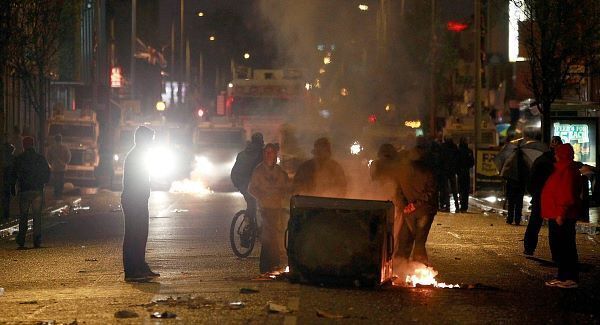
THE latest “troubles” in Northern Ireland began 45 years ago, and though much reduced, sometimes to invisibility, they are not over yet and will not be for some time.
Protests over the republican-dominated Belfast City Council’s decision to fly the union flag just on certain days happened again over the weekend, if smaller and less violent than in the past few weeks.
This is what can happen after more than a century of demand for Irish independence: violence, on both sides, takes time to lose its attraction, and its adherents.
The prism through which moderate unionists see the current events is to hope that the status quo will hold. Most do not like people whom they regard as murderers or apologists for murder being deputies and ministers in the Northern Ireland assembly. But peace eases the disgust, as does a return of tourism to Northern Ireland.
Many unionists, though, do not see things this way. They view the Sinn Féin council decision to haul down the flag as a deliberate affront, a statement of intent to whittle away the Britishness of the province.
Signs and symbols are of an importance here out of all comparison with Britain, where few display any kind of flag or allegiance, other than to a football team. The protestors were outside Belfast City Hall again last weekend, waving both the union flag and the banner of Ulster, signifying Northern Ireland’s government from the 1950s through the 1970s.
But they were only a few hundred protesters. Professor Peter Shirlow, a Belfast academic who works with unionist political groups, wrote recently that “politics in Northern Ireland responds to clamour”.
In an interview with Reuters, he said the protestors rarely numbered more than 2,000 and that “had this been 10 or 15 years ago, there would have been deaths by now”.
In what would have been seen as a miracle for most of the past decades, unionists and nationalists are tent-atively reaching out for each other. “People,” says Prof Shirlow, “are prepared to move on.”
The annual Life and Time Survey done for the North, a kind of sociological snapshot, shows that many young people simply refuse to see themselves as British or Irish — but live in a kind of post-national space which they call “Northern Irish”, and no longer allow themselves to be forced into ethnic or confessional silos.
The same survey shows that two thirds, of all faiths and allegiances, think things are much better; that they can be open about their background; and that they would prefer to live in neighbourhoods of mixed faiths rather than of one faith only.
The vigour of nationalism seems to have left — at least in the North. It is always foolish to say that identities no longer matter and inter-communal peace will be forever: that was said about the peoples of the Balkans, the Soviet Union, and of Lebanon.
But post nationalism may be taking root in Britain, where four nations were forced or woven at different times into one state.
Failure of imagination and political skill in Britain’s ruling class lost the Republic of Ireland, and after its secession, a long sore has run through Britain, as terrorism erupted in spasms and the Republic claimed the North.
Yet now the spasms are weak and the Irish Government wisely dropped the claim that it was the legitimate government of the entire island of Ireland 15 years ago. There’s a chance the sore is healing.
A final observation: that which excites both British and foreign comment — the absorption of Northern Ireland into the Republic of Ireland, the independence of Scotland and Britain’s exit, broken or not, from the European Union — is exciting to read about. But the best bet is that none of these will happen. And they will not happen because of a paradox.
Nation states remain the organising principle for governance, as the Europeans have learned. But if they are liberal and capacious in their civic and social habits, most citizens will express a kind of mild loyalty to them — eschewing flag, symbols and anthems, but accepting their right to rule.
Never say it’s forever: but for the moment, that’s the provisional settlement we’ve reached, and it should be very good news for those who call themselves Northern Irish.
*John Lloyd co-founded the Reuters Institute for the Study of Journalism at the University of Oxford, where he is director of journalism, and is a contributing editor at FT.