Clodagh Finn: A historian's mission to rebrand banshees as world’s most practical supernatural beings

Gillian Kenny says the banshee gave women — the ones on the frontline of death — time to contact the priest, organise a wake, bake, prepare the house and, indeed the body, at a time when there were no funeral homes.

I know of at least two people who have heard the banshee’s all-enveloping cry, and one woman who actually saw her, dressed in white with flowing grey hair, shrieking a warning of a death that was days away.
Historian Gillian Kenny has heard many similar accounts. After giving a talk on the Irish messenger of death in Belfast recently, at least eight people approached her afterwards to say they had heard the banshee.
Others have written to her describing how they heard an otherworldly wail shortly before the death of a loved one.
“It’s not like a fox or a dog or a cat. Just like we read about in the folklore and the stories, there’s another edge to it that’s uncanny. It is not human,” says the medievalist whose work focuses on women, magic and folklore.
It’s a potent mix, but one that is full of surprises or, to be more exact, the kind of interpretations you might not expect to hear.
HISTORY HUB
If you are interested in this article then no doubt you will enjoy exploring the various history collections and content in our history hub. Check it out HERE and happy reading
For instance, this: Gillian Kenny says she’s on a mission to recast the banshee as one of the world’s most practical supernatural creatures.
“If you think about it,” she says, “the banshee gave you a forewarning of a massive, possibly cataclysmic event for your family. I think that’s a precious thing.”
It gave women — the ones on the frontline of death — time to contact the priest, organise a wake, bake, prepare the house and, indeed the body, at a time when there were no funeral homes.
To be forewarned, even of a devastating event, was to be forearmed.
The banshee was/is also extremely loyal, staying with particular families. She has been long associated with families with an O or a Mc/Mac in their surname, but her reach is far more extensive than that.
And it goes back centuries.
Patricia Lysaght, the professor of folklore who wrote what is still considered the definitive book on the subject, , traced the emergence of the banshee as a fully formed, solitary death messenger to a lament written by Clarence Mangan for Kerry nobleman Maurice Fitzgerald around 1642.
Tales of a supernatural portent of death go back even further, although a new podcast hosted by Gillian Kenny and fellow historian Emma Nagouse, of BBC Sounds (150+ million plays), begins with a relatively recent and chilling account.

In 1973, Wexford man Patrick Leary, then aged 79, told a folklore collector named James Delaney that he heard three cries outside, “on the cement walk”, while he was sitting up with his dying father a number of years previously. “And I heard them as plain as I can hear myself talking now.”
Nobody else heard the cry, not his father nor the other person in the room. So why is the banshee so particular about who gets to hear her?
In the first of a Hallowe’en triple bill, the co-hosts go about answering that question in a podcast that is like a rollercoasting, time-travelling Tardis that will land you, with a thud, in the middle of the kind of history they don’t, but should, teach in school.
It is funny, irreverent, astounding — who knew that Irish werewolves were friendly and spoke Latin? — yet learned and deeply respectful.
As the co-hosts point out: “The archives are full of frightening saints, sidelined sidekicks, and women who said exactly what they thought of their husbands. Those stories usually get softened or quietly dropped before they reach the public. We’d rather take a closer look at them.”
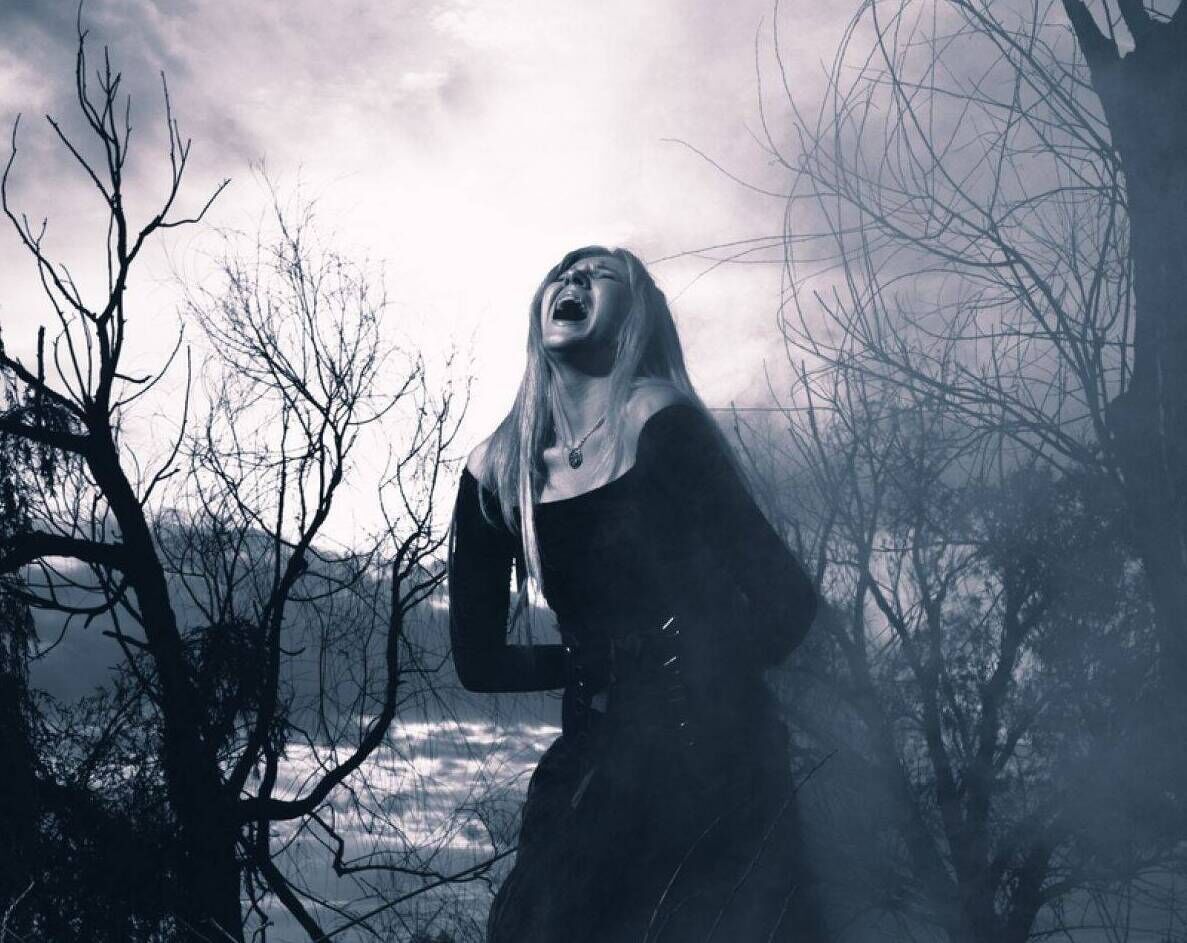
Although anyone with a shred of wit would know to give the banshee a wide berth, as illustrated by this account in the ever-fascinating folklore repository known as the Schools’ Collection (available on duchas.ie)
A man from Loughrea, Co Galway, told a folklore collector that two men, returning from a visit one night, saw a banshee sitting on a wall combing her hair.
As they approached, she disappeared but left her comb on the wall. One of the men approached the wall — it’s hard to refrain from shouting a warning here — then took her comb.
Here’s what happened next, in the words of the man telling the story: “In the middle of the night the banshee came to the window and asked the man for her comb. The man handed out the comb on a spade. The banshee thinking the spade was the man’s hand broke it in two.”
The man had some sense after all, but as Gillian Kenny says, to hilarious effect, if you happen to come across a woman combing her hair — and you can’t see her feet — just keep going.
“The banshee is a career woman with a job to do. Leave her alone to get on with her work. If you interfere with her or take her comb, there will be hell to pay.”
The discussion meanders to take in the origin of the banshee; her various names — bean-sídhe, (fairy woman), the badb, the bean chaointe (keening woman) — as well as her differing physical manifestations, from small woman in funereal dress with long grey hair to golden-haired, well, bombshell, if you are to go by some (funnily enough, male) accounts.
Incidentally, the clips of Patricia Lysaght speaking on the in 1986 are still available online. They offer a countrywide account of the banshee who has been witnessed in every county, although she has been heard but rarely seen in Cork and Kerry.
One of the theories that fascinates me is the idea that the banshee is actually a dead bean chaointe, or keening woman. There is a renewed interest in those women who ritually cried at funerals, expressing a collective grief in the most visceral and, ultimately, cathartic ways.
“Now, keening women are really extremely interesting because the Church kept trying to ban them,” says Gillian Kenny, before going on to give the most fascinating account of the women who performed a form of public poetry at funerals.
There was protest too, as sometimes they would weave political or personal messages into their chants.
And here’s a piece of hot gossip from history: we know from some descriptions that, on occasion, keening women used their funeral ritual to recall the faults as well as the attributes of the departed, or they snuck in tales of bad behaviour by a son-in-law or some other male relative.
The co-hosts of have an absolute field day with these mesmerising revelations, but there is a very important and forgotten message in their discussion too.
These women, for a short time, were allowed to step outside the bounds of convention and express themselves freely. Women, though we so often forget it, were all-important at the start of life and at its end. They brought people into the world, and they said goodbye to them.
Like the banshee, as the podcasters conclude, women were like guardians of these liminal spaces between life and death, and they were very loud while they were at it.
Unruly even, bringing us back to the joyous news that , a weekly podcast which revives all that was too weird, too outrageous or too untidy to make it into the history books, will launch on October 28.
CONNECT WITH US TODAY



Be the first to know the latest news and updates