Elaine Loughlin: Coalition reverting to the path of least political resistance on sensitive policies

The departure of the Greens has signalled a swift change of direction: In industry versus environmental arguments, it appears that big business is winning out
It is now over a decade since Simon Coveney pledged to end the use of hotels for accommodating homeless families, setting a deadline of mid-2017. File pictue 

It is now over a decade since Simon Coveney pledged to end the use of hotels for accommodating homeless families, setting a deadline of mid-2017. File pictue 

Without the moral compass of the Greens, the coalition has been unwinding and abandoning policies that would put this country in a better place for the generations to come.

Lobbyists for big business are being listened to, and political views have shifted based on quick wins.

Instead of taking what are often unpalatable decisions that provide no immediate pay-off but would reap dividends in the decades to come, this Government is reverting to the path of least political resistance.

There has been backtracking, and in some instances, full-scale U-turns taken on commitments around workers’ entitlements, transport policy, data centres, energy, and of course, the environment.

The shift has been particularly apparent in the area of housing.

This week it emerged that the Government has delayed a major action plan on child and family homelessness until the autumn.

Housing minister James Browne, who said back in April that the plan was being drafted and would be ready by June, seems to believe that more than 5,500 children living in emergency accommodation can wait.

Homeless charities and organisations supporting the most vulnerable children across this county have been screaming for adequate supports and a comprehensive approach from the Government for years, but the response has been less than enthusiastic.

A succession of housing ministers may refute this, but it is over a decade since Simon Coveney pledged to end the use of hotels for accommodating homeless families, setting a deadline of mid-2017.

In the intervening period, the number of families in emergency accommodation has continued to rise, jumping 18.1% between May 2025 and May 2026 alone.

This casual approach, however, appears to be in stark contrast to the one taken in relation to the short-term letting sector, which has been given a six-month reprieve in signing up to a new long-signalled register that the coalition has said will bring many holiday homes and apartments back into the long-term rental sector.

The change of direction came after lobbying from Airbnb, a company whose Irish-based unit reported operating profits of $151m (€130m) in 2024, representing a 24% growth. Airbnb’s European headquarters is based in Dublin and the company paid $26.4m (€22.8m) in corporation tax in 2024.

The changes, which would require property owners to register with Fáilte Ireland and would ensure units have appropriate planning permission, will now come into force in December, six months after the planned start date of May 20.

Documents released to Irish Examiner’s political reporter Tadgh McNally, under the Freedom of Information Act, show that senior Airbnb staff sought to have the short-term letting register delayed.

Airbnb’s director of public policy campaigns for Northern Europe, Middle East, and Africa Velma Corcoran wrote to the minister on May 7, expressing “strong concerns” about the introduction of the register, stating that property owners were “increasingly anxious about whether they will be in a position to comply in time for the upcoming busy tourism season”.

“The lack of a clear timeline is creating operational uncertainty for those who rely on this period as a critical part of their annual income, particularly in our rural communities, which depend so heavily on tourism,” she wrote.

The letter suggested an implementation date “in late 2026 or early 2027,” which is ultimately what the sector has been given. This reprieve was confirmed to Ms Corcoran in a response sent a week after her letter was received by an official in the department.

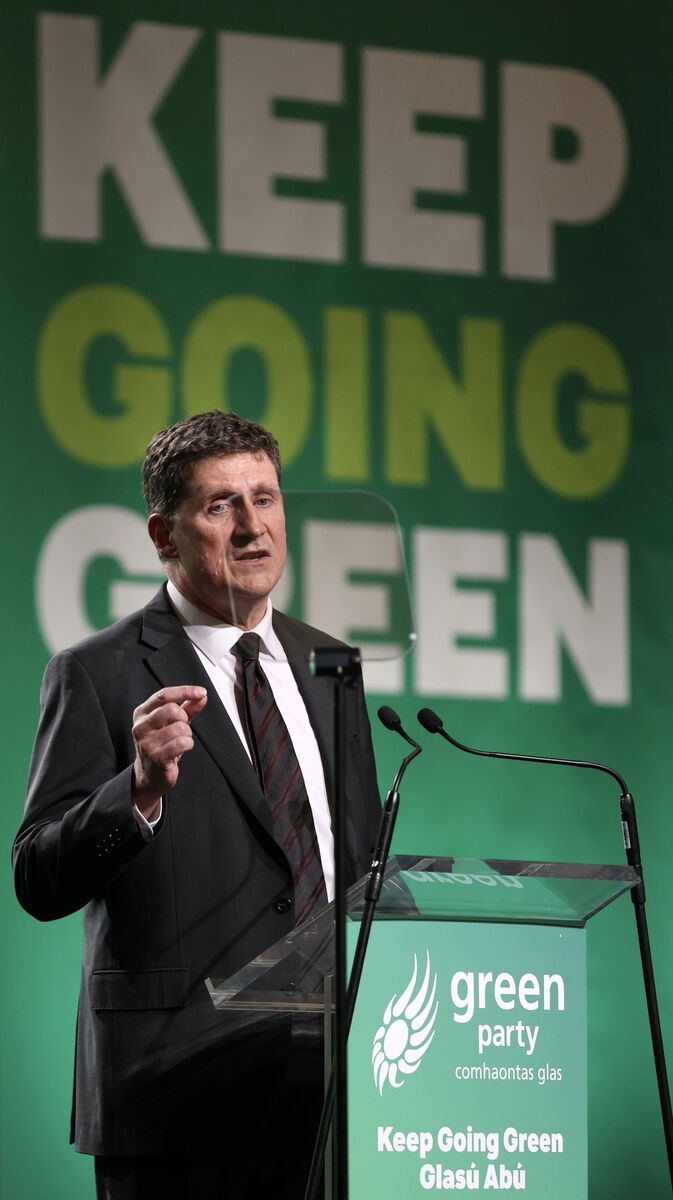
In the previous coalition, Eamon Ryan was often vilified and pilloried for his commitment to progress green-focused and socially-minded policies. A new level of toxicity entered the debate when Ryanair boss Michael O’Leary issued a volley of statements slamming the then transport minister and calling for his resignation.

Mr Ryan, as leader of the Green Party, had strongly opposed calls to raise the passenger cap at Dublin Airport, which O’Leary insisted was necessary to meet growing demand and to keep airfares down.

Those on Mr Ryan’s side of the argument raised serious concerns around the environmental impact of air travel as well as noise pollution around the airport.

But the departure of the Greens has signalled a swift change of direction. In industry versus environmental arguments, it appears that big business is winning out.

Eamon Ryan in 2024. In the previous coalition, he was often vilified and pilloried for his commitment to progress green-focused and socially-minded policies. File picture: Sasko Lazarov/RollingNews.ie

Legislation to lift the Dublin Airport Cap has already been progressed through the Oireachtas and passed into law earlier this month. Similarly, the coalition has all but forgotten previously held concerns around the expansion of data centres and the future use of LNG.

In government, Mr Ryan was willing to become a hate figure if it meant protecting his party’s core values and policies.

He became a mutual enemy of Fianna Fáil and Fine Gael backbenchers over his commitment to public transport and cycleways, a priority that was often seen as being progressed at the expense of investment in road projects. It led an exasperated Michael Ring to tell a meeting of the Fine Gael parliamentary party in 2023 that there would only be a cycleway — no roads — between his native Westport and Dublin by the time the Greens were finished in Government.

Mr Ryan was adamant that the 2:1 funding allocation was a red-line issue and provided the financial back-up for his ambition to create a public transport system that truly services communities.

Fast forward to his successor in the Department of Transport, Darragh O’Brien, who has taken a different approach. The National Development Plan (NDP), published last November, dropped any mention of the specific 2:1 funding allocation.

The plan outlined allocations of €10.1bn to public transport projects and €9.7bn to roads, an almost 1:1 ratio. Mr O’Brien has argued that a ratio that favours public transport will be maintained, but there is no doubt that the focus has shifted.

For example, figures from the National Transport Authority (NTA) show that, over the first six months of this year, just four new or enhanced local bus routes have been introduced under the Connecting Ireland plan. This compares to 36 routes introduced in 2025, 45 rolled out in 2024, and 65 introduced in 2023.

“Tar, tar and more tar, that is what the people of Ireland expect, and that is what we intend to deliver,” is how then minister of state Michael Healy-Rae described a €1.5bn roads programme announcement in February this year.

On another front, enterprise minister Peter Burke has been on a mission to unpick the progressive worker and employment measures which had been championed by the previous coalition.

A listening ear has been given to industry bodies and business heads at the expense of workers.

Plans to extend entitlement to paid statutory sick leave from five days to 10 days have been swiftly abandoned, with Burke making it clear the door has been “firmly closed” on any expansion of supports, pointing to concerns around “cumulative impact” of such regulatory measures on business owners in light of rising labour, input, and energy costs.

The Government had also changed the trajectory to a living wage from 2026 to 2029 because, as Burke put it, businesses are “under serious pressure” and “finding it very difficult”.

Being pro-business is not inherently negative, but prioritising this over workers, the environment, and the most vulnerable in society is.

More in this section

Revoiced

Newsletter

Had a busy week? Sign up for some of the best reads from the week gone by. Selected just for you.

Cookie Policy Privacy Policy Brand Safety FAQ Help Contact Us Terms and Conditions

© Examiner Echo Group Limited