Clodagh Finn: Bringing home something of the famine orphans who shaped Australia
Between 1848 and 1850, thousands of young Irish girls were sent to struggling colonies in Australia
Clodagh Finn: Bringing home something of the famine orphans who shaped Australia

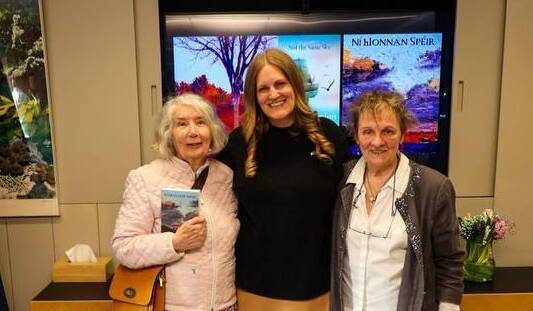
Translator Máire Nic Mhaoláin, Australia’s Ambassador to Ireland Chantelle Taylor and author Evelyn Conlon at the launch of the Irish translation of ‘Not the Same Sky’, titled ‘Ní hIonann Spéir’, which marks 80 years of diplomatic relations between Ireland and Australia.

I wish there was some way of telling the 4,114 so-called famine orphans dismissed as “workhouse scrapings” when they were first sent to Australia that the tide has truly turned.

It was extraordinary to hear the Australian ambassador to Ireland Chantelle Taylor speaking in Irish to honour the young girls who, between 1848 and 1850, were taken from workhouses all over Ireland and sent to a colony in desperate need of labour — and wives.

It was a chance to start a new life. Or so they were told when they were issued regulation trunks — packed with petticoats, clothes, utensils, and prayer books — and put on board ships to make the arduous three-month voyage to Australia.

It was part of a scheme developed by the 3rd Earl Grey, secretary of state for the colonies and son of the famous tea merchant. The Earl Grey Scheme — it took on his name — was considered mutually beneficial, if not ingenious: the burden of supporting orphans would be lifted from the authorities in Ireland while the male-dominated colonies would have a welcome influx of humble, “morally pure”, and fertile young women.

Given that the number of single men — white immigrant men — at the time was about 8,000, it is little wonder that one in ten Australians now claim Irish heritage. Between 1840 and 1914, over 300,000 Irish people made that long, perilous journey.

HISTORY HUB

If you are interested in this article then no doubt you will enjoy exploring the various history collections and content in our history hub. Check it out HERE and happy reading

And here’s one example to illustrate just how central those young Irish women would become to the foundation story of Australia. Bridget Ryan left Listowel workhouse in Co Kerry at the age of 13, which is exactly the number of children she went on to have with her Scottish immigrant husband James Murray. Her great-great-granddaughter Julie Evans estimates that she accumulated more than 5,000 Australian descendants.

But back to the story of the moment. The Australian ambassador was speaking at an unusually uplifting event to mark 80 years of diplomatic relations between Ireland and Australia. Not only were the “famine orphans” at the centre of the celebration, but they were recast as the brave young pioneers they were.

More than that, they were honoured in their own language. And with their own music.

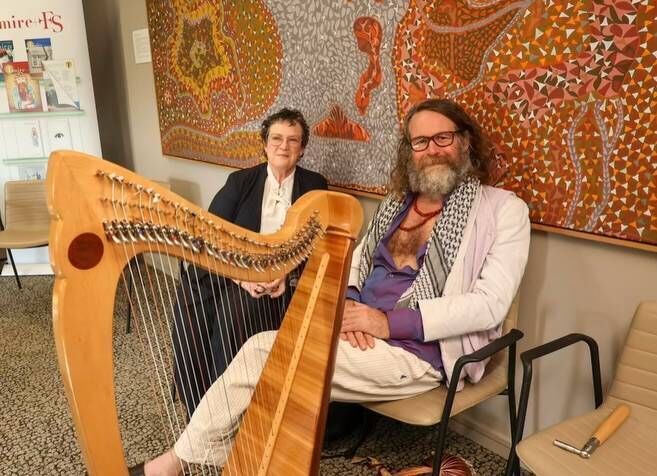
Musicians Fintan Vallely, Maighread Ní Dhomhnaill, and Liam Ó Maonlaí played 19th-century tunes they would have known.

Most significant of all, their story — so vividly told by Evelyn Conlon in Not the Same Sky — has been translated back into their own language by Máire Nic Mhaoláin.

Ms Taylor said the Irish version of the novel, Ní hIonann Spéir, re-connected the story to the young girls’ linguistic heritage, offering a more authentic understanding of their worldview.

“Their stories are central to the relationship between Australia and Ireland. In fact, one of my favourite passages in the book refers to some of the girls taking up ‘a new profession, that of making the best of it. They would polish this profession, and its gleam would crystallise to form part of the national character of where they were heading.’”

Musicians Maighread Ní Dhomhnaill, and Liam Ó Maonlaí joined Fintan Vallely to play tunes that would have been known to the 4,000-plus girls sent to Australia between 1848 and 1850. File picture

In Not the Same Sky, Evelyn Conlon follows the fate of four young girls, Honora Rafferty, Julia Cuffe, Bridget Joyce, and Anne Sherry, on board the Thomas Arbuthnot. The names of the girls are fictional, but the ship and its surgeon-superintendent Charles Strutt are very real.

Coincidentally, the aforementioned Bridget Ryan was on that ship, with some 200 others, when it sailed out of Plymouth at ten o’clock on a Sunday morning in late October 1849 and arrived in Sydney on February 3, 1850 after more than 90 days at sea.

We can join her thanks to Evelyn Conlon whose fact-informed narrative brings the experiences of these young girls, aged between 13 and 20, to life.

They are, she writes, caught between time and language as they try to make sense of the realities of going to a place where they wonder if the stars will be different, if they will be under the same sky.

Later, after arriving, one of them remarks: “And check your shadow, it falls a different way here.”

And then the devastating line: “But no one could remember how it had fallen at home.”

Evelyn Conlon captures the catastrophic uprooting in such lines, and her lyrical story is threaded with references to the loss of language, of culture, and of memory. It’s ironic that Charles Strutt has worked as a translator because, in a sense, it makes him the perfect person to witness the experiences of these young girls, beset by “spurts of fright”, as they try to translate their past into a frightening present and an uncertain future.

Half of the book focuses on the voyage, and then it follows the young women as they make their way in Australia.

I won’t give any spoilers here but in real life the new immigrants got jobs as minders, kitchen hands, domestic servants, or married and followed their husbands into the inhospitable wilds as the discovery of gold sparked a series of gold rushes.

It does not give too much away, however, to mention a particularly moving passage describing the howls of despair on board the ship as one of the girls thinks her first period is a sign she is dying.

This was a real experience described in the many records that thankfully survive, but it is powerful to have a writer as gifted as Evelyn Conlon show us the terrifying bewilderment felt by a motherless, aunt-less child-woman who doesn’t know what is happening.

At one point, the book was going to be called ‘Records on Globe Street’ because the author spent so much time researching the real experiences of the Earl Grey girls in the records office on that street in Sydney.

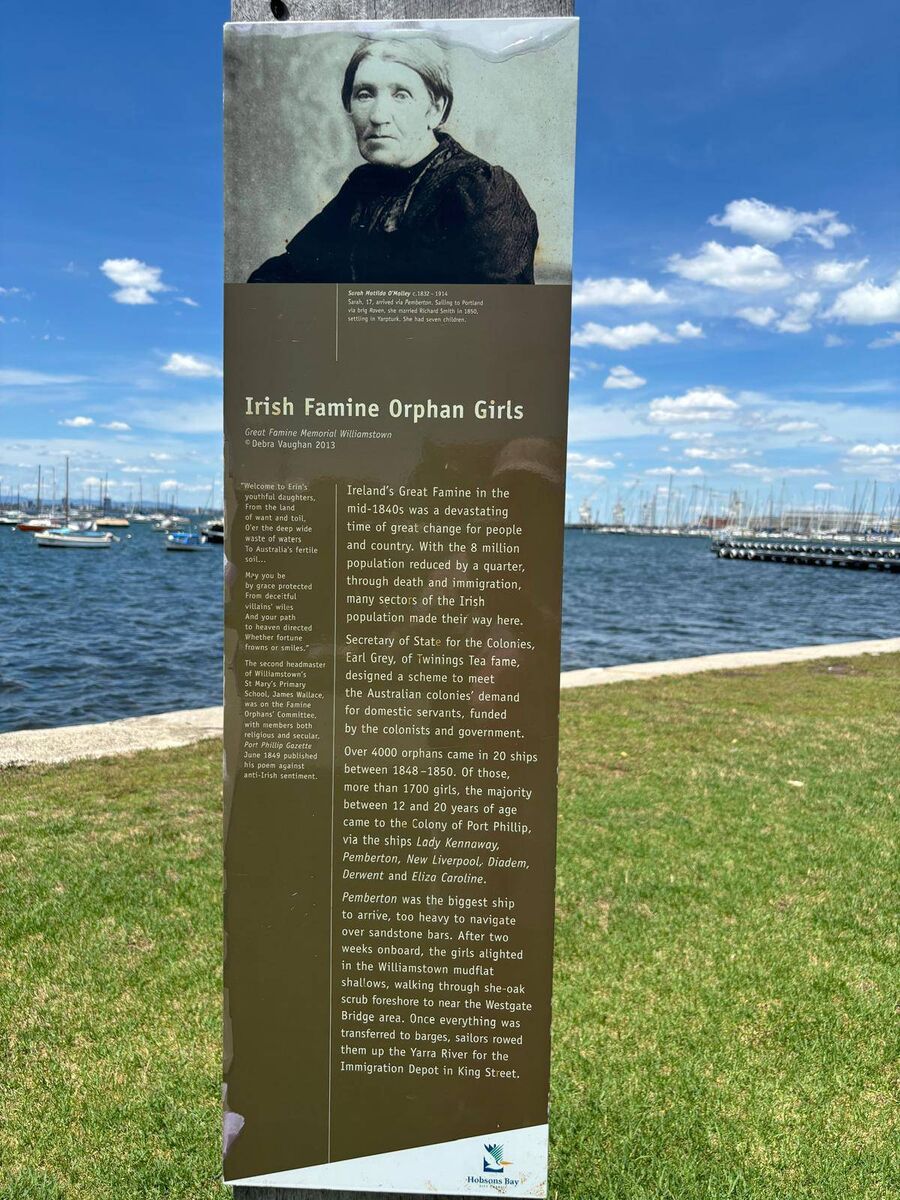
A memorial to the Irish Famine orphans in Williamstown, Melbourne, Australia. Picture: Angela Crowley

But why translate it into Irish?

“We, that is myself the author and Fionnuala MacAodha, the publisher, always felt that because of the motif of lost language throughout the book that it deserved to be translated into what would have been the language of those girls. It seemed to bring it full circle and having it launched in the [Australian] embassy, with such warmth and engagement, also helped to bring something of them home.”

Speaking at the launch, poet Annemarie Ní Churreáin said Máire Nic Mhaoláin’s translation “opened a new portal for us into history”.

She also mentioned another theme in the book, that of memorialisation.

In the opening pages, a modern-day stonemason Joy Kennedy is invited to go to Australia to plan a memorial for the girls.

Happily, there are now many real memorials, both in Australia and in Ireland. One was unveiled in Dunmanway, Co Cork, last year, and around that time a dear friend Angela Crowley sent a photo of another which she came across while travelling in Williamstown, Melbourne, Australia.

“Imagine,” she wrote, “so many young girls sent so far away.”

It is indeed hard to imagine what Sarah Matilda O’Malley, aged 17, (who is featured on the monument) felt when she arrived on board the Pemberton in 1849.

She and the other passengers had to wait two weeks on board — the ship was too big to dock near land — before wading through mudflat shallows and scrub foreshore to reach dry land.

At least now, the women who shaped Australia have been remembered in their own language in a book that succeeds in bringing at least a part of them home.

x

More in this section

Revoiced

Newsletter

Had a busy week? Sign up for some of the best reads from the week gone by. Selected just for you.

Cookie Policy Privacy Policy Brand Safety FAQ Help Contact Us Terms and Conditions

© Examiner Echo Group Limited