Paul Hosford: By-elections will highlight differing fortunes of government parties
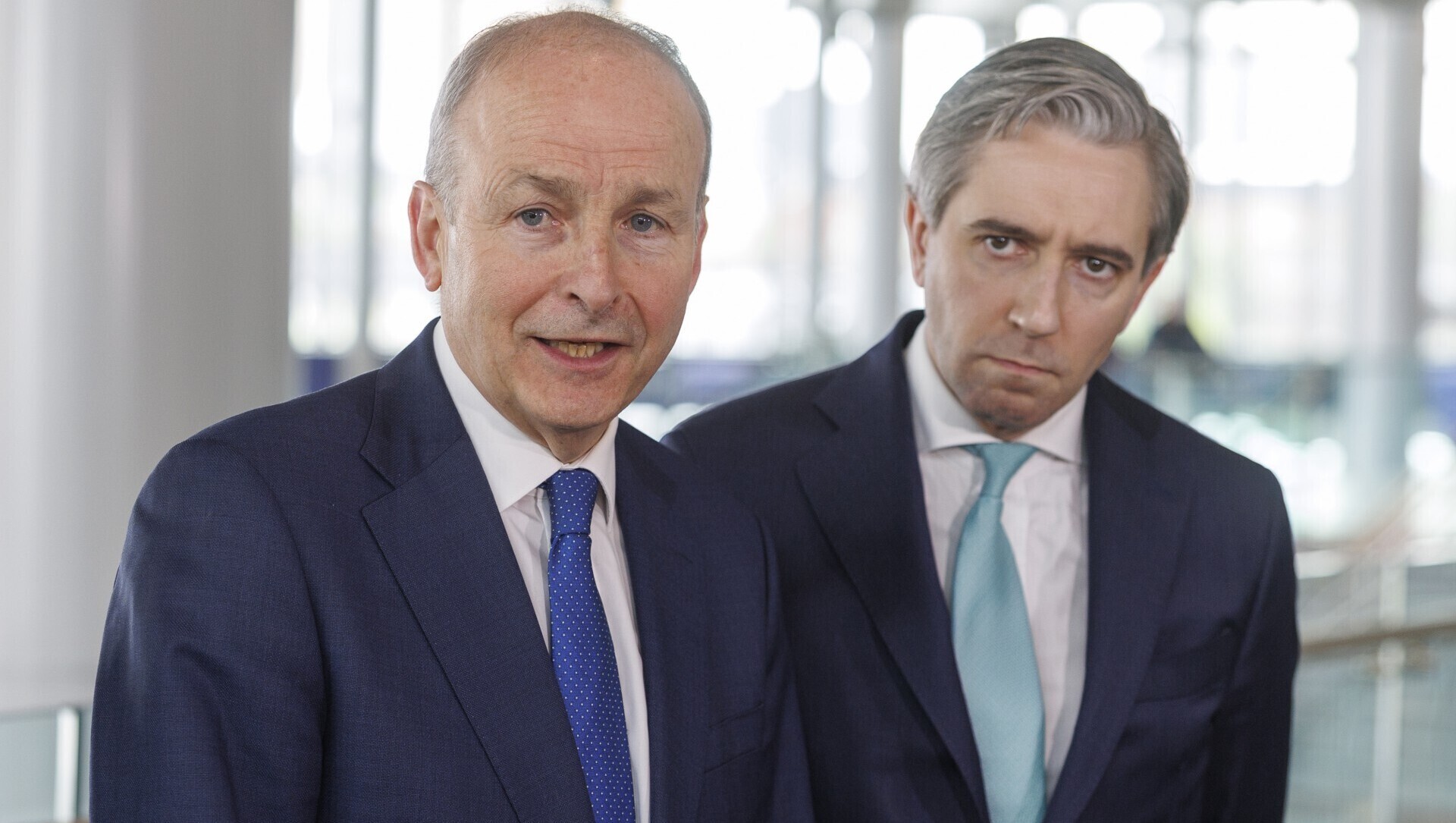
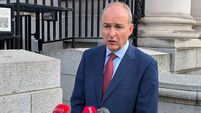
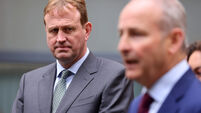
Taoiseach Micheál Martin (left) and Tánaiste Simon Harris (right) might see that government parties don't win by-elections. Photo: Liam McBurney/PA Wire
It is a sentiment that you will hear again and again over the coming fortnight. When the boxes are opened in Dublin Central and Galway West in two weeks, you will be told that the by-elections were and are a referendum on the government.
This is not untrue, it is important to say. By-elections, by their very nature, occur mid-term of a government and are always seen as a reflection of the satisfaction with and popularity of a government's manifesto.
And while it is manifestly true that this government has much skin in the game in both by-elections, particularly attempting to negate the loss of a senior cabinet minister, Fianna Fáil and Fine Gael are not the only parties with high stakes in the next 14 days.
The publication of a constituency level poll in Galway on Thursday evening has underscored just how much is at stake across the board.
To recap:
Fine Gael senator Sean Kyne holds a narrow lead in Galway West's by-election according to an Irish Times/TG4 opinion poll of the constituency.
Mr Kyne, a former junior minister, leads the poll on 17% of first preferences, followed by Independent Ireland's Noel Thomas on 16% and Labour councillor Helen Ogbu on 12%.
Míde Nic Fhionnlaoich of the Social Democrats is on 9%, while Fianna Fáil's Cillian Keane is a point behind. Both former mayor Mike Cubbard and Sinn Féin's Mark Lohan are on 7%, with Green Party candidate Niall Murphy and independent Thomas Welby on 6%.
Orla Nugent of Áontú is clocking at 4% of support with Sheila Garrity, the independent who was co-convener of President Catherine Connolly's Galway campaign, is on 3%.

The perceived and accepted wisdom is simple: government parties don't win by-elections. The last time a government party did so was when Fine Gael's Gabrielle McFadden held onto the seat vacated by the sad death of her sister Nicky in Longford–Westmeath in 2014.
Since then, eight times the parties of government have tried and eight times they have failed to win seats.
This is not surprising in and of itself. It's always easier to argue for change than the status quo, especially when the stakes are relatively low in terms of the overall make-up of the Dáil.
But seeing Mr Kyne leading, even accounting for the small enough sample size (530) and margin of error (+/-4 points) in the poll, indicates that Fine Gael is doing well to get its message across in the early days of the campaign proper.
Much of that is down to the senator's high profile and local track record, but it serves to underline the differing feelings of momentum among the two coalition parties.
In Fine Gael, they believe that Mr Kyne and its Dublin Central candidate Ray McAdam have genuine chances of either taking seats or staking claims for next time out.
In Fianna Fáil, there is not the same kind of belief. The party has been plagued by inner turmoil since the Jim Gavin for President experiment blew up on them and reports of a potential heave swirled following last month's fuel protests.
At that time, several TDs suggested that the mood of the so-called “middle ground” of the party had shifted, adding that more people would be willing to back a motion of confidence.
Fianna Fáil’s three youngest TDs — James O’Connor, Ryan O’Meara, and Albert Dolan — also published a statement warning that the party’s “social contract” with people of their generation was “strained”.
Allied to that, there have been reports that morale and enthusiasm is so low that canvassers have been thin on the ground in the by-elections, particularly in Galway where the party has, for some reason, sought to pitch the 25-year-old Mr Keane as "an independent-minded government TD" in waiting, almost casting him as something of a Healy Rae of the Tribes, an Eyre Square brawler ready to bring the fight to the Government of which he aims to be a part.
Party sources called this characterisation "bizarre" and "confusing", but some have begun to doubt that the party leader, Taoiseach Micheál Martin, would be too wounded by poor results for Mr Keane and his Dublin Central counterpart, John Stephens.
The argument goes that Fianna Fáil holds the Taoiseach's office and is therefore more identified with government policy and, some argue, has fielded less experienced candidates with an eye for the future.
Both are councillors, but neither has contested a general election, so this is essentially a free hit to build status.
But that relies on the national narrative on the day not being a Fianna Fáil disaster.
The party took nearly 17% of the vote in the general election between John Connolly who became a TD and former TV presenter Gráinne Seoige, who did not.
By-elections change the mental arithmetic of many voters and it is possible that some who would prefer to see a Fianna Fáil TD are moving towards Mr Kyne in an attempt to beat Mr Thomas, himself a former Fianna Fáil councillor.
But the potential rewards and pitfalls also exist across the opposition, too.
For Sinn Féin the fact that Dublin Central is party leader Mary Lou McDonald's constituency does, whatever party members may argue, turn the focus on her.
Ms McDonald has led Sinn Féin to being one of three mid-sized Irish parties, forcing in many way Fianna Fáil and Fine Gael to coalesce.
But doubts remain over whether that means the party can ever lead a government.
While reports of a potential heave in that party last month were played down quickly, not carrying either seat as lead opposition against a government which is hardly shooting the lights out, may cause questions.
The Social Democrats will look at Thursday's poll and see its candidate Míde Nic Fhionnlaoich as a decent outside bet.
However, in Dublin Central Daniel Ennis is seen as a front-runner and a win there over government parties, Sinn Féin and more right-wing independents like Gerry Hutch and Malachy Steenson would be a momentum boost for the party.
Labour, on the other hand, will look at it the opposite way.
The party saw Marie Sherlock beat Mr Hutch to the last seat in Dublin Central in 2024, but didn't have an obvious choice this time around.
Ruth O'Dea's polling next week will be interesting, but Helen Ogbu's third place in Thursday's version was a boon to all in red.
If she can bear out that polling and be even competitive on the day, the party will consider it a victory.
But bigger questions abound for Independent Ireland and Áontú. Both parties have seen huge bumps from the protests, but Mr Thomas appears the sole hope for a seat.
According to the figures, he will poll well but is transfer repellent. Will there be enough ballots at the end of the count day to see him over the line?
While by-elections are merely a snapshot, they will offer an insight into the level of work needed from both parties to turn dissatisfaction into votes.
Two weeks out and it's all to play for, for everyone.