Jennifer Horgan: Patriarchy makes fools of us all, men and women alike
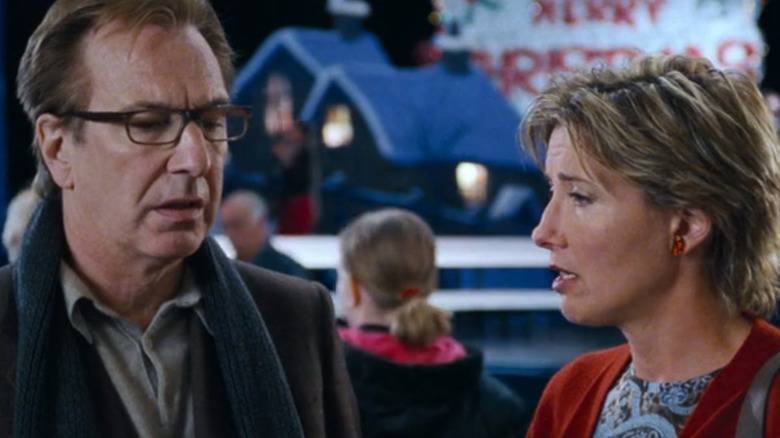
Alan Rickman and Emma Thompson in Love Actually.

Remember that scene in when Emma Thompson’s character confronts her husband about his affair? He (played by the glorious Alan Rickman) says, self-involved to the last: “I’m so in the wrong — a classic fool.”
Thompson replies: “Yes, but you’ve also made a fool out of me. You’ve made the life I lead foolish.” I’ve always loved that line. Who we are — husband, wife, friend — is dependent on someone else.
The patriarchy denies this interdependence; it closes the door on vulnerability and on our entangled need for care. It has a public face only, one that thrives on competition, force, and profit.
It is America today, chanting, beating its chest: U-S-A, U-S-A, U-S-A… The patriarchy has started to make our personal lives feel foolish. There is a growing disconnect between what is happening politically, and how we spend our days.
Kindness, care, creativity, nurture — these are absent in world leaders, in what we’re reading, seeing, and absorbing. In a political sense, we are shackled to cheating husbands, and our hearts are breaking from it.
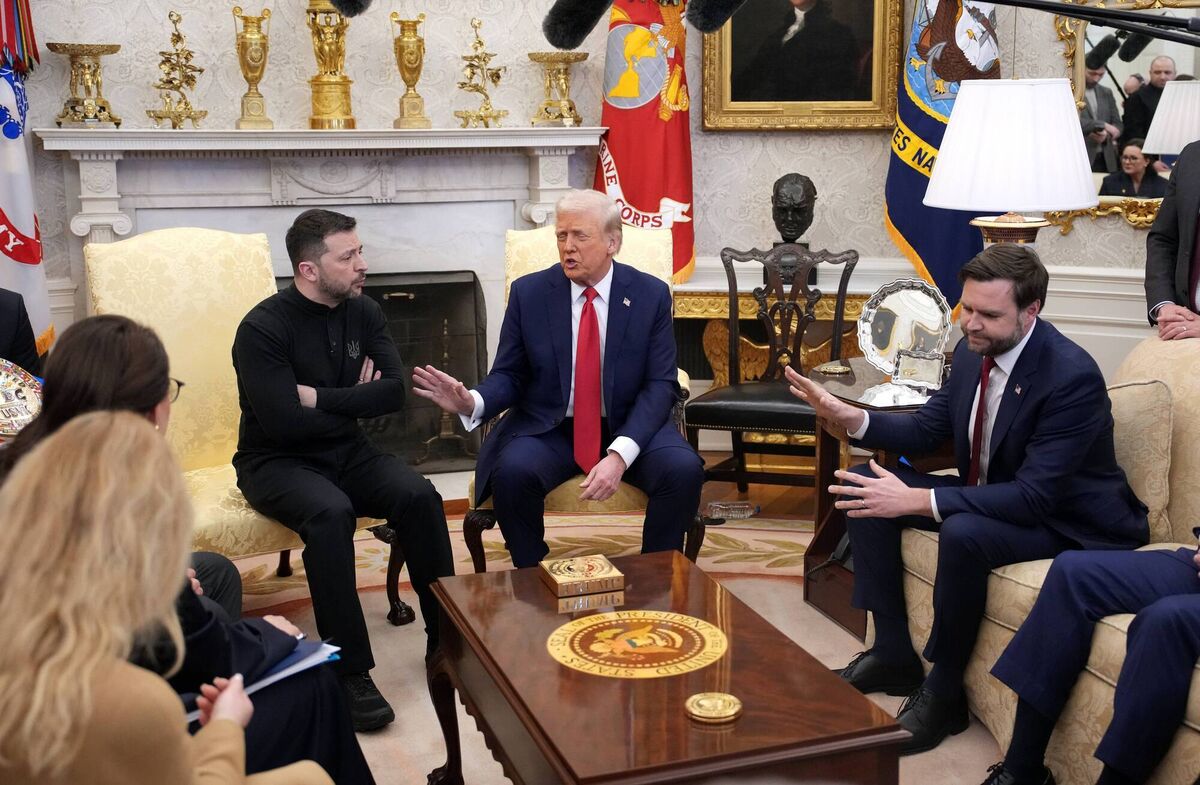
Donald Trump and JD Vance didn’t just bully Zelenskyy in the Oval Office: in that moment, they attempted to make all decent people, their lives, look weak and foolish.
Thankfully, our interdependence lifts us back up. Everywhere I look now, I see kindness and joy — each instance an act of resistance. And I wonder, desperately hope, that in this darker-than-dark hour of patriarchy we might find a brighter dawn of matriarchy.
People sometimes misunderstand the word matriarchy. It is not just more of the same, with women ruling over men. No, matriarchy flips our priorities as a society, and it supersedes biological sex altogether.
According to renowned German scholar Heide Goettner-Abendroth: “A matriarchy is based on maternal values: caretaking, nurturing, mothering. This holds for everybody: for mothers and those who are not mothers, for women and men alike.”
In a matriarchal world, the whole DEI debacle disappears. We don’t need to beg for concessions, for admittance, for acceptance. People are supported whatever their gender, race, or ethnicity.
A matriarchy acknowledges that we are born defenceless and in need of care. Being a man or a woman is of less importance. The matriarchy is as embracing of men as it is of women because every person has caring abilities. Care becomes our chief social value — the glue that binds us.
In a matriarchy, every human carries the care load as a matter of pride. We “get to carry each other”, as Bono sings in U2’s eternally beautiful song, 'One'. It is a privilege, not a burden because it is central to everything else.
I was asked recently if capitalism would be possible in a matriarchy. I don’t know, but it would certainly change. Preservation of the planet would come before profit. People would come before profit too.
The world doesn’t have to be this way. Are more of us beginning to understand that?
Might we be realising that this sidelining of care to women arguably deprives men of their humanity — harms them, literally kills them, and simultaneously harms women too.
There is a compelling argument that our patriarchal environment is physically hurting women. Four-fifths of people hit by autoimmune disorders are women. Chromosomal and hormonal differences play a role, but the impact of chronic stress caused by prioritising others’ needs in an environment that doesn’t allow for it is very real too.
This is, of course, before you even begin to consider gender-based violence and its devastating impact on us all.

Gabor Maté is well known for his work on trauma and its impact on our bodies. The Canadian physician highlights connections between women’s role in society and their health. Gabor describes how women prioritise others' needs over their own and experience chronic stress. Suppressing anger, he says, is a key part of their suffering.
Nice people, he explains, tend to become unwell. Of course they do, in a world run by people like Trump and Putin, but more significantly, in a world that ignores care, that desensitises people to their own humanity.
Women are sick from maintaining the values of a matriarchy in a patriarchal world. Men are sick from being locked out of what defines them as human beings.
This should make us all very angry but, in the patriarchy, we are told to be quiet. The medical system encourages quiet. Quiet means compliance with the systems we live in.
In this week that celebrates women, I wonder how many women are medicated, and I also wonder if they would be, if the world was better designed for the whole person, rather than an economic unit — as it would be in a truly matriarchal society.
I went to the out-of-hours doctor recently for back pain. He was a happy-go-lucky type and mentioned that I seemed down in myself, possibly because I wasn’t responding to his jokes. Then he asked if I was taking anti-depressants.
As I’ve explained here before, I’ve been taking antidepressants for over 10 years — not because I’m depressed but because I have PMDD — a sort of PMS on steroids.
“Ah well, you’re clearly not on the right dose,” he declared. “I’m going to increase it for you.” When I got to the pharmacist, I heard myself say that I didn’t want the anti-depressants on my prescription. Since seeing that doctor I’ve stopped taking them altogether.
It annoyed me that the doctor was willing to up my dose without knowing anything about me whatsoever. Anti-depressants have a terribly numbing effect on me, on both my body and my feelings. Upping the dosage might seem like a tick the box exercise to him, but it has very real consequences for my relationship with the world.
So far so good — aided by being on HRT no doubt. I couldn’t have done this five years ago, and I may be getting it wrong. Time will tell. Anti-depressants save lives but, in my case, it’s about my cycle.
It made me think: are anti-depressants really the answer for so very many of us? Are they yet another version of the hospitals and asylums we were once locked up in? Are we still locked up today? Ireland is reportedly the loneliest nation in Europe. Perhaps we need something other than anti-depressants? Perhaps we need to be seen and cared for and valued.
An programme in 2019 entitled Medication Nation found the number of patients who were prescribed antidepressants through publicly funded drug schemes increased by 18% from 2012 to 2017. Individual dosages during that period increased by 28%. Almost a quarter of prescriptions for anti-depressants in 2022 were for people aged 75 or older — how terribly sad.
Maybe they are doing us a favour as living embodiments of the patriarchy. It’s easier to defeat the enemy you can see.
Given the clear choice, maybe we will all see that the value of love, actually, is a far better bet — and that the patriarchy is making ‘classic fools’ of us all.

CONNECT WITH US TODAY



Be the first to know the latest news and updates