Clodagh Finn: The Kerry woman who needed ‘witness protection’
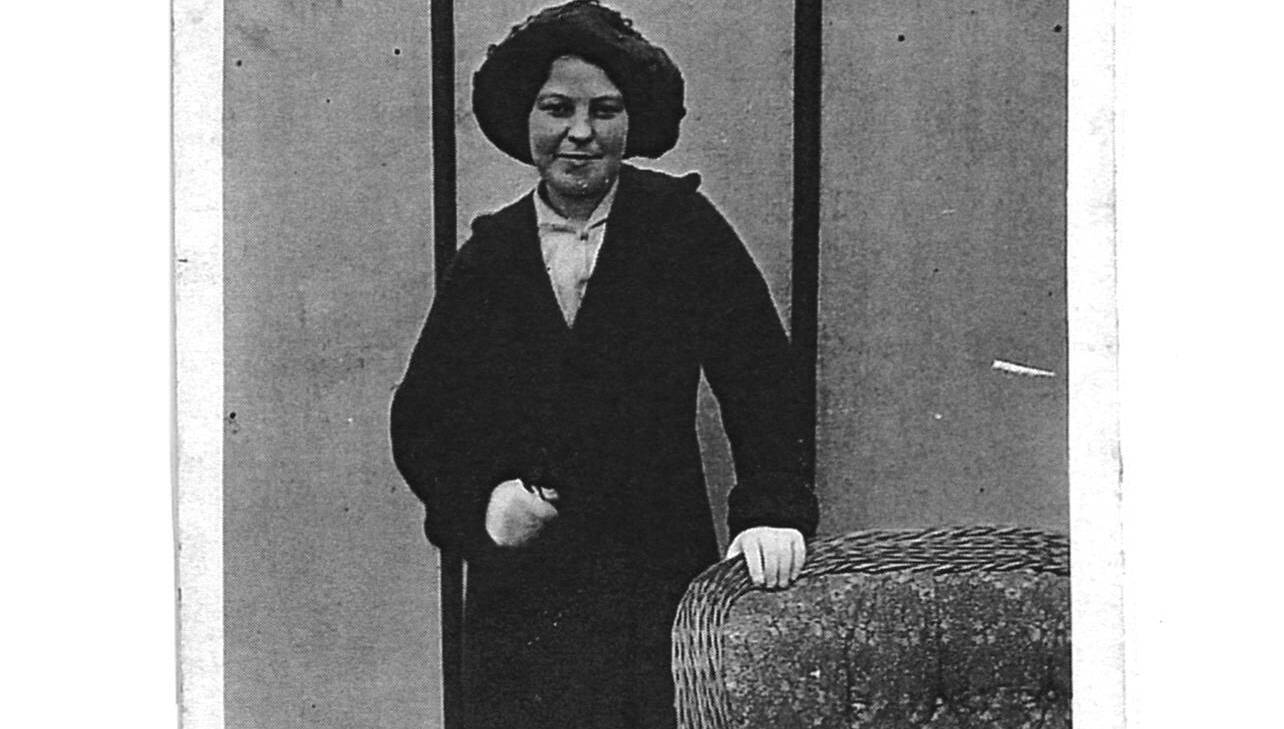
Mary Gorman while in London to give evidence at Roger Casement's trial in 1916.

There’s a film in the story of Mary Gorman, the farm servant whose life took an unimaginable course after she happened to see Roger Casement walking along the road in Ardfert, Co Kerry, with two other men on Good Friday morning of 1916.
Her accidental sighting took her to London and introduced her to celebrity of sorts, as outlined here last week. Her brief moment of fame (or infamy, depending on how you look at it) backfired cruelly when she returned home.
Two short years later, she was on her way to Dr Steevens’ Hospital in Dublin under the alias Julia Quinlan — her second name change in as many years — to be treated for a venereal disease.
At least the authorities took some responsibility for this young woman who had “fallen victim to the wiles of an Australian officer”, as one official put it, after she appeared as a Crown witness against Roger Casement in 1916.
She had little say on giving testimony, much like the four other ordinary citizens — three from Ardfert and one from Tralee — who later found themselves caught in the political crossfire when they returned home to a country much changed after the Easter Rising of 1916.
Yet, there is not a shred of self-pity evident in the letter Mary Gorman wrote to Dr Coffey, the man who helped her when she first presented at the infirmary at Tralee Workhouse in late 1917.
In it, she comes across as a well-informed, educated woman taking control of her own healthcare. She is matter of fact and open when talking about syphilis perhaps because attitudes to the illness were changing, in the medical profession at least.
Dr Steevens’ Hospital opened a dedicated venereal disease clinic in January 1919, eight months after Mary began treatment there. Even if the illness still carried an enormous social stigma, treatment for it had improved.
Mercury, so toxic to the human body, had been replaced by a course of novarsenobillon injections which was followed up by a new blood test to assess improvement.
In her letter to Dr Coffey in Tralee, it is clear Mary Gorman was aware of all of this and was looking for his advice. Her Dublin doctor had proposed she return home after getting four of the six injections. She, on the other hand, thought it would be better to stay at the hospital.
It didn’t make sense not to complete the treatment, she wrote, but her greatest concern was having to go back to Ardfert.
“I would rather go somewhere else,” she wrote, expressing her clear dread of returning to a small community where she was seen not only as a traitor but now as a woman of loose morals as well.
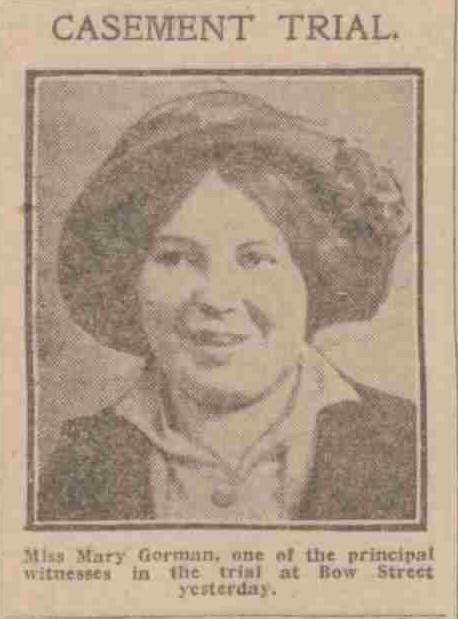
What is striking was how this young woman — she was still only 20 — was able to make her case and say she was entitled to treatment. She had read in the paper that the treatment scheme got plenty of money from the government.
“I can’t understand why they treat me as if it was a compliment. I think it is for the good of the State I am contenting myself here so long. It isn’t like as if I wanted to go around and give it to everybody else like others do.”
By then, she had spent more than a year at the hospital while the authorities at Dublin Castle tried to find her a job abroad as soon as she was cured.
It must have been impossibly difficult for Mary Gorman. She had expressed the injustice eloquently herself earlier in 1918 when she was brought before the Board of Guardians at Tralee workhouse. She had gone in there as Mrs Mary Donaldson but was outed as the witness in the Casement trial shortly afterwards.
In her defence, she said: “I only said I saw three strangers passing down the road… The police came and said I would go off to England. I knew nothing about Sir Roger Casement. They sent me off to England where anyone is not safe.”
Her situation was not only personally distressing, but it was considered hot news.
On its front page, labelled the proceedings “unusually interesting, in fact they were almost historic”, yet it expressed some sympathy for Mary Gorman.
“It is hard, very hard for a young, and I suppose unsophisticated country girl to be drawn into the whirling vortex of great political happenings and come out unscathed.”
The writer also agreed Mary Gorman had been abandoned by the authorities and argued the government and not the Tralee ratepayer should provide for her now: “What I look upon as the most important, and disgraceful feature of the whole affair is that Mary Gorman, after working for the government — and thereby rendering herself obnoxious to many in the community — was subsequently ‘thrown away’ by them, as herself stated.”
Mary Gorman had others to speak for her, such as local government inspector Alfred P Delany, who said she had been subjected to a “most painful inquisition” at Tralee workhouse and should be given a chance of a new life.
“She is held up as an odious outcast, and her case is cited as an example of the dire consequences that must overtake anybody who, in a political case, assists the Crown — these consequences being first, Irish hatred, and secondly, English abandonment,” he wrote.
A series of fascinating letters in the Dublin Castle records, marked secret, tell the story of how the authorities did, in fact, do the right thing. They paid for her treatment and sought a job abroad for a woman who had “met with misfortune”.
Meantime, her uncle Timothy Gorman wrote to the king of England and the British government to say he would care for her at his home in New York.
“She is afraid they [will] shoot her [if she returns to her grandmother] for the people there is sticking up for Casement’s radical work,” he wrote.
At the end of 1919, 'Julia Quinlan' was deemed fit to travel, and her passage to New York was paid. She was escorted to Liverpool by policewoman Mary O’Neill with a suitcase full of new clothes — boots, four chemises, a skirt, frock dress, underwear and travelling rug, among them — and £10 in her pocket.
She set sail on January 14, 1920, on board the ocean liner Baltic, to be met, we assume, by her uncle of 206 West 19th Street, New York.
At home, it would take nearly a century to rehabilitate her memory and that of the other witnesses, Michael Hussey, Martin Collins, 12, Maurice Moriarty and John McCarthy.
As the latter said: “We are the innocent victims in this misfortune and you only brought us here [London] to throw the blame down on us.”
In 1966, John Blackwell wrote an article in arguing the witnesses were ordinary people caught up in events beyond their control.
But, says his grand-daughter Helen O’Carroll, historian and curator of Kerry County Museum, people were not ready to hear that side of the story. In 2016, she wrote an article in the Kerry Archaeological and Historical Society journal outlining the fate of those reluctant witnesses.
Attitudes had finally shifted, 100 years on.
Meantime, Mary Gorman aka Julia Quinlan, disappeared from the historical record once she landed in New York. Did she change her name again?
If so, who could blame her and yet we owe it to her to write the next chapter of her story. The search continues.

CONNECT WITH US TODAY



Be the first to know the latest news and updates