Joyce Fegan: There's a reason Seamus Heaney said to drive out west
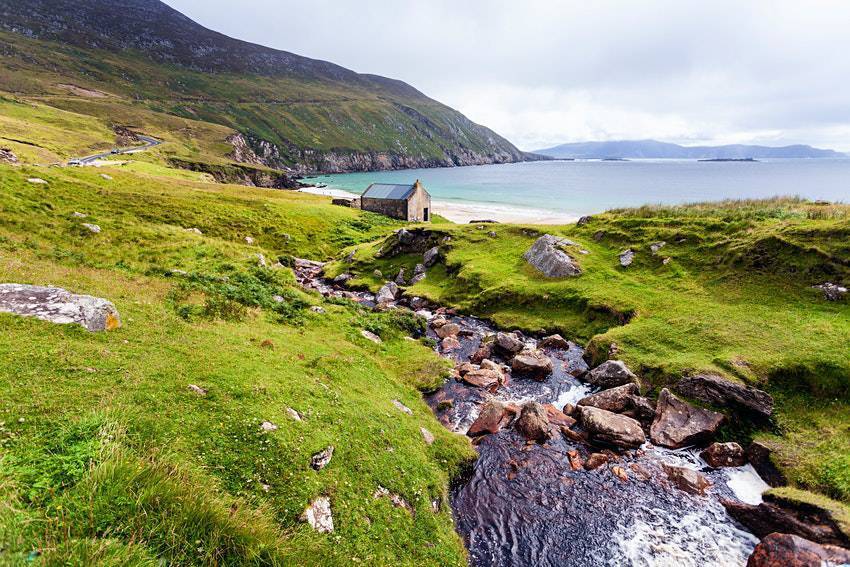
The majestic Keem Bay on Achill Island has been included among Lonely Planet's Top 20 beaches in Europe.

Sitting on a deserted white strand, next stop Newfoundland, with shallow turquoise water rippling softly towards you and blue skies up above, the Great Famine is the farthest thing from your blissed-out mind.
And yet here on Omey Island, in Connemara, between 1841 and 1851, its population almost halved because of hunger, poverty and misery.
It must be hard for our ancestors to imagine us now, 170 years later, driving out here with our smartphones and our Instagram, having nothing more to do than to take our shoes and socks off to walk barefoot around this paradise.
It's hard to imagine how a place that contained so much pain, suffering, and death can now provide new generations of this land with so much beauty, pleasure and solace after months and months of hardship of a different kind.
And, of course, now, as so many of us heed Seamus Heaney's advice to drive out west, be it to Clare as he suggested, or to Kerry, Cork, Donegal or Mayo - there are other Omey Islands. It is paradoxical that places of such pain have become places of such pleasure.
Find me another country that contains the turquoise waters of Keem Bay, the sheer cliffs of Slieve League, the soup bowl loop walk of Coumshingaun, the Great Saltees off Kilmore Quay, the peninsula of Loop Head with its views to Kerry, a summer sunset on Sherkin Island, the stoney shore of Clahane, the Howling Ridge of Carrauntoohil and pollock holes for life-affirming cold-water immersions.
No jet lag necessary.
Last summer, some of us talked about staycationing with an almost condescension.
"Where are you going on your 'holidays'?", we'd ask, air quotes around or a tone change for the word holidays.
Twelve months later, has our gratitude for this island matured beyond the term "staycation"? Because it's not that there are worse places you could "stay" for a vacation, but on a good day, can you find me a better one?
The fact of accessibility also comes to mind. Travel here is not just for the rich or privileged. Transport doesn't require expensive flights and accommodation doesn't mean beach chalets in the Maldives or bed nights in New York. Time off work needn't come into the equation either.
Lahinch, from Dublin, is a three-hour drive and camping isn't the poor man's option - who wouldn't want to wake up looking on to the Atlantic Ocean, wind and weather willing.
In my local supermarket, a staff member who has made Ireland his home, recently clocked up 50 hours in a week. Smiling, he said he was grateful for the work, but couldn't wait for the reward - to spend time with his young family out west, "the best thing" he could do. He couldn't believe where he could get to in just a weekend.
During our collective lockdowns, we hailed our frontline workers, such as the aforementioned supermarket employee. Some of us also hailed the beauty around them, the nearby green space or swim spot or forest walk.
While "eaten bread is soon forgotten" is an idiom for a reason, perhaps the once-in-a-lifetime experience of a pandemic might turn the temporary fad of appreciation into a permanent fashion.
If you follow the money, maybe the appreciation is here to stay. Property website Daft said the price of coastal properties has gone up by 23% since the pandemic.
The new option of remote working was cited as a reason. Remote, a word that has been thrown into our common parlance these last 15 months without much reflection, we've used it to refer to an activity, work, performed in a different place to where it is usually done.
But using it how we used to, to indicate a place that's far away, a remote beach, or a remote village, or a remote headland or a remote swim spot, it's another paradox that we are now retreating to all these places of remote beauty when given the choice of where to live.
Surely that endorsement, to settle somewhere new, shows the real appreciation many people have for this island, having been confronted by a life-altering event such as a pandemic.
With its wind-slanted trees, hundreds-years-old stone walls, and miles of wild daisies lining the boithríns of the west, this is a place people take in on planned and long-saved-for world trips.
Those people would probably be bemused at any condescension used by someone who has the good fortune to drive out west and end up in places like Keem Bay, Clahane shore, Loop Head or Rossbeigh Beach.
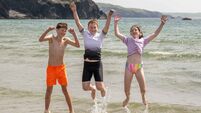
You pack up the car, grocery shop done, sausages packed, maybe a deck of cards, the togs, and can arrive in a place a few hours away with white strands, turquoise waters, next stop Newfoundland, surrounded by your cousins, your grandchildren and nieces, and the pet dog.
Find me a worse scenario.
Seamus Heaney, a Nobel laureate, could have written about anything or anywhere. There is a reason he wrote about the Flaggy Shore in Postscript. And there are many Flaggy Shores around.
"And some time make the time to drive out west," he starts, "And catch the heart off guard and blow it open," he ends.
This land, that was once a place of so much suffering and misery, is now a place offering us much solace after much hardship. The choices for remote beauty are plentiful. We can climb mountains, soak in salty Atlantic waters and eat freshly-caught fish at the end of the day.
We mightn't be able to count on sun-soaking ourselves, or getting in rounds of golf on the Algarve or eating fresh tomatoes on the Amalfi Coast but Ireland is not a place to be sneered at as sloppy seconds.
This island is another man's treasure.
And after 15 months of loss, loss of life, missed rites of passage and disconnection, this island, this summer, offers us all some much needed restoration and reconnection.

CONNECT WITH US TODAY



Be the first to know the latest news and updates