Paul Hosford: Irish politics is so fractured, an outright majority for any party is hard to see
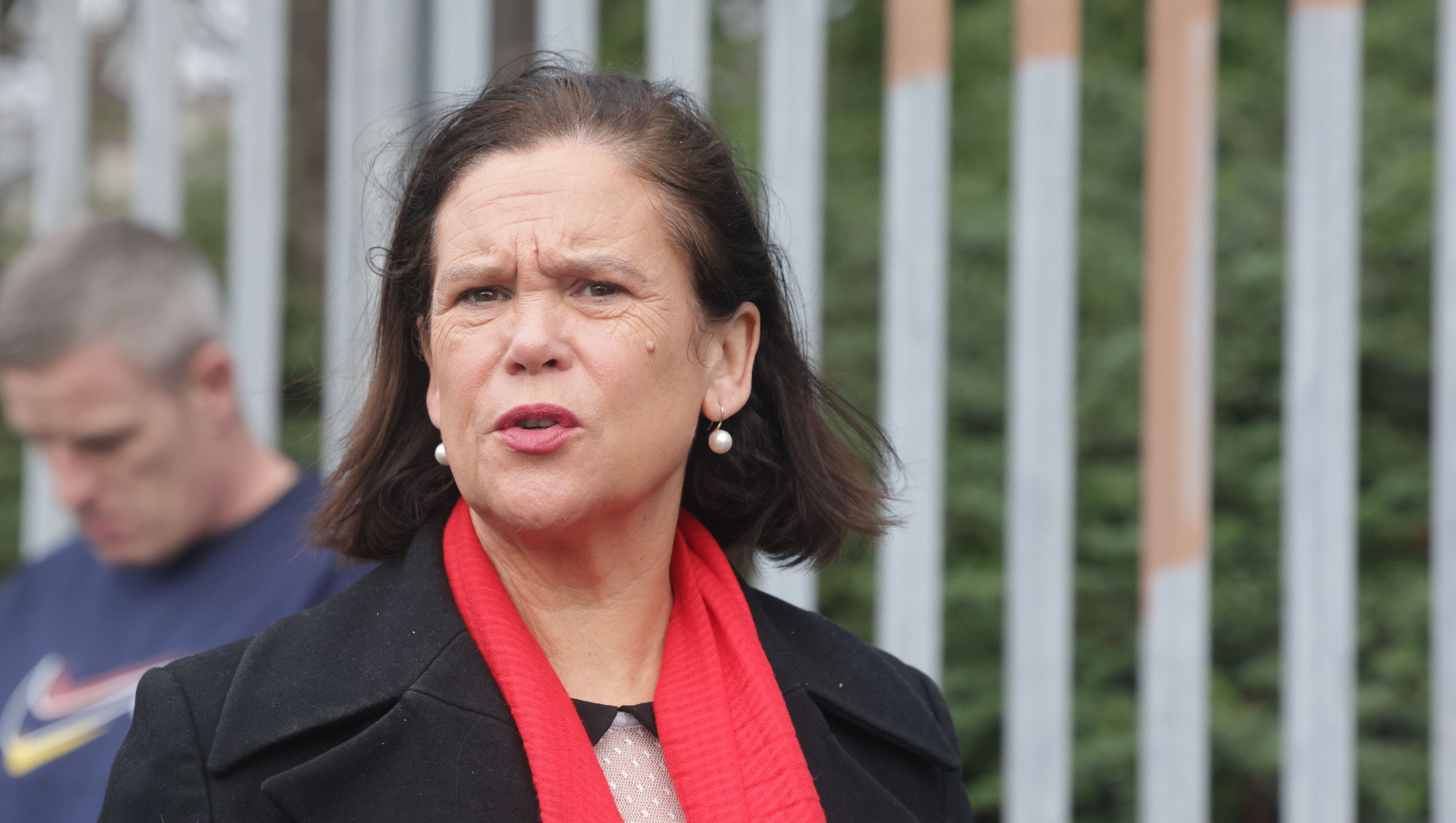
Mary Lou McDonald's party was the most popular in this week’s Irish Times/Ipsos B&A opinion poll at 24%. Picture: Leah Farrell
It's a funny thing, opinion polling.
Just over a year after the Government was formed, the polls once again have Sinn Féin leading, with alarm bells being sounded about Fianna Fáil’s sluggish performance.
It’s deja vú all over again, as the great Yogi Berra once said. Part of this is simply frequency. Since the last general election, there have been 28 published opinion polls. That’s roughly one every two weeks.
Does the public mood swing to any great extent fortnight to fortnight? Is anyone, really, that mindful of a general election when the coalition looks solid, an election is four years away, and the country has had every type of poll it could have in the last two years? All debatable.
That Mary Lou McDonald’s party was the most popular in this week’s Irish Times/Ipsos B&A opinion poll at 24%, even with a three-point slide, is not surprising.
The Government parties are largely perceived to be somewhat stuck in the mire and there’s something of a public sense of apathy towards the whole edifice of politics, particularly in the dreary post-Christmas weeks.
Besides, Sinn Féin has led in the polls outright since October, its central role in the combined left effort to elect Catherine Connolly president setting the stage for a minor surge in polling which has since held but levelled out.
However, there won’t be any suggestion that Sinn Féin HQ was popping champagne corks on Thursday, not least because the party has been here before.
At the one-year mark of the last government — the summer of 2021 — Sinn Féin was regularly polling around 30% alongside Fine Gael, with Fianna Fáil on the brink of collapse according to polling.
This time, it doesn’t feel the same.
The party that had an unexpectedly good 2020 election and a disappointing 2024 has solidified itself as capable of attracting 20% of the electorate.
It has built a more robust and deeper parliamentary party and has attempted to craft its way into being a more broadly appealing party overall.
But there is a nagging doubt with the party that, much like the Irish soccer team, it struggles to play while ahead or as the favourite.
Likewise, there is a risk of writing Fianna Fáil off as a busted flush as many did back in 2021.
Sinn Féin has spent much of the past five years looking like a party on the brink of power.
It topped the popular vote in 2020, regularly polls near the top, and has successfully branded itself as the voice of voters angry about housing, healthcare, and the cost of living.
And yet, in general election terms, its path to government remains stubbornly uncertain.
The first problem is arithmetic.
Irish elections are not winner-takes-all affairs, and governments are made in the space between parties rather than at the ballot box.
Sinn Féin could again emerge with the highest vote share and still find itself locked out of power if Fianna Fáil and Fine Gael choose to do another deal — something both parties have shown they are perfectly willing to do, turning a once unthinkable coalition into a go-to centre holding option.
Unless one of the Civil War parties blinks, Sinn Féin needs a crowded and potentially ideologically messy coalition to reach the magic number and that’s assuming that it can carry a large number of those seats.
Then there’s the question of whether there is a ceiling on its support and where it might be.
Sinn Féin has proven it can mobilise younger voters and those locked out of home ownership, but that coalition has limits.
Polling over the past half decade suggests its support is soft rather than solid, drifting to independents, the Social Democrats and Labour.
Its pitch on housing is clear and emotionally resonant, but its broader economic position can feel less settled as it tries to sell a message radical enough to justify change, that also reassures middle-income voters that it won’t rock the boat too much.
That is a very fine line to tread.
On the flipside, Fianna Fáil’s polling numbers have a habit of looking terminal, right up until they don’t.
Time and again, the party has appeared written off, only to recover when elections loom and voters start asking themselves who they actually trust to run the country.
Poor polling has rarely been a death sentence for Fianna Fáil; more often, it has been a familiar staging post.
In the 150 or so opinion polls before the 2024 election, Fianna Fáil held a lead in just two before taking the most seats and highest vote share.
The party’s near-wipeout in the teeth of the financial catastrophe in 2011 was supposed to mark the end of its relevance, the death of Fianna Fáil as an electoral force.
Instead under Micheál Martin it has rebuilt steadily from the ground up, clawing back support election by election, culminating in its return to government less than a decade later.

Even in more recent cycles, Fianna Fáil has shown an ability to outperform expectations, converting middling or weak polling into solid seat numbers once the campaign begins and undecided voters drift back to the party.
Part of this resilience lies in Fianna Fáil’s deep organisational roots and broad, if sometimes unenthusiastic, voter base.
It benefits from a cohort of voters who may not profess strong loyalty in polls but reliably turn out on polling day, arguably the most important thing a party can have.
When campaigns sharpen around issues of stability, economic management, and governing experience, Fianna Fáil has repeatedly found a way back into contention arguing its record of being able to command the levers of the State.
For his part, Mr Martin during the week played down his party’s polling, as he seems to have to do on a weekly basis nowadays.
“I mean I don’t really get fazed by those polls,” he told Newstalk’s Claire Byrne.
“I mean the bottom line is, if you go back to a month or two before the last general election, we were at 17% in the polls.
“It means nothing; OK, it means something.
“I don’t want to be too dismissive but it seems to me the three bigger parties in our system are in and around 20%.”
Mr Martin’s contention is one that is substantatively true; Irish politics is fractured to the point that an outright majority for any party is hard to see.
Those parties’ recent histories matter now. Polls capture mood, not muscle memory.
How Sinn Féin plays from the front and whether Fianna Fáil can once again steadily improve in the build-up to elections will be a four-year storyline.
But for the next two weeks, the polls say what they say. Until they don’t.