Carnival is over and long hot summer in Ireland awaits
Here in La Gomera, and throughout Spain, the Burial of the Sardine is over, and the end of Lent is celebrated with ‘Carnaval’, writes Damien Enright

Carnival is over and long hot summer in Ireland awaits

‘Carne’ means meat, and ‘valle’ means ‘farewell’ —presumably farewell to 40 days of fish suppers. Soon, the festivals of Easter will begin.

We will be home for Easter, and looking forward to a long, glorious Irish summer, if it happens. In a lifetime of travel, I have concluded that nowhere is more beautiful than Ireland, and few places as hospitable and friendly. Looking through photographs on my computer, I find myself amazed with the beauty of scenes I casually snapped. It was just another walk, just another view — but it was in Ireland and, most likely, breathtaking.

I’ve written yards about Ireland’s beauty but, of course, have failed to capture the beauty as it exists. The words, if I get them right, may have a pleasing ring to them, but they are not the thing itself. Its loveliness is uncapturable. It changes with the light, from nanosecond to nanosecond. Great painters entrap it.

Light-entrapment is, perhaps, the most identifiable characteristic of great painting, and a standard by which great painting may be judged.

However, while, at the hands of a great painter, the magical light of a landscape, a bowl of flowers, a face, is ‘captured’, caught in stasis, it cannot ever be the same as it was then. The living light plays on the captured light and changes it.

In the landscape in Ireland, this is especially true and we may thank the gods of nature for it. Forty shades of green, and a country which, at all times of the year — not only in March — has many weathers. Nevertheless, I shake my head in wonderment at the beauty of the scenes which my camera, often set on automatic, captured. It is, as they say, ‘eye-candy’; the photographer cannot miss. And for the naked eye, Ireland, is visually worldclass.

Maybe being born in Ireland brought changes in light to my attention, the light on leaves, on water, on the sea, in alleyways, on car bonnets. When I was a teenager, I used to be able to tell the time of day without a watch. Of course, in Ireland, we live in light that is constantly changing, perhaps more than elsewhere — more than in, say, the skies over deserts or snowscapes, unchanging deep blue for hours at a time.

The sun breaks through the clouds; the clouds sweep over the sun; the mist becomes rain; the rain clears and everything sparkles. Seen thus, we can say truly that, on our native island, we live in many different worlds. This is no hyperbole. We all know that it is a different world when the sun shines and we view our surroundings standing out of doors, and when the rain falls and we have to see it through a window, sheltering inside.

To return to the Spanish ceremony of The Burial of the Sardine, the ritual may arouse some curiosity.

In the case of this island, a giant, papier-mâché sardine is put on a podium and set fire to. On the nearby island of La Palma, a sardine effigy is exploded with rockets.

The sardine’s demise is part of the Carnaval, which has its origins in the Roman feast of Saturnalia. At Carnaval, the streets become a moving circus of parades and floats crowded with men and women half-dressed, cross-dressed or costumed like cabaret stars.

The carnival of Santa Cruz de Tenerife is famed as one of the most magnificent in the world. Carnaval was banned for 40 years by the dictator Francisco Franco because he feared that its uncontrolled freedoms might engender revolution against his repressive state.

However, no sooner had he passed away than the dusty costumes were recovered from the attics and cellars where they lay hidden, and the Carnaval burst forth again.

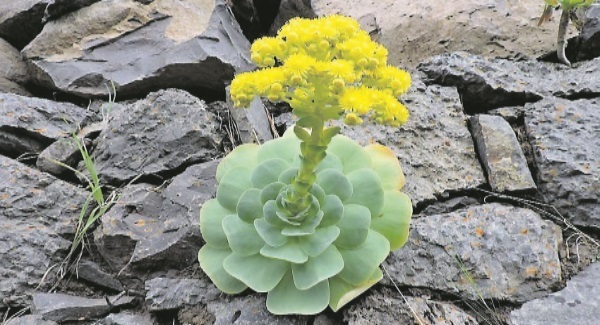
It signals, too, the coming of spring which, indeed, it already here. Meanwhile I learn that at home the ravens are already nesting on the cliffs of the Seven Heads and the first celandine and primroses are in flower. Here, the wild aloe vera is blooming, and house leeks.

House leeks (Supervivium tectorum) are weird succulent plants, and have nothing to do with onions. Flowering bright yellow to deep purple, they grow on cliff faces, walls and the roofs of old, clay-tiled houses. Tectorum relates to roof; the ancient Romans grew them on roofs to protect them from thunderbolts. Where the “leek” comes from I don’t know.

More in this section

Revoiced

Newsletter

Had a busy week? Sign up for some of the best reads from the week gone by. Selected just for you.

Cookie Policy Privacy Policy Brand Safety FAQ Help Contact Us Terms and Conditions

© Examiner Echo Group Limited









