Trumpeting the wonders of snorkelling in La Gomera
In La Gomera, below the giant manta ray, a trumpet fish swirled and swam, slowly and gracefully, like a Disney creature, write Damien Enright. 
Trumpeting the wonders of snorkelling in La Gomera

This was only, of course, after the manta ray hauled itself onto the edge of the concrete steps, receiving its evening sardines to the delight of onlookers. Nothing is lower than a manta’s belly.

I mention the trumpet fish only because I encountered one a week ago when I was snorkeling in shallow water, and was greatly surprised to see it, firstly because I’d never seen one in all the years I’ve surface dived in these waters and, secondly, because they look so surreal.

Long and thin —their length is a dozen times their diameter — they swim with a tiny, whirring fin almost at the tail, and have heads with jaws extending one third of their entire length. These can, apparently, can extend like the mouth of a trumpet to suck in unwary prey.

The jaw is articulated and looks it, in the mechanical (rather than linguistic) use of the word. The design might work well for a JCB.

They are attractive fish, expert as an octopus (or nearly) at changing colour but pink overall, with parallel black spots. On the move, they cruise slowly and sinuously between the mossy chasms of the seabed. What I found most fascinating was the little whirring fin near the rounded, black- and-white striped tail, and the fact that the 50cm specimen I saw was, at first, hanging head down, slowly wafted along in the gentle flow of the incoming and outgoing sea. It was a live fish, not a dead stick; it was quite surreal.

However, this pretending-to-be-a-stalk-of-drifting-kelp is one of the trumpeter’s hunting techniques: it simply hangs upside down and sucks up any creature — sometimes broader than itself — that passes underneath. It has a built-in vacuum device for doing so, a sort of a stomach Hoover or Dyson. Like the pelican in the children’s rhyme: “Its beak can hold more than its belly can”, and it can engorge prey large than its gob.

It must, indeed, present a bizarre sight, hanging upside down with a fat clown wrasse, or some similarly colourful dinner sticking out of its elasticated mouthparts, tail wriggling.

What took me down to the sea that day was the arrival in the post of a strange and wonderful device sent to me from the Czech Republic by my son. It is like a Stars Wars space helmet, and wearing it, I looked like a bug, a creature whose head was all eyes and too big for its body.

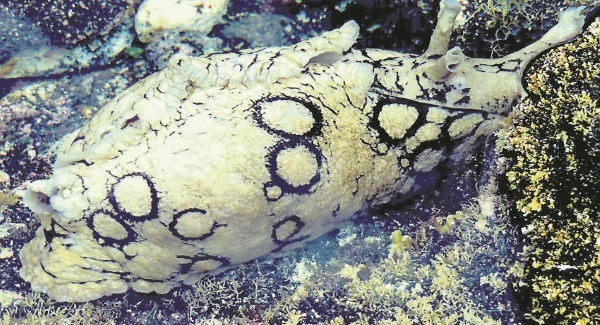
Per my son’s comments, while old-fashioned masks and snorkel tubes suffered from leakage and misting, this device gave a clear view, and did not leak. It can be found on the internet and, having used it, I would recommend it to any amateur fish observer. One breathes inside the mask with perfect ease and, provided one does not ambitiously dive, it seems leak-proof, at least so far. It is perfect for someone who, like myself, enjoys simply lying face down on the surface, observing the world below. [This will be impossible in Ireland just now, I realise, but summer is only months away, after all.] Some days ago, exploring the shore at the lowest of low tides in bare feet, my companions and I, mask-less, found exotic creatures of hues and forms almost beyond belief in the clear waters of rock pools, the floors and walls of which, themselves, might have been scattered with the jewels of the east so lovely were the sea lichens and corals, anemones and starfish and shells. It is near impossible to not be arrested and awestricken (never mind awestruck) by the astonishing beauty of each pool. The creatures within are “of such stuff as dreams (or nightmares) are made on”. They would be unimaginable, were they not real — the sea slug that issues purple dye in clouds as soon as touched, the brittle stars of different colours, with four thin, snaky legs emanating from a hub as big as a euro, the 30cm sea worms, brilliant pink and white, with a hundred feet — and the octopus.

It was your correspondent here that found the octopus — by chance, of course: I am no octopus-aficionado. I saw it peek from beneath a coralline-covered rock, a single, yellow eye, and soon we had it out, and changing colour, climbing all over us, showing its talents brilliantly before we let it go — despite the fact that it was a two-suckered occie, a delicious species, distinguished by two rows of suckers per tentacle, unlike the single-row species which are tough to eat.

More in this section

Revoiced

Newsletter

Sign up to the best reads of the week from irishexaminer.com selected just for you.

Cookie Policy Privacy Policy Brand Safety FAQ Help Contact Us Terms and Conditions

© Examiner Echo Group Limited