Sarah Harte: It's strange to attend a wedding as an almost-divorcée
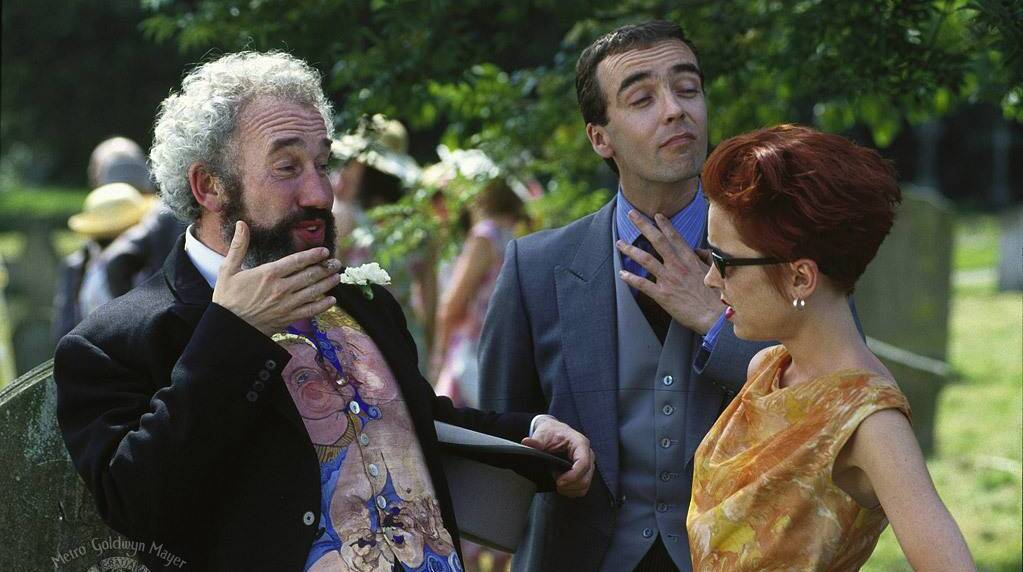
Simon Callow in Four Weddings And A Funeral. The two- or three-day conspicuous multiple outfit wedding took a bath during the recession, to re-emerge post-covid with a vengeance.

It’s wedding season. Time to buckle up and watch couples light candles. It’s strange to attend a wedding as an almost divorcée. You can feel like a haunting ghost of marriages past.
You’re not quite matrimonial Basil Fawlty goose-stepping across the carpeted hotel room or aisle, saying: "Don’t mention the divorce". But nor are you scrambling to catch the bouquet.
Read More
You can also indulge in a few private laughs. As couples quaveringly read their vows (the ones personally written usually have the most comedy), you adopt the standard ‘ahh’ wedding resting face. You still believe in love and being a polite guest.
Inevitably, though, a part of you imagines them arguing over who forgot to put out the bins. You tell the bride she looks elegant, even if she is trailed by a train that requires air traffic control.
Last weekend, I attended a family civil wedding, which is now the most popular way to get married according to new CSO data. The CSO also confirmed fewer of us are getting married.
The number of marriages fell by 7.7% between 2014 and 2024. Catholic ceremonies decreased by 51% in that same 10-year period.
Yet the marriage plot celebrated in Victorian novels still has a grip on us. To watch a teenage girl as a bridesmaid at a modern wedding is to have it confirmed that, even in the era of no-fault divorces and serial monogamy, the matrimonial Princess fantasy still has massive purchase power. And not just on teenagers.
How we celebrate has changed. In our grandparents' day, short wedding breakfasts were common, with the bride and groom leaving for their honeymoon on the day. In rural areas, some guests went back to work afterwards.
Change came gradually until the Tiger, when credit smoothed consumption. Weddings became extravaganzas with cinematic production values. The grandchildren of couples content with a modest honeymoon in a B&B required back-up wedding dresses, a retinue of hair and make-up people, stylists, wedding planners, multiple bands, and retro chip vans.
The theme became ‘I’m worth it’. During that era, you may have crisscrossed the globe for different weddings. You’d wake up somewhere and think, wait, where am I? Is it Tuscany, Umbria, Puglia, or Lazio? No sea, so it can’t be the Amalfi Coast.
At one African extravaganza involving connecting flights, bi-planes and boats to get there, one older guest, batting away a mosquito, posed the question to me: "What’s wrong with your generation? Why can’t people get married at home and honeymoon here instead of dragging us halfway across the world?"
He was also unconsciously pointing out that weddings feel compulsory even when people resent attending.
Stuck up the top of an Umbrian hill in a monastery, admiring the view for the hundredth time, supping warm white wine, fretting about how to get back to my lodgings (for this read vastly overpriced with no flushing loo and low lights to mask the dust in some palazzo passed off as shabby chic), I became a refusenik.
I permanently recused myself from foreign weddings, developing health problems, or having fictitious elderly relatives who needed me.
The two- or three-day conspicuous multiple outfit wedding took a bath during the recession, to re-emerge post-covid with a vengeance. Some weddings go on so long that it’s like being taken prisoner of war.
But getting married is a serious business in Ireland. We can take a bow for our attitude to marriage in Ireland, because, along with Malta, we have the EU's lowest divorce rate.
As to the health of those marriages? I divide the more longstanding unions I know into three broad categories.
First up are the happy marriages. It’s not that they haven’t had spats, but they are characterised by true friendship and an enviable simpatico.
In the second gang, love often flickers like a night-light about to go out. Now and then, after a few too many wines, wives sidle up to you to speculate on a future untethered to their better half.
They often wistfully ponder what solitude might be like before jettisoning the self-revision and soberly ricocheting back to, "He’s great, really".
Very common in this group is the statement that "if I were unlucky enough to be widowed, I’d never marry again". Maybe this is good enough because, as Kafka wrote: "There are no unhappy marriages, there are only incomplete ones, and they are incomplete because they were made by incomplete human beings."
There’s something realistic about a couple being grateful for what they have, not expecting to have it all, and being willing to negotiate within the bounds of something workable.
That said, you secretly suspect it might be curtains for some marriages in this category if the money ran out, or they felt they had money enough to leave, two sides of the same financial coin.
Then there’s the third category, the crew going down on the Titanic. They have morphed into polite flatmates who lead separate lives with a nominal marriage. Security has been traded for happiness.
Nothing is prising this pair apart, presumably because of convention, fear of stigma, or a lack of imagination.
They’ve ticked that box, and when they bury each other, there’s presumably a grim satisfaction in reflecting that nobody could say they didn’t make the finish line.
Noticeable as well after lengthy, unhappy marriages is the tendency of the one left behind to canonise the newly departed.
Jane Austen was right that marriage is fundamentally a social contract. It might not be acres these days bringing people together, but people must bring things to the party for it to work. When that equation is lopsided, cracks appear.
Archconservatives, often with smug, eerie opinions, would say you should keep on papering over those cracks even when they become fissures.
These opinions are often bookended by a study from an obscure American institute on how a small sample of couples chose to stay together when the rules around divorce were tightened.
Many of us agree that keeping the marital engine running is better for social stability and children. But the much-vaunted model of marital continuity that is pushed at us culturally sometimes leaves a person a captive of an unhappy marriage that has become a bad habit.
Like most things in life, it is about striking a balance between trying hard to make something work and not throwing away a marriage like a digital photo and not squandering your life in the service of an ideal.
So powerful is the marriage plot, in which matrimony is the ultimate goal, that it takes courage to change your mind.
So, at last weekend’s wedding, emotions clashed against one another like tectonic plates. I admired the leap of faith. I checked myself from saying: "Run for the hills".
I wistfully noted my failed marriage. I hoped the couple would not just make it but be happy.
But later, after a twirl around the dance floor, I slipped away to my hotel bedroom, flung the gold heels into a corner, and, padding to my bed, thought, oh, to be single and accountable to no one.
I can’t lie. It’s not the worst fate.

CONNECT WITH US TODAY



Be the first to know the latest news and updates