Leopards encountering a spot of bother
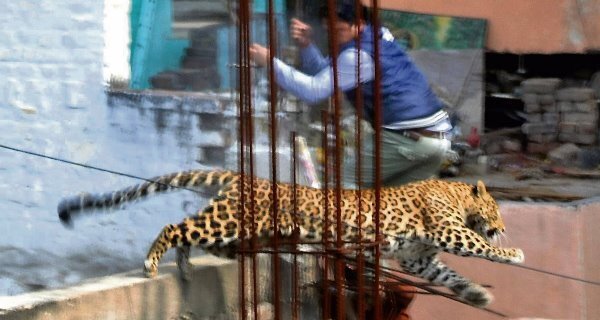
Her research confirms a widespread belief, among ordinary Indians, that leopards have a penchant for eating domestic dogs.
Athreya studies leopard/human relationships, a hot topic in India where the big cats are sighted, occasionally, even in large cities. Leopards hardly ever attack people but the exploits of some notorious ones live on in folk memory. The infamous Rudraprayag leopard, for example, killed 125 people before it was despatched by the legendary Jim Corbett in 1926.
Athreya collected ‘scats’ in a cropland area of Maharashtra where there is a substantial leopard population. The cats visit Akole, the local town of 16,000 souls. Analysing DNA extracted from the dung, she identified what the leopards had been eating. There are 174 goats per km2 in the study area but only 24 dogs per km2. However, only 11% of the leopards’ food was goat-meat, while dogs accounted for 40%. Dogs are more vulnerable than goats; farmers round up and protect their livestock at night. Given the numbers of feral dogs and cats, researchers believe, the area could support 10 leopards and hyenas per 100km2.
As part of her study of human-leopard interactions, Athreya captured two male and three female leopards, living close to human habitation. The cats were given neck-collars with GPS tracking devices. One of the animals was released 45km from where it was found. Another was transported 89km away before release. The three remaining leopards were let go where they were captured. All were tracked for up to a year and their movements logged. Two of them gave birth during the study. None of the cats was ever in conflict with people.
The two trans-located leopards avoided humans, although they often came within 25m of a dwelling. Active only at night, their home ranges proved to be much larger than those of the three animals not transported. Indeed, the cats released close to home ranged over the smallest areas ever recorded for leopards. These results debunk the theory that leopards seen close to human habitation are wandering vagrants which have blundered accidentally into the area. They are, in fact, residents living under cover locally, perhaps killing domestic and feral animals for food.
Athreyas’s work is well known in India, thanks to an animal adventure film, based loosely on fact, released in Maharashtra last May. ‘Ajoba’ is the leopard hero of the piece; his name means ‘grandfather’ in Marathi. In 2009, Ajoba fell into a well in Ahmedabad and was trapped for three days. Then, rescuers lowered a ladder and the chastened cat climbed up into a cage. Athreya ministered to him, fitted a GPS collar and released him 60km away. She is played by an actress in the film. On a 29-day journey, Ajoba crosses rivers railway tracks and busy roads on a 120km journey to Mumbai. He never harms anybody; the film’s message is that leopards are no threat to people. The real-life Ajoba was killed trying to cross a road two years after being released.
Leopards are very adaptable creatures. Visiting South Africa’s Thornybush Reserve recently, I encountered a mother and her cub. She had killed an impala and dragged it under some bushes. Extraordinarily, she allowed our jeep to come within a few metres. Indeed, neither she, nor her kitten, took much notice of us. Perhaps the cats had grown accustomed to jeeps approaching them and knew the vehicle wasn’t a threat. The encounter suggests that leopards, given a modicum of tolerance, are prepared to live close to human settlements without undue problems for either man or beast, apart from stray dogs. Athreya’s work in India confirms that such détente is possible.
- A cat among the dogs: leopard diet in a human-dominated landscape. Vidya Athreya. Conservation India. 2014

CONNECT WITH US TODAY



Be the first to know the latest news and updates