Our political culture is at stake if we tinker with budgetary targets

I wonder how many people now remember Pedro Solbes? Don’t worry if you don’t, not many had heard of him at the time and fewer paid any heed to him. Pedro was a Spanish MP for Alicante. An economist by profession, he served in Spain’s socialist governments as a minister in the 1990s and was EU Commissioner for Economic and Monetary Affairs 1999-2004. I couldn’t remember his name either, so I googled.
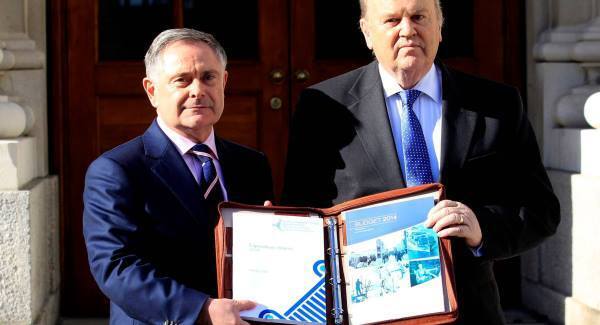
What sent me looking for him was listening to the chairman of the government’s Fiscal Advisory Council, Professor John McHale. McHale followed up on the Fiscal Assessment Report — think mock Leaving Cert results for Michael Noonan and Brendan Howlin — with interviews across the airwaves yesterday. McHale is fluent, keeps it relatively simple and I think is fairly persuasive. If I have it right the gist of what the Fiscal Advisory Council has to say is that so far, the Government has more or less gotten it right on the economy. Yes, they should have gone a bit further in terms of the adjustment carried out in last year’s budget, but they were lucky and have gotten away with it. Give or take I think that’s all reasonably fair. The Government has thus far, done a good job economically.
Their political problems are connected, but also distinct. Firstly Labour in government has done almost the opposite of what it said it would do when in opposition.
The fact that I think Brendan Howlin has done a good job as minister for public expenditure (but not reform!) is part of their problem. I am not a Labour voter and Labour’s so-called ‘values’ give me acid reflux. If the likes of me is giving him two cheers, he really does have problems with his political base. And the policies I credit him and Michael Noonan for have been tough and unpalatable. Their value is, however, apparent. Appreciable numbers of people are going back to work. It’s slow, it’s very uneven and there are towns around the country where it is still bloody miserable. But any fair answer to the simple question of whether economically Ireland is going, backwards or forwards, has to be that we are now going forward.
The second problem the Government has is that having come up to the line, carried through the programme agreed and begun by their predecessors, they have suffered the consequences of delivering unpalatable policies. But the fact is that, to take two examples, local property tax, and water charges are not only absolutely necessary to raise revenue, they are major fiscal reforms as well. The much maligned Phil Hogan, if he escapes before a kerfuffle collapses him, will go down as a reforming minister of substance. Unlike some of his colleagues he hasn’t wasted the current crisis.
The third problem the Government has is its increasing tiredness and incompetence. One avoidable episode after another has sucked credibility out of them. Several of those messes, and this week the banking inquiry is another, have provoked blame games, suspicion and retribution within. Eamon Gilmore’s departure is the most obvious consequence, but there are a lot of bruised relationships high-up and low-down in government. It’s all a lot of wear and tear; it’s increasingly telling on their form — and its right at the tipping point where it may seriously affect performance. This brings me back to McHale and the now forgotten Solbes of Alicante.
The fact that the Government eased a little on the quantum of fiscal adjustment required last year, and got away with it is not a do-or-die issue. This year ahead of Budget 2015 in October they had planned, but are now pulling back from, a proposed adjustment of a further €2 billion. Their rationale is that that’s the exact number decided upon in the arithmetic of budgetary readjustment, is a secondary, tactical issue. The primary, strategic issue is that we succeed in lowering the budget deficit to 3%. If higher than anticipated tax revenues this year and a little optimism about economic growth next year allows us to meet the primary, strategic objective all the better. A planned downward €2bn adjustment in the budget will be less. A lesser reduction, if realisable would then allow our government to offer some comfort to us, the afflicted, in either tax cuts or additional spending.
Both our own Fiscal Advisory Council and the EU Commission have strongly advised against this. Their reasoning is that it is a very uncertain world out there. We are an overwhelmingly export driven economy dependent on continuing recovery in the markets we sell our goods and services to. Any downturn abroad will rapidly translate as a serious economic problem at home.
Jobs, tax revenues and confidence only tentatively regained at home, could rapidly be lost. We don’t have any headroom, and we can’t afford to take afford to take any rest. We risk leaving ourselves sorely exposed to events aboard we have no control over. Iraq and Ukraine are just two powder-kegs that could explode with enormous economic consequences. The Government is never done reminding us of the role of ‘light-touch’ regulation in getting us into this mess. They are now being forcibly reminded of the fatal fallacy of the once hoped for soft landing that ended in economic abyss. Ominously they seem set to ignore the warning.
The €400 million less in adjustment opted for last year wasn’t a do-or-die issue. And if several hundred million is shaved off the €2bn pencilled in for this year the sky is unlikely to fall in immediately — unless we are unlucky. But it’s the cumulative effect that counts and even more than the cumulative fiscal effect, it is ultimately cultural change that becomes gangrene.
In 2001 Solbes, the then EU Economic and Monetary Affairs Commissioner, warned the government it was spending £400m more than it should and was out of line with Ireland’s commitments. The sky didn’t fall in then, or for a long time after, but a line had been crossed and a cultural change begun. The then Minister for Finance Charlie McCreevy is blamed now for that.
Ironically most of the blame he got from the opposition then was for not spending enough. When, after the 2002 election, the economy flat lined, he put the brakes on spending and was excoriated. After 2004 he was in Brussels and spending increased again. Year on year the economic headroom was eaten up. The expected soft landing turned out to be the mother of all global economic crises and the rest is our horrible recent history.
What is really at stake here, is not the detail of the budgetary numbers. It is our political culture. Listening to McHale, I was reminded of Solbes and it left an eerie sense of going back to the future.

CONNECT WITH US TODAY



Be the first to know the latest news and updates











