Jennifer Horgan: Herzog Park renaming debacle shows how difficult it is to think with nuance
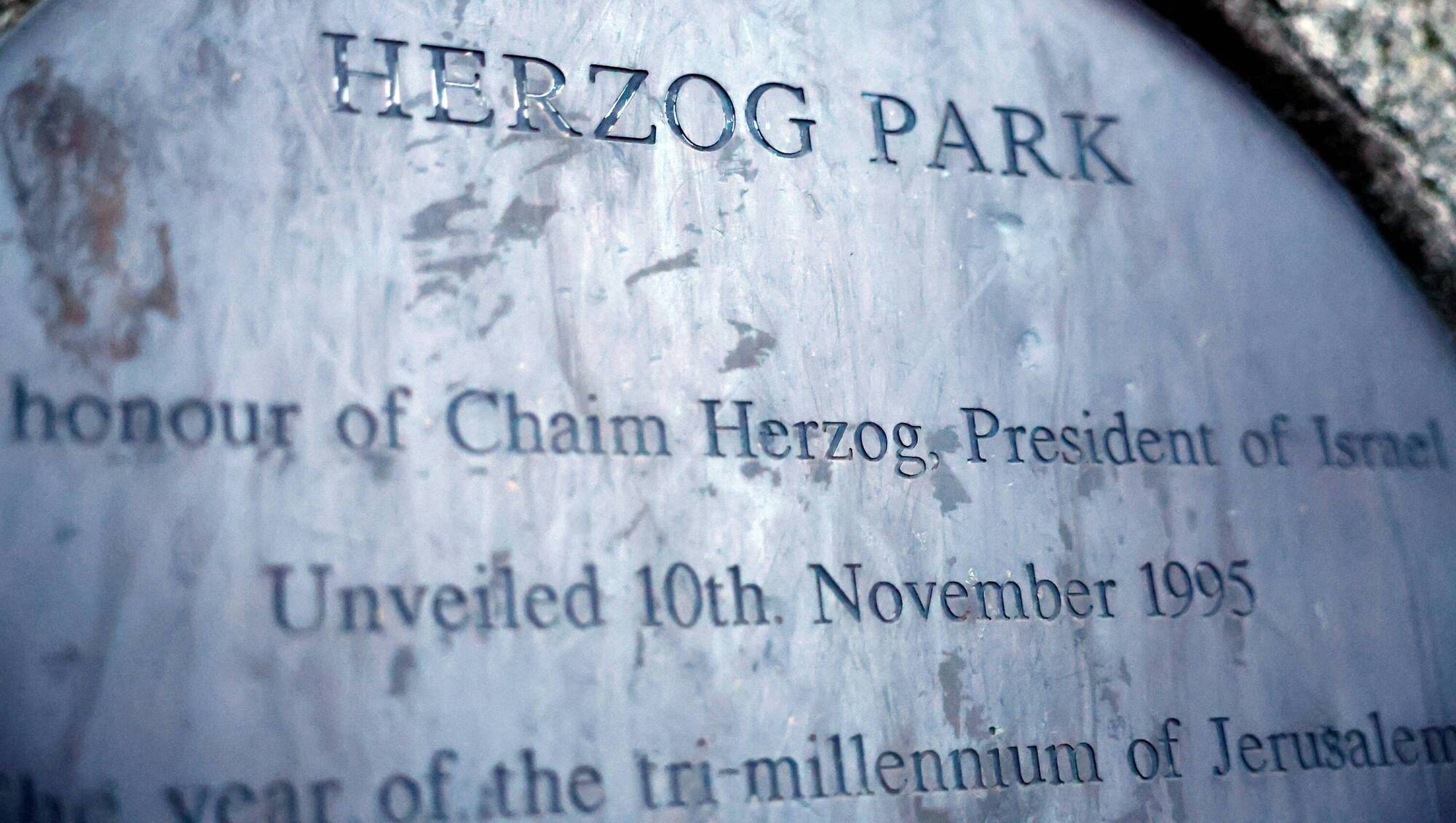
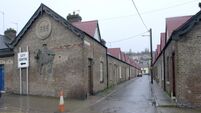
A plaque commemorating Chaim Herzog in Dublin, Israel's sixth president. Dublin City Council has prepared a motion to rename 'Herzog Park' to 'Hind Rajab Park' after Hind Rajab from Gaza. Photo: REUTERS/Clodagh Kilcoyne
My parents were a young couple living in London during the IRA’s bombing campaign there.
Merlyn Rees, the Secretary for Northern Ireland lived nearby and his security police regularly passed up and down their road, a reminder of the ongoing tensions and violence of the time. Not that my parents needed reminding, given the anti-Irish sentiments shared on British television and radio daily.
They were grateful for Terry Wogan, an Irish voice who acted as a spokesperson for the Irish diaspora, reminding the British public that the IRA didn’t represent most ordinary, Irish people — people like them.
It was late in the day, sometime in 1975, when they heard a thunder of knocks on their front door. Mum was sitting with their first child, my sister, in the front room. She may have been pregnant with my brother.
Just home from work, dad went to answer. A group of 10 or so neighbours were gathered in the darkness. They looked a little awkward. Men and women, middle-aged couples. They asked to come in.
Mum felt relieved to see two women she recognised from her mother and baby club, neighbours who had always made her feel welcome. Then an older man spoke on behalf of the group.
“We want you to know we are delighted to have you as neighbours. You are a lovely couple and you’re very welcome here.” If my parent’s neighbours had decided on righteous anger or intimidation I would be telling a much sadder story. I’m grateful that I’m not.
Presumably, those ordinary English people understood the complexity of politics, identity and conflict. They grasped the difference between community building and a broader political cause or issue.
It strikes me that Irish people used to be good at doing the same, and that we are in danger of losing that flexibility.
Twenty years after my parents’ experience in London a small park in Rathgar was named after an Irish Jewish man, a local Irish Jewish family, with considerable reach in Irish society.

I have no doubt that the naming of this park back in 1995 after Chaim Herzog had everything to do with commemorating a person of Irish-Jewish descent in a very specific neighbourhood, and very little to do with the broader political state of Israel. At the time, Dublin City Council seemed capable of appreciating this nuance.
Certainly, there are differences between these two events, one in 1975 and one in 1995. My parents were a young couple trying to get by in a small London suburb. They didn’t represent the Irish state in any way.
Chaim Herzog was the sixth president of Israel. He represented a state that oppressed and killed Palestinians. He worked for the IDF during the Nakba — the mass displacement of Palestinians during the 1948 Arab Israeli war.
He also fought for the British army during the Second World War and was among the first British officers to enter the Bergen-Belsen concentration camp after its liberation. His son, the current Israeli president Isaac Herzog, said: “I will never forget how he described to me the horrors that unfolded before his eyes as one of the first liberators of the death camps, including Bergen-Belsen.
History is messy and bloody and deeply complex and Chaim Herzog as an individual is not the easiest to separate from a political cause — granted. But that is what happened in Dublin in 1995. It was a symbolic, local gesture, a recognition of an Irish-Jewish legacy. It was not a State-driven political act.
This is what connects the two. The naming of the park was a community moment, a gesture by a local council. Like my parent’s experience in London, it was an act of neighbourliness.
By 1995, Ireland’s criticism of Israel was clear. Ireland was already championing the Palestinian cause within Europe. And yet, at the same time, a local council could name a Dublin park after a local Irish-Jewish family. This was by no means an endorsement of the brutality of the state of Israel. It was something entirely different.
The park was given a Jewish name to commemorate one of the best-known Irish-Jewish families in the Irish state. The man’s father had been a close friend to de Valera; he had been Ireland’s first Chief Rabbi, serving an important spiritual and cultural function.
The local council was recognising the history of this community. Naming the park was also an act of solidarity with a persecuted minority who had suffered a genocide only decades before, whose names had been erased from the public realm.
Nowadays, too much is seen in simple, binary terms. Without any consideration of the complexity of history and legacy, Chaim Herzog has been aligned solely with the state of Israel. The context of the naming of the park has been omitted or at least forgotten.

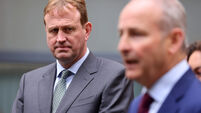
I am grateful to our Taoiseach and Tánaiste for reminding people of it, and for bringing the word inclusion back into the debate.
This renaming debacle is over for now, but a huge amount of damage has already been done. International media, suspicious before, are now convinced that Ireland is anti-semitic. When I first heard about the renaming it sounded anti-semitic to me too. Given the context in which the park was named in the first place, it still does.
Who are these people, I thought on first hearing about the motion, who can think in such simple terms? Who are these people with such tone-deafness that they didn’t, at the very least, come to the table with the idea of commemorating a different Jewish person, someone not so directly linked to Israel?
Who can so easily reduce everything to light and dark — erasing the complexity of Jewish history and the close Irish-Jewish ties experienced at a community level in Dublin? Who are these people who simply have no understanding of the existence of an Irish-Jewish legacy, centred around Portobello (“Little Jerusalem”), the heart of Jewish life in Dublin?
When I heard Sinn Féin Councillor Conor Reddy publicly defend the motion, the irony struck. I thought back to my parents in 1975, their nerves rattled by a knock on the door at night.
Sinn Féin, the political party that still attends the funerals of members of the IRA. A party whose leader, Mary Lou McDonald, attended the funeral of senior IRA man Bobby Storey in 2020 during covid, to give just one example.

I wondered: 'Where was Bobby Storey in 1975 when my parents heard the first knock on their front door?' How easy it must be to see the world so simply, never having to look at your own past, your own legacy, with similar scrutiny.
Besides that, this renaming motion has done nothing to help Palestinians. It has done nothing but scare and alienate ordinary Irish-Jewish people in their homes in Dublin.
“We want you to know we are delighted to have you as neighbours,” that group of Londoners said to my parents in 1975. What are we saying to our neighbours now?