2016: a jamboree or a real challenge?
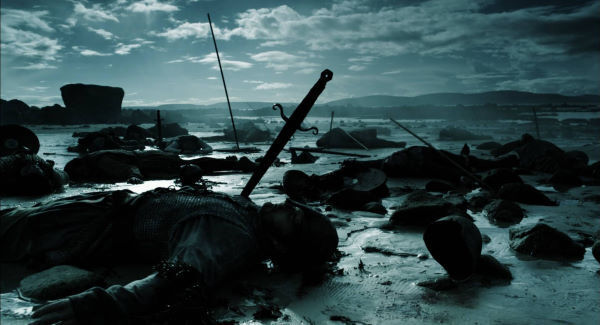
The victors — our side of course — will drive their co-actors into the sea, or as close to the waves rolling onto Dollymount strand as the boundary walls of Dublin’s St Anne’s Park, the site of the battle re-enactment, might allow. Undoubtedly the event will be a great success, especially as the right side — our side of course — is guaranteed victory at every performance. There will not be a Russell Crowe-led Gladiator-style refutation of history in Clontarf this weekend. Or at least history as is commonly and comfortably embraced in Ireland.
That certainty stands even if the anniversary has reopened the debate about who was who, what was what and what the objectives of Brian Boru’s forces, Irish troops and mercenaries augmented by some Scandinavians, really were.
The old-school version — septuagenarian Brian Boru, philosopher, warrior king of Munster, decapitated as he knelt in prayer giving thanks for the victory of the saintly, scholarly Irish over the devil wolves from across Northern seas — has been discounted as simplistic and one dimensional. These are just polite words used by historians to describe bunkum presented as fact.
Historical revisionism, that discipline so reviled by nationalist/republican historians unable to resolve the struggle between professional, emotional and moral formation, has suggested we review what we know, or think we know, about Brian Boru. As he has been dead for a millennium this seems, even in Ireland, possible. It might even provoke a what-if parlour game — if Brian Boru had been defeated might this be one of those enviable Scandinavian societies rather than a peculiar mixture of the Anglo and the Catholic riven by self-destructive indulgences?
This weekend the 98th anniversary of the 1916 Rising will be marked as well. As the centenary of that event, seen as an act of sacred selflessness by some but very differently by others, approaches it seems appropriate to wonder what the 2016 events will celebrate and who might bask in the reflected glory of whichever narrative is celebrated. We might wonder how far we have to go realise the objectives of those who resorted to violence because they believed that democracy had failed them. Or even, if it is not a blasphemy, if we still want to realise those objectives. We might even wonder, if we can summon the courage and objectivity needed, how well we have used the great opportunity independence brought us.
There are worrying suggestions that the work of the Government group established to oversee these celebrations — and, in this context, even that is a loaded word — is still at the embryonic stage. In another country, where the past does not have such leverage on the present or the future, that might not be a significant issue but here, where myth and actuality are such ready conspirators, it seems an unnecessary danger.
This risk was recognised by one of the 1916 leaders James Connolly when he warned: “The worship of the past could become a tactic to reconcile people to the mediocrity of the present.”
We need to decide if we are going to have a Brian Boru-style jamboree, colourful and entertaining as that might be, in 2016, or a series of events that can challenge, motivate and strengthen this society.