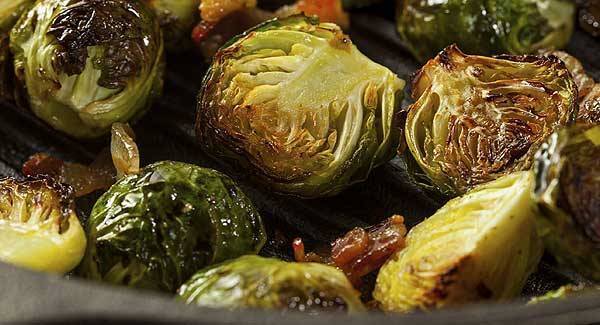
Brussels Sprouts with Toasted Hazelnuts and Candied Bacon
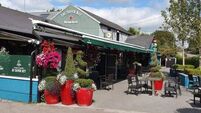
I recently spent a weekend with friends in the UK in a prosperous part of middle England. The local village had neither pub nor local shop and the nearest town (about the size of Midleton) had five supermarkets, two of which were discounters. There was not a single food shop or deli and only one butcher hanging on by his finger nails.
The main street had several estate agents, betting shops, a Spec Savers, a couple of charity shops, several fast food outlets and a Boots.

At one point the conversation at dinner centred around two nearby villages where the local community were desperately trying to save the last local shop. In Dymock in the Forest of Dean the last remaining pub in the village was destined to be a housing development so the locals joined with the parish council to buy the Beauchamp Arms for the community.
Here in Ireland the Government made a decision not to allow supermarkets to build in greenfield sites outside towns and villages. Consequently we still have life and livelihoods for our local community in our towns and villages. It’s not easy for small shops to survive, especially in the current climate. Low, and below-cost-selling makes it impossible to compete on price.
However, an emerging trend brings a flicker of hope; both in the US and in the UK smaller shops are beginning to pop up again and apparently there is a craving for a more personal type of shopping experience. Mary Portas did a TV Series on Channel 4 — Mary Queen of Shops — about the demise of the high street and small shops which highlighted the problem.
Here are a few new recipes we’ve enjoyed cooking recently.
Brussels sprouts are the number one most hated vegetable. The poor little sprout has had very bad press, mostly because it can be tough to cook well. If you follow the conventional wisdom to cut a cross in the base and boil them, you are pretty much guaranteed the result that has condemned the sprout to its appalling reputation.
Preheat the oven to 200C/400F/Gas Mark 6. Toast the hazelnuts on a baking tray in a preheated at 180C/350F/Gas Mark 4 for 15 minutes, shaking regularly until golden and skin. Allow to cool, then chop coarsely. Cover a baking tray with a sheet of parchment paper. Dip the streaky bacon in pale soft brown sugar so both sides are coated. Cook for 10-15 minutes until the bacon is caramelised on both sides. Remove from the oven and allow to sit for a minute or two and remove to a wire rack to crisp up.
Meanwhile, over a medium high heat, melt the butter in a sauté pan. When it foams add the shredded sprouts, toss to coat, add the chicken stock, cover and allow to cook for 4-5 minutes tossing regularly. Season well with salt and freshly ground black pepper. The sprouts should be still fresh and green.
Snip the bacon into uneven pieces with scissors. Add most of the coarsely chopped hazelnuts and candied bacon. Toss, taste and correct seasoning.
Turn into a hot serving dish. Sprinkle with the remaining hazelnuts, candied bacon and chopped parsley. Serve immediately.
Emily Johnson from Switzerland recently did this delicious
variation on our scone recipe.
Cream the butter with the finely grated lemon rind. Add the sifted icing sugar and beat until fluffy.
Sieve the flour into a large wide bowl; add a pinch of salt, the baking powder and castor sugar. Grate the rind of one lemon on the finest part of the grater over the dry ingredients in the bowl. Add the poppy seeds. Mix the dry ingredients with your hands, lift up to incorporate air and mix thoroughly.
Cut the butter into cubes, toss well in the flour and then with the tips of your fingers rub in the butter until it resembles large flakes. Make a well in the centre. Whisk the eggs with the milk; pour all at once into the centre. With the fingers of your ‘best hand’ outstretched and stiff, mix in a full circular movement from the centre to the outside of the bowl. This takes just seconds and hey presto, the scone dough is made. Sprinkle some flour on the work surface. Turn out the dough onto the floured board. Scrape the dough off your fingers and wash and dry your hands at this point. Tidy around the edges, flip over roll out to about 1inch thick and cut or stamp into scones. Put onto a baking sheet. No need to grease. Alternatively roll out the scone dough or pat gently into a rectangle about 3/4 inch (2cm) thick. Spread the soft lemon butter over the surface. Roll up lengthwise and cut into pieces about 1 1/4 inch (3cm) thick.
Brush the tops with egg wash (see below) and dip the tops only in granulated sugar. Put onto a baking sheet fairly close together.
Bake in a preheated oven for 10-12 minutes or until golden brown on top.
If making classic scones, cool on a wire rack. Serve, split in half with lemon butter — delicious.
Whisk one egg thoroughly with about a dessertspoon of milk. This is brushed over the scones to help them brown in the oven.
Scone mixture may be weighed up ahead — even the day before. Butter may be rubbed in but do not add raising agent and liquid until just before serving.
The rich West Cork pasture that the buffalos feed on gives the Toonsbridge Mozzarella its quintessentially Irish taste. A few beautiful fresh ingredients put together simply make an irresistible starter.
Just before serving, scatter a few watercress leaves over the base of each plate, slice or tear some mozzarella over the top.
With a sharp knife remove the peel and pith from the blood oranges, cut into ¼ inch (5mm) thick slices, tuck a few here and there in between the watercress and mozzarella.
Drizzle with honey and really good extra virgin olive oil. Finally add a little coarsely ground fresh black pepper and serve.
Keep the sliced fennel and radishes in iced water for at least 5 minutes.
To serve: Remove the stalks from the kale and shred very finely. Put some kale, drained fennel and radishes into a bowl. Drizzle with extra virgin olive oil and lemon juice. Grate on some Parmesan with a slivery micro plane. Season with salt and freshly ground pepper. Toss and taste and serve.
Home Butchery, Charcuterie and Sausage Making with Philip Dennhardt at Ballymaloe Cookery School: There’s a growing interest among chefs and enthusiastic amateurs for home-curing and sausage making. On this oneday course Master Butcher Philip Dennhardt will teach you to make a wide variety of lamb, beef and pork sausages and cured meats. This course is also designed for those who would like to explore ways to add value to their meat products, with a view to developing an artisan food business. Ballymaloe Cookery School, Saturday, March 1, from 9.30am to 5pm; €195, lunch included.
Whiskey and Artisan Food: Enjoy a taste of real Irish craft beer, Irish whiskey and artisan food at the Irish Craft Beer Village during the five-day celebration of Irish food at the IFSC inside the CHQ Building, Dublin March 13-17, as part of the St Patrick’s Festival 2014. www.irishfest.ie
Goats Bridge Trout Farm in Thomastown, Co Kilkenny, is a food businesses poised to capitalise on food tourism. Meg and Ger Kirwan will open a visitors centre on March 1. To book a tour with canapés (€15) or a day with lunch (€100), see www.goatsbridgetrout.ie