Sorry seems to be the hardest word to say for former taoiseach
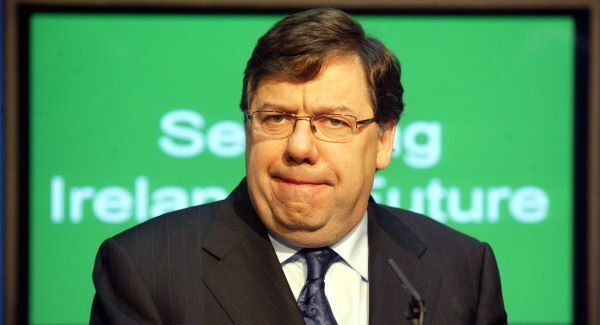
Brian Cowen missed a trick during his TG4 interview, which is to be shown next Thursday, but has been well-flagged in advance.

Sorry seems to be the hardest word to say for  former taoiseach

The former Taoiseach had an opportunity to be contrite for his failings, and to make a sincere and deliberate apology for his performance, and for his performance prior to that as Minister for Finance; what he had to do was say, without equivocation, that he was sorry.

He came close during the first public interview he has given since leaving office in 2011. The interview was in Irish and he used the word ‘brón’, which was taken by most observers to mean ‘regret’ for the consequences to others of his actions. Close, but no cigar. Of course he regrets the damage he caused, because he has paid a price for that, with the ignominious ending of his political career and the place in Irish history that awaits him. But he needed to say sorry.

It would not have provided rehabilitation. There is little chance of that. Many will never forgive Cowen for his complacency as Minister for Finance — confirmed by his admission that he had never believed the warnings about an overheated economy and, therefore, never put a plan B into place, just in case they were correct — nor for his subsequent actions as taoiseach, in trying too late to rectify the mess and, in the process, probably making things worse.

But there are many who would look more favourably upon him if he had said sorry and, in doing so, admitted that he got things wrong, with adverse consequences for others.

It takes a big man to admit that he was wrong and that he was sorry.

Expressing regret seems only to be a partial response.

It’s a bit like those people who say they are sorry for any offence caused by what they said or did, but who don’t express a real apology for what happened in the first place.

Now, there is an argument that it doesn’t matter a damn whether or not Cowen says sorry, in addition to expressing regret.

Doing so won’t change anything for anyone; won’t make anyone else feel any better.

Strangely enough, though, it might prove cathartic for Cowen, if not for the nation.

Cowen appears to be close to admitting publicly that he was asleep at the wheel during his tenure as minister for finance. The likelihood is that he has known that for many years now, that it became very apparent to him during 2008, as the wheels came off the economy.

As taoiseach, he had time to reflect on his failings in that regard, as he desperately sought to limit the damage that his own inaction on important issues had caused.

He has stopped short of defending himself on the basis that he was only following orders from then taoiseach Bertie Ahern, partly because it would make him look even weaker, and partly because party loyalty still remains important to this Fianna Fáil die-hard, but it would be a partially valid defence.

Cowen only got the job because Charlie McCreevy, for all his faults, had realised that things were going awry and was trying to rein in increased public spending, which had become unsustainable.

Ahern panicked after the 2004 European and local elections went against Fianna Fáil, and dispatched his minister to Brussels as EU commissioner. Cowen replaced him, and spent, as Ahern demanded, for political reasons.

Cowen told TG4 that “we wanted to improve services such as education, health, social welfare, old-age pension, and so on. That was our motivation and, at the time, the money was there to do that.”

The problem was that it wasn’t; there was a temporary inflow of tax revenues, based on a wholly unrealistic activity in the construction sector.

And there were plenty of people telling him and Fianna Fáil this, and they were ignored. The money was there temporarily, but the revenues to fund increases in spending were needed annually.

Cowen has a reasonable point in reminding people that “the opposition were telling us we should have been doing more. Whereas, now, they’re saying that we spent too much”.

But that is what opposition parties do. It is what Fianna Fáil does in opposition. And oppositions don’t have the power or responsibility.

For the sake of his own sanity, it is likely that he will defend, until his dying day, the bank guarantee of Sept 2008 as the correct thing to do. The decision was about preventing money leaving the country’s banks, the so-called liquidity issue, the one with which his friends in Anglo Irish Bank were obsessed.

It is interesting that he argued in the TG4 interview that it was only after the introduction of the bank guarantee that “other things started to happen, which we hadn’t foreseen”.

This provides a clue to his likely evidence at any banking inquiry: he, and all his officials, failed to take into account what experts such as Morgan Kelly were warning: that the banks did not merely have a liquidity issue, but a solvency one. The banks had written loads of big loans that would not be repaid, and did not have sufficient capital to stay in business. That is why the guarantee landed the State with a bill for €64bn — and rising — to save the banks. No wonder he doesn’t want to say sorry.

Cowen’s TG4 interview merely opens a small window to what we want to know from him. There are thousands of other questions to be asked. It is noticeable that, despite all of the recent publicity, we are no closer to knowing the form and conduct of an inquiry or when it will happen.

Cowen’s few relevant comments in the interview suggest that he will turn any public investigation into a political slugfest, as much as revealing anything of the behind-the-scenes goings-on for the relevant period, which must be about a decade in duration. He may be facilitated in that by a government seemingly intent, judging by its comments to date, on a political show-trial, rather than a real and comprehensive inquiry into the relationships between the banks and public administration, and the political input into that process.

THERE is also a real risk that the inquiry will end at the banking guarantee, when there is a mountain more of material that deserves to be examined, running through the creation of Nama, the circumstances that led to the deal with the troika (which ended Cowen’s career), and then the handling of that deal, subsequently, by the new government and its ill-fated efforts to unravel it, including the extraordinary liquidation of Anglo Irish Bank this year.

Let’s assume, though, that eventually there will be some form of limited inquiry. If Cowen is clever, he will express full regret before he gives any evidence. But Cowen may not ever have been as intellectually clever as had been claimed on his behalf, on his ascent to power, and what is certain is that he lacks emotional intelligence. That was evident in his sincere, but cold, approach to dealing with the public from the moment the crisis hit. In the TG4 interview, a warmer Cowen might be present, one with whom people can associate, being as he often is in private. But in the glare of an inquiry, the old, tough, unapologetic Cowen would suffer.

The Last Word, with Matt Cooper, is broadcast on 100-102 Today FM, Monday to Friday, 4.30pm to 7pm.

More in this section

Revoiced

Newsletter

Sign up to the best reads of the week from irishexaminer.com selected just for you.

Cookie Policy Privacy Policy Brand Safety FAQ Help Contact Us Terms and Conditions

© Examiner Echo Group Limited