Designs for living

CUTTING-edge engineering projects by CIT students will be on show at the 27th annual Cork Mechanical, Manufacturing and Biomedical Engineering Exhibition at the Bishopstown campus on Thursday.

Designs for living

It’s open to the public, and there will be 240 stands, up from 190 last year.

Projects range from completed, state-of-the-art design to prototype.

Sean F O’Leary, senior lecturer at CIT’s department of mechanical, biomedical and manufacturing engineering, established the exhibition to showcase the students’ work, which is seen by industry professionals. He says there is “a strong entrepreneurial ethos at CIT. Our Rubicon Centre is a hugely successful, entrepreneur start-up centre.”

Kieran O’Callaghan, a CIT graduate of mechanical engineering, was the first Irish student to win European student innovator of the year, in 2012, competing with hundreds of entries from 28 European countries. His project is VisionRE. It’s a ‘real-time, interactive, obstacle-detection and navigation aid for the visually impaired.’

O’Callaghan, who now works for De Puy, a biomedical device company in Ringaskiddy, describes his award-winning visual aid as “an electro-tactile device fitted into a person’s palette, like a gum shield. When a person puts their tongue up against it, they can feel the outline of the shapes or obstacles in front of them.

“It also has an audio element. When the person touches the object being portrayed on their tongue, they get information back, telling them how far away the object is.”

Mechanical engineering student John Roberts won this year’s ‘Speak Out for Engineering’ finals, a competition open to undergraduate and postgraduate engineering students in Ireland.

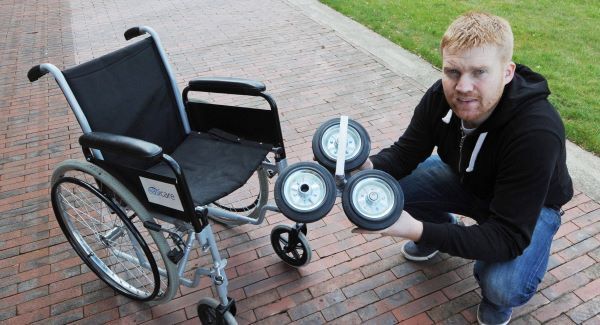
Roberts won for a wheelchair-enablement device. There are three million wheelchair users in the US and five million in Europe; 1% of the population of the western world is a wheelchair user. Wheelchair mobility is restricted by barriers such as steps or kerbs.

Roberts’ invention, a Pyra-Aid, is “a momentum-powered mechanical device” that aids in the mounting of obstacles. The design is informed by wheelchair users. The device has been tested and step-and-kerb mount tests have been promising.

Last year, Martin Evans designed and developed an advanced scrum machine, in conjunction with Munster Rugby. He was the Engineers of Ireland student innovator in 2012. In 2011, Munster Rugby approached CIT to increase the functions of its intermediate scrum machine to that of an advanced scrum machine.

“I jumped at the opportunity to combine two of my greatest interests, rugby and engineering. I was given carte blanche to redesign and remanufacture the structure and mechanisms (of the scrummaging machine), and design and implement, from first principles, a scrum-performance-measurement system,” Evans says.

The location of the Munster Rugby’s elite training facility on CIT’s campus has been critical to the close liaison of club and international players and coaches “which has driven this project to a customer-driven, advanced state of development.”

As Munster scrum coach, Paul McCarthy, says: “Most scrum coaches will agree that ‘live’ scrummaging is the best way to prepare your forward pack for a match. But it can be very tiring on a short turnaround. The testing on the advanced scrum machine has shown us that it has narrowed the gap between live- and machine-scrummaging. This is a massive positive for us in properly preparing our forwards for games and keeping our players fresh. We can now simulate opposition scrums and applied forces, and come up faster with a strategy for games.”

Siobhan Hickey is a final-year student of biomedical engineering at CIT. She will be exhibiting her boccia ball project. (Boccia ball, similar to the French game, boules, is a sport played by people with cerebral palsy and muscular disabilities.) Hickey is working with Jack Cronin, from Mallow, who won a gold medal in boccia at the Paralympics last year.

Hickey is delighted to be able to express herself using her mathematical abilities and her creativity “to improve other people’s lives.” While there are measures to enable disabled people to play boccia, Hickey is focusing on the ball. “There’s quite a few issues with it, regarding predictability and performance. I’m working on developing a new, modified ball, which improves the performance of the original ball,” she says.

Hickey is involved in material manipulation. While rules dictate that the ball must be leather, “there are no rules as to the inner materials of the ball. I’m focusing on the dynamics of how the ball reacts in different situations with different materials. It will make a big difference to the Irish boccia team and will bring back the positivity of the game. For people with cerebral palsy, there’s very few games that they can compete in. Boccia is a game that can be enjoyed by them.”

Louise Connolly, a mechanical engineering graduate of CIT, was the first woman to win the chartered Engineer of the Year title, in 2011. She was a student from 2000-2004. Her final year project, carried out in conjunction with Amersham Health, involved the design of a sterilisation autoclave system. Connolly now works for ESB International, a subsidiary of the ESB.

“I do project management and engineering for the construction of power stations. I’m currently working on a gas pipeline in Manchester,” says Connolly.

She always wanted to be an engineer. “My father used to build agricultural trailers. There was always some welding or cutting going on. One of my sisters became a mechanical engineer and another one is an engineering teacher. It was always there in the background.”

* CIT’s Mechanical, Manufacturing and Biomedical Engineering Exhibition, 2013 takes place in Nexus Hall, the Student Centre at CIT, on Thursday, Apr 25. Admission free.

x

More in this section

Revoiced

Newsletter

Sign up to the best reads of the week from irishexaminer.com selected just for you.

Cookie Policy Privacy Policy Brand Safety FAQ Help Contact Us Terms and Conditions

© Examiner Echo Group Limited